
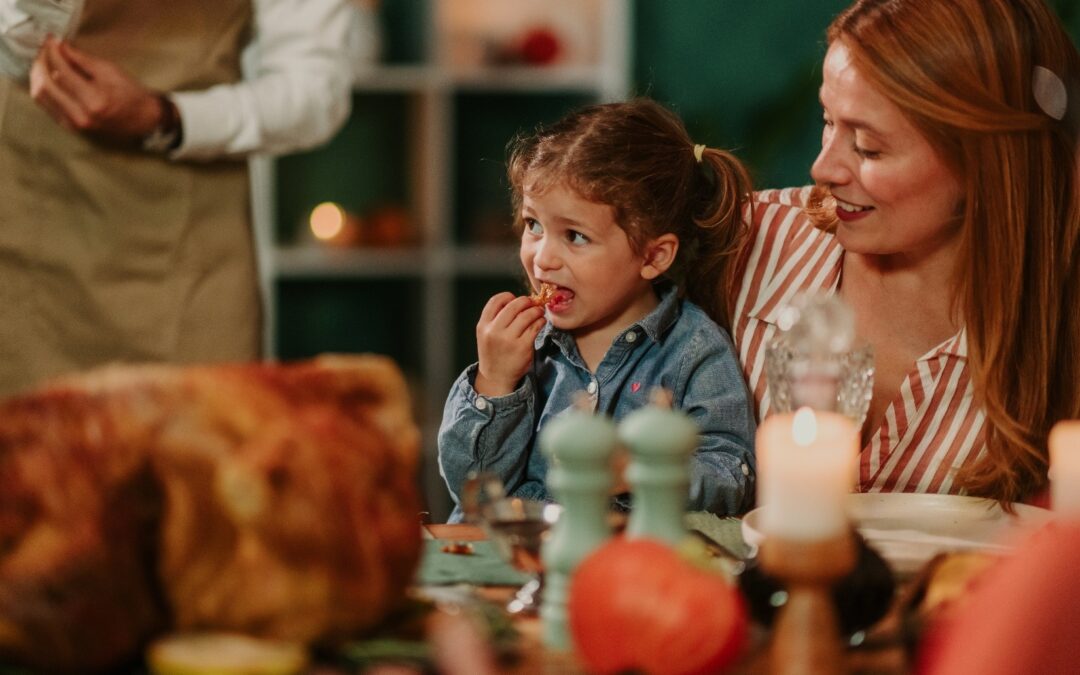
You know the Thanksgiving tradition.
Everyone goes around the table and says what they are thankful for.
Then it is your child’s turn.
“My toys.”
“Pie.”
“I don’t know.”
Or they repeat whatever the person before them said while keeping one eye on the dinner roll they would really like to eat.
There is nothing wrong with asking your child, “What are you thankful for?” It can start a good conversation. But sometimes it is such a big question that young children are not quite sure what to do with it.
If you want to talk about gratitude at Thanksgiving without making it feel like an assignment, try making the question a little more specific.
Why Can “What Are You Thankful For?” Be Hard to Answer?
Think about what the question is asking.
Your child has to understand what thankful means, think back over the day, choose something, and explain it while everyone at the table waits.
That can be a lot when you are 4.
Research on children’s gratitude led by developmental psychologist Andrea Hussong looks at several parts of a grateful experience: what children notice, what they think about it, how they feel, and what they may want to do in response.
You can see that framework in this Greater Good in Action guide to gratitude questions for kids.
A broad question may skip over some of the experiences that help a child get there. So, if “What are you thankful for?” gets you a shrug, it does not mean your child is ungrateful.
They may just need a more concrete place to start.
Ask About Something That Happened
Young children often have an easier time talking about an actual moment. Instead of asking for gratitude directly, try:
- What was your favorite part of today?
- What made you laugh?
- Did anything surprise you?
- What did you have the most fun doing?
- What is something we did today that you want to do again?
NAEYC encourages parents to use open-ended questions during everyday routines such as meals because they give children more room to talk about their experiences and ideas. It also recommends giving children time to think before jumping in with another question.
Suppose your child says: “Making rolls with Grandma.”
You do not have to immediately respond with, “So you are thankful for Grandma?”
You could simply say, “You two had fun doing that together.”
Then see where the conversation goes.
Ask About a Person
Gratitude can be easier to talk about when children connect it to someone specific. Try questions like:
- Who helped you today?
- Who made you laugh?
- Who did you have fun spending time with?
- Did anyone do something kind for you?
- Is there someone you would like to thank?
Your child’s answer may give you a glimpse into something you did not realize mattered to them.
Maybe their cousin helped them reach something. Grandpa let them stir the gravy. Their older sibling let them sit in the “good spot” on the couch.
Those moments may be easier to remember than trying to come up with one big answer about gratitude.
Ask About How the Day Felt
Some children find their way into the conversation through feelings.
You might ask:
“What made you happy today?”
“When did you feel excited?”
“Did anything make you feel proud?”
“What made you feel loved?”
Celebree teachers use conversations about emotions throughout the school day. Through Conscious Discipline, children practice recognizing feelings, expressing what they need, listening to others, and working through situations together.
You can use that same kind of language at home without turning Thanksgiving dinner into a social-emotional learning seminar.
And the answer does not have to be positive.
Thanksgiving can be loud. Someone may have traveled all day. A child may be tired, overwhelmed, or thoroughly done with wearing the sweater Grandma bought.
If their favorite part was going outside with their cousin because the dining room was too noisy, that still tells you something worth hearing.
Ask What Someone Did
Another way to make gratitude easier to understand is to point toward effort.
Ask:
“Did someone make something special for you today?”
“Who worked hard to help us get ready?”
“Did anyone help you with something?”
“Did someone remember something you really like?”
A child may not spontaneously think about the fact that Aunt Melissa baked their favorite pie or that Dad got up early to start cooking.
Once they notice the effort behind something, the conversation has somewhere to go.
This connects closely with what we explored in our recent article, Gratitude in Action: Helping Children Turn Appreciation Into Kindness[CC1] . Gratitude can become more meaningful when children start noticing what other people do and how their own actions affect someone else.
Ask What They Would Like to Do
The conversation can move forward from there. Maybe your child tells you Grandma helped them make dessert.
You could ask:
“Is there something you want to do for Grandma?”
They might want to draw her a picture, help carry her bag to the car, or say, “No.”
All three are possible.
Young children are still figuring out what gratitude, empathy, and generosity look like. One question does not have to end with a heartwarming moment.
One Question Is Enough
Please do not arrive at Thanksgiving dinner armed with a checklist.
The American Academy of Pediatrics encourages open-ended conversation during family meals while also recommending that parents keep meals enjoyable and avoid turning the table into a lecture or pop quiz. HealthyChildren.org offers more guidance on family meals and conversation.
Pick a question. Listen to the answer. Ask a follow-up if it feels natural.
If your child clearly wants to return their attention to the macaroni and cheese, let them. Young children usually have an impressive ability to let you know when an interview is over.
Let the Adults Answer Too
The tradition can feel more like a family conversation when adults answer too. Instead of only saying: “I’m thankful for my family.”
You might say: “I’m thankful Uncle Marcus drove all the way here. I really like having everyone together.”
Or: “I appreciated that you helped me peel potatoes this morning. It made getting dinner ready easier.”
Children get to hear what appreciation sounds like when adults talk about something specific.
HealthyChildren.org also notes that family meals can be a useful place to ask simple questions, listen to one another, and learn what kinds of prompts actually get your children talking.
And when everyone participates, your child is not sitting at the center of the table trying to come up with the “right” answer.
Let the Silly Answers Count
Your child may be thankful for pie.
Or dinosaurs.
Or their cousin’s Nintendo Switch.
Or butter.
You do not need to steer them toward “family,” “health,” or another answer that sounds more appropriate for the occasion.
If you ask a genuine question, give them room to give a genuine answer.
“What do you like so much about Grandma’s pie?”
Now you are having a conversation.
Maybe Grandma makes it every year. Maybe your child helped sprinkle the cinnamon. Maybe they remember eating it beside their favorite cousin last Thanksgiving.
Sometimes the story behind the answer is more interesting than the answer itself.
The Thanksgiving Table Is Already a Good Place to Talk
At Celebree School, we see how much children learn during ordinary conversations.
Our Mealtime Curriculum uses the time children already spend together to practice listening, turn-taking, sharing, talking about feelings, and being a positive friend. Teachers also use open-ended questions throughout the day to encourage children to explain their thinking rather than simply supply the expected answer.
That same idea works at your table.
You already have people together, stories being told, and a meal that probably took somebody a considerable amount of work to prepare.
Make room for the conversation that comes with it.
Celebree education expert Kristen Miller shares more ideas for listening, connection, and communication in our guide to family dinner rules that help children build better manners and connections.
Keep Asking What They Are Thankful For
You do not actually have to stop asking the traditional question. Keep it in the rotation.
If your child has an answer, listen. If you get the shrug, try:
“Who made you laugh today?”
“What was your favorite part?”
“Did anyone do something kind for you?”
A smaller question may give your child an easier way into the conversation. And if the answer is still mashed potatoes?
Ask what made them so good.
You may learn more about what your child noticed, enjoyed, and cared about that day than you would have from the answer you were expecting.