
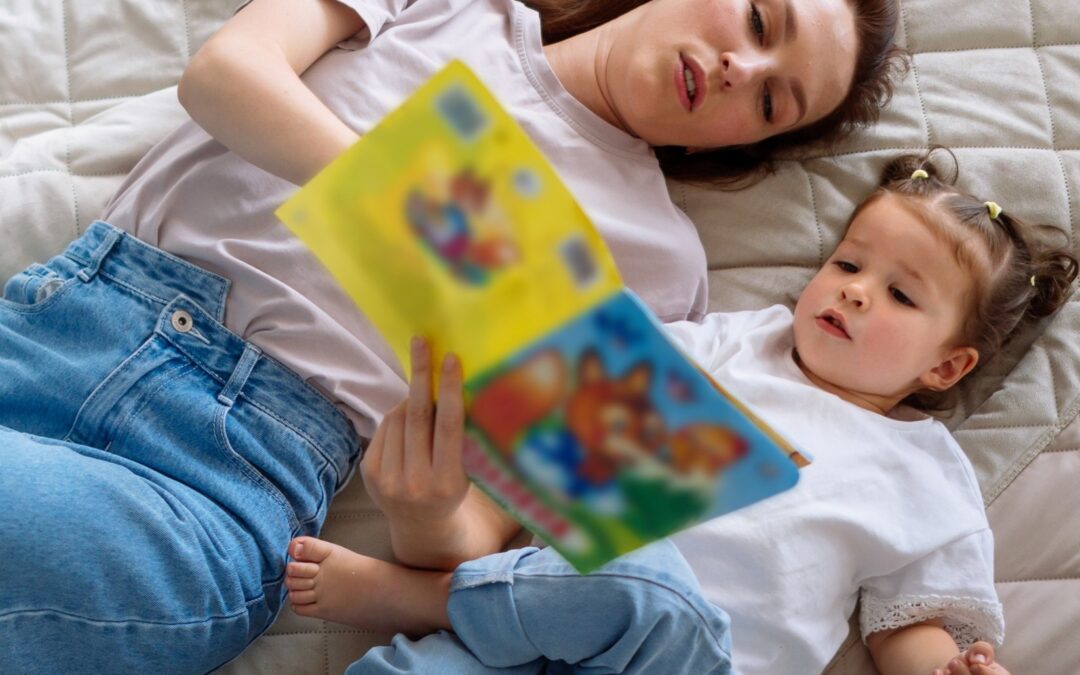
Few parenting questions sneak in quite like this one: When should my child be reading?
Maybe another parent mentions sight words at pickup. Maybe an older sibling seemed interested in letters much sooner. Maybe your child loves books, but mostly because one has a dinosaur on the cover and another lets you use the funny voice on page six.
It can be hard to know what counts.
When do kids learn to read? For many children, independent reading begins in the early elementary years. But the work that comes before it starts much earlier. It shows up when your child listens to stories, asks what a sign says, notices the first letter of their name, remembers part of a favorite book, plays with rhymes, or fills a page with scribbles and tells you exactly what they wrote.
Reading grows through a lot of these little pieces. Some are easy to spot. Others happen in the middle of a busy morning, and you may not realize they are connected to reading at all.
Most Children Follow Their Own Reading Timeline
Some children become curious about letters very early. They want to know what everything says: the cereal box, the stop sign, the label on a shirt, the name on a cubby.
Other children are drawn to books for different reasons. They care about the story, the pictures, the animals, the silly ending, or the fact that they know exactly when you skipped a sentence.
That child is learning too.
Reading Rockets notes that most children learn to read by age 7, and that the language skills used for reading begin developing from birth. That gives the preschool years a little breathing room. A 3- or 4-year-old does not need to be reading independently for meaningful literacy growth to be happening.
A child can love books before they can read the words. They can act out a story, retell it out of order, make up their own version, or ask for the same book so many times that everyone in the house knows it by heart.
That nightly book is doing work, even when you are the one reading.
Early Literacy Signs Parents Might Already See
Early literacy does not always look like reading.
Sometimes it is your child holding a book upside down and “reading” with total confidence. Sometimes it is a scribbled note left on the kitchen table. Sometimes it is your child recognizing the big red STOP sign before they know any other word in the neighborhood.
You may also notice your child:
- Turning pages from front to back
- Recognizing their name in print
- Asking what a word says
- Repeating favorite lines from a story
- Playing with rhyming words
- Drawing a picture and explaining the whole scene
- Pretending to write a card, list, menu, or sign
- Telling a story while playing with blocks, dolls, cars, or stuffed animals
These signs can be easy to miss because they are mixed into everything else. Breakfast. School drop-off. Errands. Pajamas. One more book before bed. A child stalling at the door because they noticed the first letter of their name on a poster.
Reading is built from those pieces.
Reading Readiness Happens in Real Life
You do not need flashcards on the coffee table to help your child get ready to read.
Books help, of course. So does conversation. So does singing in the car, talking about the picture before you turn the page, and letting your child choose the library book with the sparkly cover.
Here are examples of some practices you can slip into your daily activities to help move things along:
At the grocery store, you might point out the word milk because you are already standing in front of it. In the car, your child might notice that McDonald’s and Mommy both start with the same sound. At home, they might ask you to write their name on a drawing, then add a row of marks underneath because they have something to “write” too.
Songs and rhymes matter here. So do stories told out loud. A child who laughs at made-up words or notices that bear and chair sound alike is practicing the sound play that later helps with reading.
Drawing can be part of this too. Ask your child what is happening in the picture. If they want you to, write down a sentence they say. Some children love seeing their own words on paper. Others will take the marker back, add a purple circle, and tell you the story changed.
For more practical ideas, our related blog on literacy activities for preschoolers offers simple ways to build early reading skills.
Pre-Literacy Milestones Are Helpful, But They Are Not a Race
Milestones can help you know what to watch for. They can also make parents worry too much when a child does not follow the exact path they expected.
It helps to think of pre-literacy milestones as signs of growth, not a strict schedule.
Toddlers and twos may start by pointing to pictures, handing you a favorite book, turning pages several at a time, filling in the last word of a familiar song, or scribbling with great seriousness. They may listen for two pages and then wander away. They may bring the book back five minutes later.
Preschoolers often begin to notice more. A child may recognize their name, remember parts of a story, ask what signs say, pretend to write a grocery list, or make up long stories during play. Some children start hearing rhymes. Some notice letters everywhere for a week and then seem to forget about them completely.
Pre-K children may begin connecting some letters with sounds, making predictions during stories, writing a few letters from their name, or noticing when two words begin the same way. At this stage, your child might already be able to sound out simple words. If they aren’t there yet, don’t panic.
There is a wide range of normal. Interest can come in bursts. A child may ignore letters for months, then suddenly ask about every letter they notice on a cereal box. When your child equates reading to fun, the whole process is a lot more enjoyable for everyone.
A Love of Reading Usually Starts With Enjoyment
There is a skill side of reading, and there is also the relationship your child builds with books. That relationship matters.
If every book turns into a quiz, reading can start to feel like something your child has to perform. What letter is this? What sound does it make? What happened first? What happened next? Can you read this word?
Those questions can be useful in small doses. They do not need to take over the story.
Sometimes it is better to read the page in the silly voice. Let your child interrupt. Pause because they noticed a tiny bug in the illustration. Read the same favorite again, even if you could recite it while loading the dishwasher. Let them choose the book that seems too babyish or too noisy or too repetitive.
Children are often more willing to come back to books when books feel good to them.
That does not mean every reading moment will be sweet. Some nights are rushed. Some books can feel like a slog to get through.
Still, books can become part of the way your family connects at the end of the day. That is a strong place for reading to begin.
How to Support Early Literacy Without Pushing Too Hard
The best reading support is pretty simple and straightforward.
Keep a few books where your child spends time and rotate the options every week. Put paper and crayons where they can reach them. Let them see you reading a recipe, a library book, or whatever you genuinely read.
You might ask your child to tell you about a drawing. Let them “write” beside you while you make a grocery list. Point out the first letter of their name when it appears on a sign. Pause during a familiar book and see if they fill in the next line. Clap the beats in family names while you wait in the car.
Try not to correct every little mistake. If your child calls a letter by the wrong name, say the right one and keep going. If you can’t understand the “words” they wrote down, ask what they mean.
This gives your child the opportunity to try and learn as they go, while feeling encouraged to keep trying.
When Reading Seems Challenging
Some children are slower to warm up to the stepping stones of reading, like letter sounds or rhyming games. That alone is not necessarily a reason to worry.
Still, you know your child. If reading-related moments more often devolve into frustration, or if your child has ongoing trouble with things like rhyming, remembering letter names, recognizing sounds in words, or following spoken directions, it may be worth asking for another perspective.
Start with your child’s teacher or pediatrician. You are not looking for a problem. You are simply trying to understand whether your child needs more support.
A child can be bright, curious, and full of ideas while still finding parts of reading difficult. With patience and the right guidance, reading can feel less discouraging and more manageable.
How Celebree Supports Reading Readiness
Celebree’s approach to curriculum supports language and literacy as part of our commitment to whole-child development. The goal is to help children build the early skills that make reading feel familiar and connected to the world around them. Through a strong foundation, reading becomes a joyful experience that they embrace.
Raising a Reader Starts Small
When you wonder, “When do kids learn to read?” it may help to look at what is already happening.
Notice their relationship with letters, sounds, books, and writing. Are they recognizing letters? Are they making connections on their own? Are they making up their own stories?
The building blocks to reading rarely appear to be actual reading. Eventually, the pieces all come together, and your child will be the one reading to you before bed.