
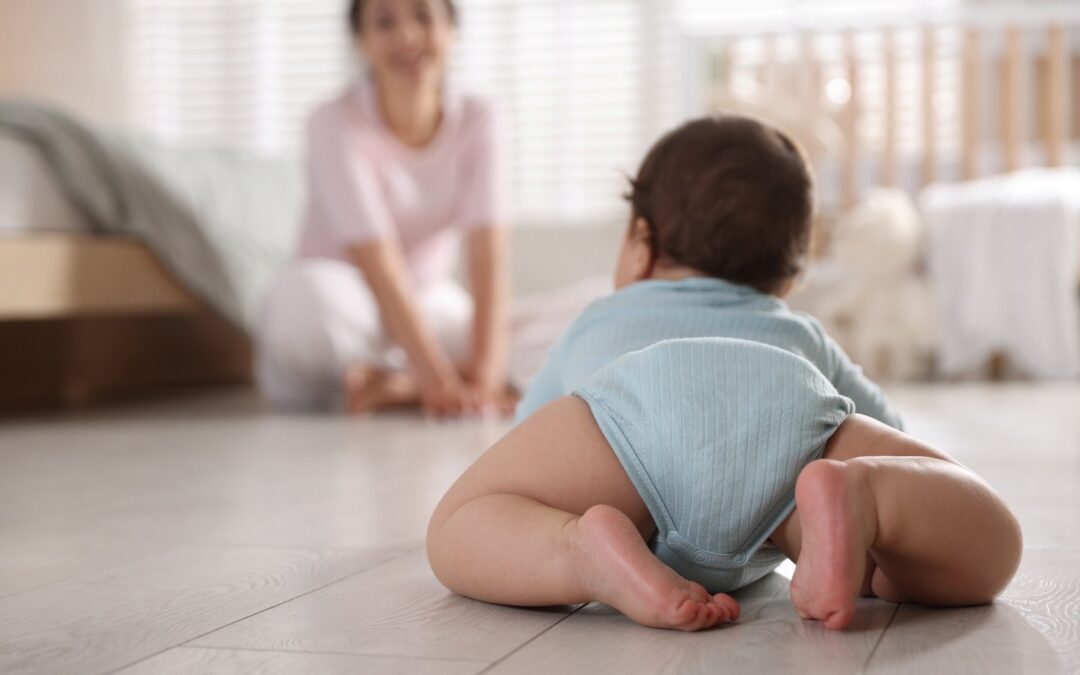
There comes a point when floor time starts looking a lot more purposeful. Your baby reaches farther for a toy. They push up, twist, rock, or somehow end up a few feet from where you originally placed them. You can see that they want to move, even if their body has not quite worked out how yet.
So, when do babies start crawling? Many babies begin around 7 to 10 months, but there is a wide range of what crawling can look like and when it appears. Your child may move earlier or later, spend weeks experimenting before going forward, or find a completely different way to travel across the room.
Understanding what may happen along the way can make this stage easier to enjoy without turning every new movement into a test.
When Do Babies Start Crawling?
For many babies, crawling develops between about 7 and 10 months. That range gives you useful context, but it is not a deadline.
Your child may seem close to crawling for quite a while before it actually happens. They might rock on hands and knees for weeks, push backward instead of forward, or discover that rolling gets them where they want to go much faster.
It is also helpful to know that crawling itself is not currently listed on the CDC’s 9-month milestone checklist. At that age, the broader movement picture includes skills such as sitting without support and getting into a sitting position.
In other words, the question is not simply, “Has my baby crawled yet?” Pay attention to how your child is becoming stronger, changing positions, using both sides of the body, and finding new ways to interact with the space around them.
What May Happen Before Your Baby Starts Crawling?
Parents often hear about the “stages of crawling,” but babies do not move through a universal sequence. There are, however, several changes you may notice as your child becomes more mobile.
Pushing Up and Getting Stronger During Floor Play
Long before crawling, your baby spends time learning how it feels to support more of their own body.
You may see stronger pushes through the arms during tummy time, more active kicking, rolling, or attempts to lift the chest farther off the floor. These movements may look simple, but your baby is doing a lot of work.
They are learning what happens when they shift their weight, brace with their arms, or push against the surface beneath them.
Sitting, Reaching, and Shifting Weight
As sitting becomes steadier, your child may start taking bigger chances.
A toy placed slightly to one side may inspire a long reach. Your baby might lean, catch themselves with one hand, twist, or move into an entirely different position while trying to get closer.
Sometimes the most interesting signs happen when your child nearly loses balance and figures out how to recover.
These are not required “pre-crawling steps.” They are simply examples of how movement can become more complex over time.
Rocking on Hands and Knees
Seeing your child get onto all fours can make crawling seem seconds away. Then they rock. And rock. And drop back onto their belly.
That position may appear shortly before crawling, or your baby may practice it for quite a while. Some children spend very little time rocking at all.
Think of it as another experiment rather than a countdown.
Going Backward Before Going Forward
One of the more entertaining and sometimes frustrating stages can happen when your baby is clearly trying to reach something and moves in the opposite direction.
They may push against the floor and slowly slide backward, putting the toy they wanted even farther away.
Backward movement can happen while babies are still figuring out how their arms, legs, and weight shifts work together. Once your child gets the coordination right, forward movement may follow. Or they may surprise you with another strategy entirely.
Finding a Way Forward
Eventually, your child may connect effort with results. For one baby, that means moving forward on hands and knees. Another pulls across the floor on their belly. Someone else sits upright and scoots.
Once your baby realizes, “I can get over there,” the room changes very quickly.
What Does Crawling Look Like? There’s More Than One Answer
You may picture crawling as two hands, two knees, and a smooth trip across the floor.
Some babies do exactly that. Many do not. Here are several movement styles you might see:
| What you may notice | What it can look like |
|---|---|
| Hands-and-knees crawl | Your baby moves forward using hands and knees, often alternating sides |
| Belly or army crawl | The stomach stays close to the floor while the arms and legs pull or push forward |
| Bear crawl | Hands and feet stay on the floor while the knees are lifted |
| Bottom scoot | Your child stays seated and shifts or pulls the body forward |
| Crab-style movement | Your baby travels sideways or backward using an uneven-looking pattern |
| Rolling | Your baby rolls repeatedly to reach a destination |
Your child may also mix styles. A belly crawl may become hands-and-knees crawling later. A baby who usually scoots might crawl occasionally. Another child may choose whichever method gets them to the toy fastest.
There is no prize for having the most textbook-looking crawl.
Do All Babies Crawl?
No. Some children never spend much time crawling in the traditional sense.
They may scoot, roll, belly crawl, or move from sitting into pulling up and other forms of mobility without becoming dedicated hands-and-knees crawlers.
That does not mean you should ignore movement concerns. It simply means that traditional crawling is not the only way your child can become mobile.
What matters more is the broader picture of how movement is developing.
Signs Your Baby May Be Getting Ready to Crawl
Crawling can arrive with very little warning, but you may notice changes beforehand.
Your child might:
- Reach farther for toys or people
- Shift weight more confidently from side to side
- Sit more steadily
- Turn or pivot on the floor
- Get onto hands and knees
- Rock forward and backward
- Push themselves backward
- Become increasingly determined to reach things that are just out of range
These are clues, not promises.
Your baby may do several of them and still take weeks to crawl. They may skip some completely. Try to notice the progress without turning the list into something your child has to complete.
How Can You Help Your Baby Learn to Crawl?
You do not need to teach crawling like a lesson. What you can do is give your child safe opportunities to figure out movement.
Give Your Child Plenty of Supervised Floor Time
Floor play gives your baby room to turn, reach, kick, push, roll, and change positions. That freedom is difficult to replicate when your baby spends most of the time in equipment that limits movement. You do not need an elaborate setup. A safe, comfortable area with room to move can be enough.
Put Something Interesting Nearby
Place a favorite toy, safe object, or even yourself a short distance away. Your baby may reach, roll, scoot, pivot, or attempt to crawl toward it. Keep the distance realistic. If you repeatedly move the object farther away, the game can become frustrating instead of motivating.
Get Down on the Floor Too
Sometimes the most interesting thing in the room is you. Sit or lie nearby, talk to your baby, make eye contact, or encourage them as they experiment. You are not coaching a crawling drill. You are simply giving your child another reason to explore.
Let Your Child Choose the Route
If your baby rolls to the toy instead of crawling, they still solved the problem. If they move backward, let them work through it. If they belly crawl, resist the urge to constantly place their knees underneath them. Your baby learns a lot by experimenting with what their own body can do.
Resist Turning Crawling Into Practice
You do not need a daily crawling routine or a series of exercises to speed things up. Repeatedly positioning your child’s arms and legs into a textbook crawl can turn a natural stage of exploration into something much more complicated than it needs to be.
Give your child opportunities. Let development do the rest.
Crawling Changes What Your Baby Can Reach
The first successful trip across the room is exciting. It can also reveal how much babyproofing suddenly matters.
Once your child becomes mobile, look around from their level.
Can they reach a cord hanging beside a table? Pull something from a low shelf? Get to a small object underneath the couch? Reach the edge of a tablecloth? Head toward the stairs before you expected it?
Pay particular attention to:
- Small objects that could become choking hazards
- Unstable furniture
- Cords and window coverings
- Stairs and appropriate safety gates
- Cleaning products and medications
- Breakable items on low surfaces
- Objects your baby can pull down from above
Babyproofing is rarely a one-time project. Your child’s new abilities will keep changing what they can reach.
What If Your Baby Isn’t Crawling Yet?
Watching other babies become mobile can make timing feel more important than it is.
A baby who is not crawling may still be gaining plenty of other movement skills. Your child may be scooting, rolling, changing positions, becoming steadier while sitting, pulling up, or finding another way to reach what interests them.
Instead of focusing on crawling alone, ask yourself what has changed over the past several weeks.
Is your child becoming more capable? Trying new movements? Using both sides of the body? Finding new ways to interact with the environment?
Those observations can be more useful than one date on the calendar.
When Should You Talk With Your Pediatrician?
You never need to wait until a particular birthday if something about your child’s movement concerns you.
Bring your questions to your pediatrician if your child loses a skill they previously had, consistently avoids using one side of the body, seems unusually stiff or floppy, or you are concerned about how movement is progressing.
If your baby is not sitting independently around 9 months, that is also worth discussing with your pediatrician.
You do not need to figure out on your own whether something is a developmental problem. Your doctor can consider crawling along with the rest of your child’s development and decide whether any follow-up is appropriate.
What Crawling Can Look Like at Daycare
Crawling develops through all the little opportunities your child has to reach, turn, follow something interesting, and explore.
That same spirit of discovery matters in infant care.
At Celebree School, teachers observe children during everyday activities and stay connected with families through regular communication. Teachers share the things they notice during the day: a new way your baby changes position, an enthusiastic attempt to reach a toy, or the first time they discover they can travel across the floor.
Those small updates can be especially meaningful during a stage when your child seems to change from one week to the next.
Today, your baby may work incredibly hard to move a few inches. Before long, you may find yourself wondering how they crossed the room so quickly.