
How physical development in early childhood supports healthy hearts, capable bodies, and confident minds.
Picture a classroom in your mind. What image appears? Probably something indoors, with small tables and chairs, and a bookshelf for good measure. And you are right. That is a classroom in a traditional sense, and a very important one. But what is equally as important are the outdoor spaces in which children spend time: the parks, the backyards, the playgrounds.
Especially in childhood, but equally as true at any age, a surprising amount of learning takes place before anyone ever sits down or steps inside, for that matter.
Physical development in early childhood is connected to academic learning. It is an imperative component.
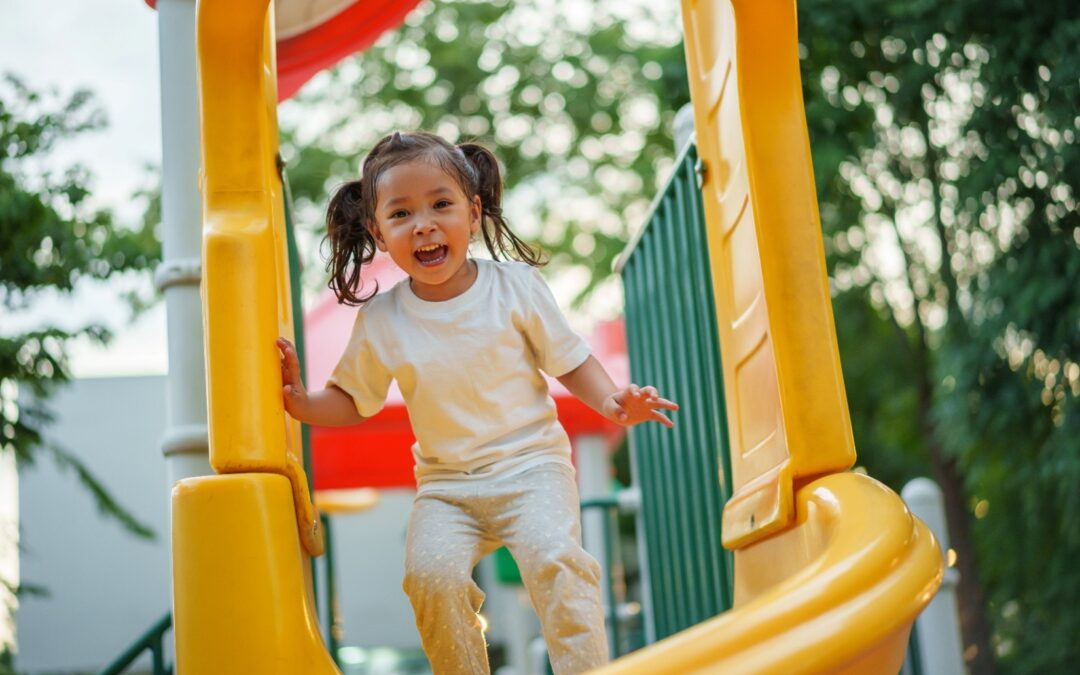
Running. Climbing. Balancing. Figuring out how to maneuver the monkey bars and make their way to the slide without bumping into someone else. These aren’t mere distractions or breaks. They’re part of how children make sense of the world.
The playground and the play that takes place on it are a major part of how children learn.
Rethinking Where Learning Happens
Watch what happens when a three year old climbs something for the first time. They pause. They look. They decide where to put their foot next. If they misjudge a step, they adjust. All of that is thinking in action.
While your child is moving, their brain is busy. They’re solving problems, making decisions, and strengthening the neural pathways that later support reading, writing, and math. Developmental research has shown again and again that movement activates areas of the brain tied to attention, memory, and executive function. Physical experiences quite literally help prepare the brain for more structured academic tasks.
As Kristen Miller, Director of Education at Celebree School, explains, “Children learn from their surroundings and activities they are exposed to. By providing them with new facets to explore, you open the opportunity for future development.”
When children have consistent opportunities to move, they’re strengthening:
- Brain-body coordination
- Focus and sustained attention
- Early problem-solving skills
- Self-regulation
Healthy Hearts Start Early
According to the World Health Organization, children under five should accumulate at least 180 minutes of physical activity throughout the day. That may sound like a lot, but for young children, it adds up quickly, especially when movement is naturally integrated into daily life.
Outdoor play makes this easy. Children run with excitement, chasing each other across the playground. They climb whatever structure they can because they are curious about what they can do. And they want to test their balance, walking across an elevated surface. All we have to do as adults is provide the place where they can do that safely and test their boundaries with a helping hand nearby.
Those early patterns matter. When movement feels enjoyable rather than forced, children are more likely to:
- Build endurance over time
- Strengthen heart and lung capacity
- Develop comfort with active play
- Associate movement with something positive
These habits formed in preschool are more likely to carry over into adolescence and adulthood.
Capable Bodies Shape Confident Minds
There’s a noticeable shift when a child begins to feel capable.
You might see it when your child approaches a new activity without hesitation. Or when they recover quickly from a stumble instead of melting down. Physical confidence changes how children enter situations.
Climbing isn’t just about upper-body strength. It’s about assessing risk. Trying again after slipping. This serves to build resilience in a way that a seated task rarely can.
When children develop physical competence, you often see growth in:
- Independence during daily routines
- Confidence in social settings
- Willingness to try unfamiliar tasks
- Emotional resilience
A child who trusts their body tends to trust themselves a little more, too.
Learning Happens on the Playground
Free movement is so important. A child needs opportunity to move their body around without any inhibiting factors. When a child has the space to run and jump, along with safe structures to climb or hang from, they have more chances to test their limits and move beyond them.
There is a meaningful component that enables the measurement of this growth. The teachers. Movement matters, but it carries even more value when educators are fully engaged. Teachers are there to supervise, yes, but what they are really doing is observing. They notice who pauses before climbing. Who tries again after falling? They observe stamina and coordination. And they make note of reactions when something feels hard.
That kind of attention matters. It allows teachers to respond in real time and provide necessary support, whatever they might look like for that specific scenario.
Sometimes support looks like offering a steady hand the first time your child attempts something new. Other times it’s a gentle prompt to slow down and think through the next step. And in many moments, it means stepping back so your child can work through the challenge independently.
As Kristen Miller, Director of Education at Celebree School, has shared, “Intentional experiences allow children to build essential skills while staying engaged and motivated.” When educators approach outdoor play thoughtfully, they create opportunities for meaningful development throughout the day.
With intentional guidance, children can:
- Practice safe risk-taking
- Strengthen problem-solving skills
- Gradually increase stamina
- Develop awareness of their body in relation to others
These experiences are woven into the rhythm of the day and into the curriculum itself.
At Celebree School, movement connects directly with cognitive, social, and emotional growth. Executive function develops alongside coordination. Attention improves as endurance builds. Body awareness strengthens self-regulation. Outdoor time becomes another place where foundational learning unfolds.
What This Means for Your Child
So how does movement translate into kindergarten readiness? It’s a common misconception that you must send your child to kindergarten already knowing how to read and write. And if that is the case, then that is wonderful! Letters and numbers matter and certainly serve as a significant foundation. But what matters just as much, if not more include stamina, coordination, self-regulation, and confidence.
Physical development in early childhood supports your child’s ability to:
- Sit comfortably during group learning
- Transition between activities with fewer frustrations
- Maintain focus for longer stretches
- Navigate social situations with awareness
- Approach challenges with persistence
You may start to notice subtle shifts. Your child moves through routines with more ease. They recover from minor setbacks more quickly. They step into new experiences with less hesitation.
Many of those changes begin with movement.
When your child runs, climbs, balances, and explores, they strengthen their body while also building attention, resilience, and independence.
Over time, those physical experiences reinforce academic growth in ways that become clearer as expectations increase.
Yes, the playground is a great place to burn off some energy. But it is so much more than that. It’s the place that lays the groundwork to develop focus and confidence.
As you explore preschool options, take a close look at how movement fits into the day. Ask how outdoor time is supported. Notice whether children have space to move freely and whether teachers are actively guiding that growth.
In early childhood, meaningful learning often begins while children are in motion.
Want to dig deeper into this topic? Check out our blog: What Outdoor Play Is Really Teaching Your Preschooler