

Even for the most extroverted kids, daycare can take some getting used to — and the early days are often a mix of excitement, uncertainty and adjustment for both children and their parents. But experts say the first 90 days are especially telling, offering key insight about whether a center is truly the right fit.
“The first 90 days are important because they determine if the child will feel comfortable in their new environment and with their new community of classmates and teachers,” says Gigi Schweikert, chief executive officer and parenting expert at Lightbridge Academy. “Some children warm up to new people faster than others, but within the first 90 days, children should feel well-adjusted enough that they are looking forward to going to daycare every day and seeing their teachers and friends.”
So how can you tell if your child is settling in or if something isn’t quite clicking? Here’s what to look for during those first few months.
Key takeaways
- The first 90 days of daycare are a key adjustment period where children build trust, learn routines and begin forming relationships with caregivers and peers. By the end of this window, parents should have a clearer sense of whether their child feels safe, engaged and comfortable in the environment.
- A good fit typically reveals itself gradually through small but meaningful progress, like easier drop-offs, growing engagement and increasing comfort over time. Consistent communication, trust in caregivers and a calm, responsive environment are equally important signals for parents.
- While some ups and downs are normal, a lack of progress, ongoing distress or poor communication from staff can signal a mismatch. If concerns arise, experts recommend partnering with teachers, staying curious and giving it time — while also trusting your instincts if things don’t improve.
Why do the first 90 days matter in daycare?
The first 90 days are essentially the adjustment period — and by the end of it, it should be clear whether or not the center is a good fit.”This period of time is really about building trust, both for the child and the parent,” explains Kristen Denzer, founder and CEO at Tierra Encantada, a Spanish immersion early education franchise. “For a child, it’s when they’re learning who their caregivers are, whether they feel safe and what to expect each day. For parents, it’s the window where they’re deciding, ‘Do I feel confident leaving my child here?’”
This sense of consistency and routine, Denzer adds, is what allows kids to settle in and start engaging with teachers and peers — something that’s particularly important for kids who have never been enrolled in group care.
Britt Riley, founder of The Haven Collection, a child center and workspace, adds that the first 90 days of daycare also show and shape how secure a child feels separating from their parent or guardian and how confidently they engage with peers and learn in the classroom.
“This is when patterns start to emerge,” Riley notes. “You begin to see how a child responds to transitions, communicates their needs and manages big emotions. Early observations allow educators to proactively support the child.”
Should I be worried if my child isn’t happy?
If everyday is a battle, it may give you pause (more on this shortly), but if there are ups and downs, that’s OK, says Kristen Miller, director of education at Celebree School in Baltimore.
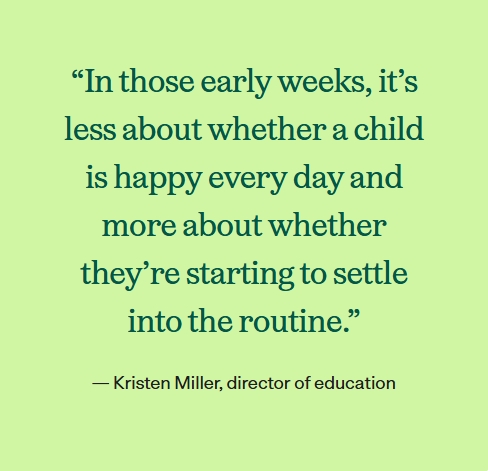
“Adjusting to daycare doesn’t happen overnight,” she says. “In those early weeks, it’s less about whether a child is happy every day and more about whether they’re starting to settle into the routine.”
The key, she explains, is to focus on the whole child — social, emotional and developmental growth — not just academics.
“This means giving children time to build relationships, understand routines and learn how to navigate a group setting,” Miller continues. “You want to see moments where they’re engaging, participating and beginning to feel familiar with their surroundings. That gradual sense of comfort is what tells you the adjustment is moving in the right direction.”
What are signs a daycare is a good fit during the first 90 days?
Parents will be able to discern whether a daycare is a good match “pretty clearly over time,” says Denzer. That being said, the reveal is typically gradual, so don’t expect your child to do a 180 overnight.
Here are early signs that a daycare is a good fit for a child, per Denzer, Riley, Schweikert and Miller.
- Easier, less emotional separations at drop-off over time.
- Shorter recovery time after difficult drop-offs.
- Increasing comfort, familiarity and overall adjustment.
- Engagement with teachers and responsiveness to them.
- Curiosity, participation and connection during the day.
- Settling into and recognizing daily routines.
- Mentioning friends or showing interest in peers.
- Talking about activities from the day.
- Participating in group time, snack time and play with others.
- Playing alongside or interacting with other children.
- Showing recognition of teachers, classmates and environment.
Note: Many of the above signs will be from teacher reports, as opposed to parent observation — and that, in and of itself is also a good sign. “Communication should be consistent, thoughtful and transparent,” notes Riley.
As for parents, here’s what to look for per experts:
- Feeling informed about your child’s day.
- Consistent, thoughtful and transparent communication from staff.
- Feeling comfortable reaching out to teachers or administrators.
- A sense of trust in the caregivers.
- Observing genuine warmth between teachers and children.
- An environment that feels calm, responsive and intentional.
- Educators who seem attuned to individual children (not just managing the group).
What are daycare red flags during the first 90 days?
One of the biggest daycare red flags, Miller notes, is when there’s no forward progress over time. “It’s normal for children to have a tough start, but after a few weeks, you should begin to see some easing,” she says. “If drop-offs are just as difficult, that’s something to pay attention to.”
While kids are bound to have ups and downs during the adjustment period, here are a few child-centered signs the center may not be a good fit, per Denzer, Riley, Schweikert and Miller:
- Ongoing distress that doesn’t improve after a few weeks.
- Drop-offs that stay just as difficult over time.
- Intense or persistent fear about going to daycare.
- Withdrawal or lack of engagement.
- Significant behavioral changes.
- Refusal to participate in activities.
- Spending most of the day on the sidelines.
- Not connecting with teachers or peers.
- Disruptions to sleep or eating.
- Increased clinginess at home.
- Strong, ongoing resistance to attending.
Here, parent-centered signs a daycare may not be a good fit:
- Lack of clear, consistent or transparent communication.
- Feeling uninformed about your child’s day.
- Difficulty getting answers from staff.
- Caregivers who seem overwhelmed or dismissive.
- Inconsistency in staffing or lack of follow-through.
- Not knowing who is regularly in your child’s classroom.
- A noticeable gap between what was promised and actual experience.
- Lack of clear structure or routine in the day.
What should parents do if daycare isn’t going well?
The first thing you should do if daycare doesn’t appear to be going well is talk with your child’s teacher, says Schweikert. “Ask about how they are adjusting to the new environment,” she says. “Daycare teachers are very observant and can tell parents why children may be having a difficult time adjusting to the new daycare.”
During your conversation, share what you’re seeing and ask how they can support, Denzer adds. “That may be adjusting routines, providing more updates or supporting the transition differently,” she says. “Regardless, a strong center should want to partner with you and work through concerns together.”
Ask your child how they’re feeling
In addition to speaking with the center, speak with your child. “Ask them how they feel about their new daycare and if they are making friends,” notes Schweikert. “Conversations with both teachers and children can help parents learn how they can help their children adjust and thrive at their daycare.”
Pro tip: Stay curious, not reactive
“It is best not to jump to conclusions if daycare is not going as smoothly as you would hope, “Families should partner with the school to understand what is happening, rather than assuming a situation can’t or won’t improve.”
Play a supportive role
In addition to keeping communication — and minds — open, here are a few more tips for helping the transition period, per Schweikert:
- Keep drop-offs short, positive and predictable.
- talk about daycare like it’s a safe, fun place.
- Create a special goodbye ritual (hug, phrase, wave at window, etc.).
- Stay consistent with attendance.
Finally, Miller adds, if concerns continue, it’s OK to reassess. “Not every environment is the right fit for every child,” she says, “and finding the right one can make a meaningful difference in how a child shows up day to day.”
A final note on the first 90 days of daycare
The first 90 days of daycare are a transition period, not a determination of how your child willth fare. While it’s important to keep an open mind, it’s also crucial to go with your gut.
“Think of the first 90 days as establishing the relationship between the family and school,” Denzer says. “Strong communication and building trust early on is crucial for a child’s long-term success.”
“What matters most isn’t that everything is perfect; it’s how the center responds if you have concerns,” she continues. “If they’re thoughtful, proactive and you start to see progress, that’s a good sign. If not, it’s OK to trust your instincts. Not every environment is the right fit for every child.”
Published on Care.com.