
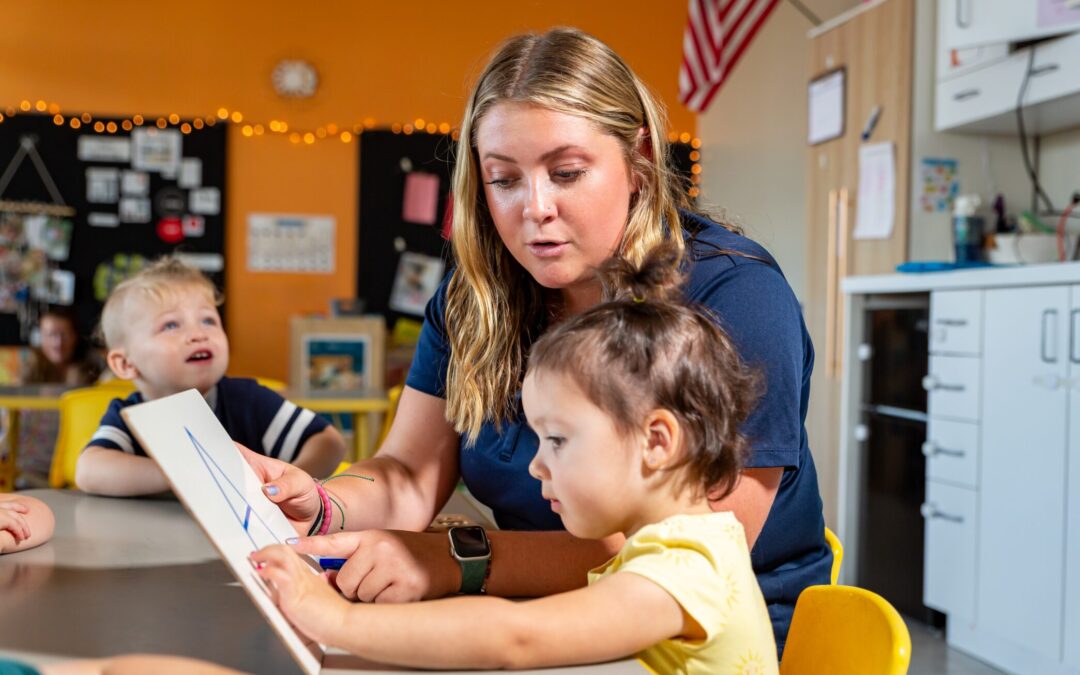
Ask 10 parents about the perks of enrolling your child in preschool, and you’ll likely get 10 different answers. For some, preschool simply offers stability when it comes to schedules. For others, it’s an easy way to build a child’s social circle. Cue the confusion so many first-timers feel when trying to determine what preschool is really all about and if it’s necessary.
But despite parents rarely having the same view on the value of preschool, the good news is that early childhood education experts overwhelmingly do. “Preschool is a powerful growth and development time for our youngest of learners,” explains Stefanie Shurer, director of learning and development at Celebree School. “By attending a licensed preschool program, even as young as an infant, children are provided with a strong foundation for lifelong learning.”
Here, experts walk parents through everything they need to know about preschool so they can make a confident decision about when to kick off their child’s educational journey.
So, what is preschool exactly?
Preschool is an early learning program designed to prepare children for kindergarten and beyond. It takes place within a structured environment built to develop a child’s cognitive, social and emotional skills, explains Gigi Schweikert, chief executive officer of Lightbridge Academy and a parenting and early education expert with over 30 years of experience.
And what is preschool not? “The most persistent misconception is that preschool is babysitting, or supervision, rather than education,” Schweikert says. “This is because a lot of the social-emotional learning that happens in preschool is often mistaken for play.”
For example, unstructured play in a preschool classroom develops risk tolerance, creative problem-solving and self-direction while collaborative play helps establish communication and empathy, Schweikert explains. Early literacy and math concepts are also part of preschool, but learning through play is often the primary method of instruction at this age.
Is preschool the same as pre-K?
No. Preschool is an early learning program tailored to children under the age of 5, Shurer explains. Pre-K, or pre-kindergarten, is designed specifically for 4- and 5-year-olds with a focus on kindergarten readiness skills. Think of pre-K as the “grade” right before kindergarten, while preschool can encompass early learning programs for multiple ages.
What is preschool vs. daycare?
Daycare provides child care while preschool provides an early childhood education. “Traditional ‘daycare’ locations focus solely on providing a safe and reliable environment while families are working,” Shurer says. “Preschool places a stronger emphasis on school readiness and whole child development through intentional learning experiences.”
What age are kids in preschool?
Preschool typically serves children ages 3 to 5. But many early childhood education centers also offer earlier “preschool-style” programs for younger children, including infants and toddlers.
For example, Lightbridge Academy welcomes babies as young as six weeks old into its infant program and children ages 1 and 2 into its toddler program. “Our youngest learners receive more than just care,” Schweikert says. “They experience a nurturing, curriculum-based environment designed to support their growth and development from day one.”
Are there preschool age limits or legal requirements to enroll?
In general, preschool is not required anywhere in the U.S., and there is no national standard “preschool age.” With this in mind, age cutoffs vary by state and program. Our experts offer these tips to find out what the preschool age requirements are in your area:
-
Check your state’s Department of Education website. Most states have an early childhood section that spells out eligibility ages. For example, “A child must turn 4 by September 1 to enroll in pre-kindergarten.”
-
Look at public vs. private preschools separately. State-funded pre-K programs almost always have legally defined age windows since they’re tied to public funding and kindergarten entry laws. Private preschools have more flexibility and often set their own age ranges by classroom. For example, they may have a “2s room” or a “3s room,” etc.
What do kids learn in preschool?
Much more than many parents may think. “When children enroll in an early learning program, they learn how to be a part of a classroom community, communicate effectively, develop confidence and empathy, problem solve and discover a love of learning,” Shurer says. “These are just a few of the foundational skills that support kindergarten success and beyond.”
Specifically, in preschool, children will learn foundational skills across these key developmental domain areas, according to Shurer:
-
Social-emotional: Self-regulation skills, conflict resolution, emotional awareness, and cooperation.
-
Physical: Self-help skills, gross motor coordination and fine motor skills.
-
Language: Listening skills, language comprehension and language expression of thoughts and needs.
-
Cognitive: Curiosity and inventiveness; focused attention; connecting and recalling; and classifying and thinking symbolically.
-
Literacy: Story comprehension, letter recognition, early writing and vocabulary.
-
Math: Counting, shapes, patterns, measuring and problem-solving.
-
Science: Observation, cause and effect, questioning and exploration.
-
Social studies: Diversity, responsibility, community and traditions.
-
Arts: Music, drama, visual arts and dance.
Full-day vs. half-day preschool: What’s the difference?
Most preschools offer both half-day and full-day programs simply to give families more options based on their schedules. Full-day programs run from 9 a.m. to 4 p.m., often with optional after-school care. Here, Shurer offers a snapshot of a typical full-day preschool schedule:
-
Arrival and AM activities.
-
Teacher-led small or large group activities.
-
Gross motor skills movement, such as outdoor playtime.
-
Self-guided indoor play or centers.
-
Group music and movement.
-
Meals and snacks.
-
Rest or quiet time.
-
PM activities and dismissal.
Half-day programs, on the other hand, are typically three to four hours per day. Some preschools also offer part-time programs two or three days a week rather than all five days. But while hours differ between program options, learning stays pretty consistent, Shurer notes.
“Both half-day and part-time preschool programs offer a variation of full-day components,” Shurer says. “However, the full-time programs tend to incorporate additional enrichment sessions for extended learning opportunities or exploration.”
“When children enroll in an early learning program, they learn how to be a part of a classroom community, communicate effectively, develop confidence and empathy, problem solve and discover a love of learning. These are just a few of the foundational skills that support kindergarten success and beyond.”
What are the biggest benefits of preschool?
Preschool helps children develop social-emotional skills while also strengthening language, communication, and key cognitive abilities, such as memory, focus and executive functioning. Here’s a closer look at the biggest developmental benefits of preschool, according to Shurer:
-
Builds social-emotional skills, such as empathy, resilience, cooperation and emotional regulation.
-
Develops language and communication skills through meaningful conversation, literacy exploration, music and collaborative play.
-
Strengthens cognitive development through focused attention, memory recall, transitions between locations and activities, as well as executive functioning skills.
-
Encourages independence through self-help skills and navigating the daily routines and classroom expectations.
-
Creates a love of learning by encouraging exploration, asking questions and discovering new concepts and ideas.
How much does preschool cost?
The price for private preschool tuition ranges from $300 to $900 per month for a part-time program and $800 to $2000 per month for a full-time program, according to Shurer. But many factors can influence the cost for preschool programs, including:
-
Location
-
Program length
-
Public or private
-
Teacher qualifications
-
Class size
-
Curriculum
Since the cost of preschool is largely determined at the program level, Shurer encourages families to ask questions with their budget in mind when choosing a preschool. “When visiting a preschool program, a family should ask about their options, such as flexible scheduling, sibling discounts, employee partnerships or financial assistance,” Shurer says.
Is preschool ever free?
Only four U.S. states currently enroll all 4-year-olds in free universal preschool regardless of family income. In other states, if free preschool or reduced preschool tuition costs for families exist, they will be offered through the following programs, according to Shurer:
-
Federally funded programs, such as Head Start, an early childhood program that provides low-income families with financial support for children from birth to age 5.
-
Public school pre-kindergarten programs primarily funded by state and local governments.
-
State-funded programs that provide scholarships or tuition assistance.
How do you know if your child is ready for preschool?
Experts we spoke with agree that there is no single checklist for determining if your child is ready for preschool. However, they offer these helpful indicators for families to help gauge a child’s level of readiness when starting a preschool program.
A child may be ready for a half-day preschool program if they:
-
Participate comfortably in routines at home.
-
Show curiosity about other children.
-
Follow simple instructions.
-
Express basic needs verbally or through other communication methods.
-
Enjoy exploring independently and can concentrate on a task that lasts several minutes without an adult keeping them engaged.
A child may be ready for a full-day preschool program if they also:
-
Adjust well to longer routines.
-
Benefit from predictable daily schedules.
-
Are comfortable eating and napping away from home.
What should you look for when choosing a preschool?
A high-quality preschool program will be licensed by your state to operate a safe and nurturing environment for children, Shurer stresses. Licensing often includes requirements for teacher qualifications, background checks and child-to-staff ratios, but it varies by location. Here’s where you can search and verify a preschool’s license to ensure it meets your state’s standards.
Once you’ve found a licensed preschool, planning a tour is the next step. “When visiting a school to determine if it is the right fit for your child, family members need to focus on the interactions and engagement between the teachers and with the children,” Shurer says.
Here are the top visible qualities to look for when touring a preschool, according to Shurer:
-
Warm, welcoming and responsive teachers who get on the child’s level.
-
Clean and organized play spaces and food areas.
-
Positive teacher-child relationships with meaningful conversations.
-
Classrooms that inspire active exploration, creativity, curiosity and independence.
-
Expansive outdoor environments and safe indoor play spaces or classroom activities.
-
Developmentally age-appropriate materials and planned activities.
-
Strong communication with families.
Best questions to ask when touring a preschool
To gauge the alignment of your family’s unique needs to what a specific preschool program has to offer, Shurer encourages families to ask the following questions:
-
How do you communicate with families?
-
What does a typical day look like?
-
How do you individualize learning for each child throughout the day?
-
How do you prepare children for kindergarten?
-
How do you measure a child’s success?
-
What certifications do your teachers have and what professional development do they receive throughout the school year?
So, is preschool really necessary?
Preschool is not typically viewed as a “necessity.” This is because young children can thrive in many different settings, from group care, such as a daycare or preschool program, to individualized care, such as with a nanny or family member at home, Shurer explains.
Instead, Shurer encourages caregivers to view preschool as an investment in a child’s overall development so long as it is the right fit for your family. “Preschool programs set the stage for learning and foster an inclusive environment with intentional activities and experiences for a child’s growth and development,” Shurer says. “Preschool sets the child up for success.”
Published by Care.com.