
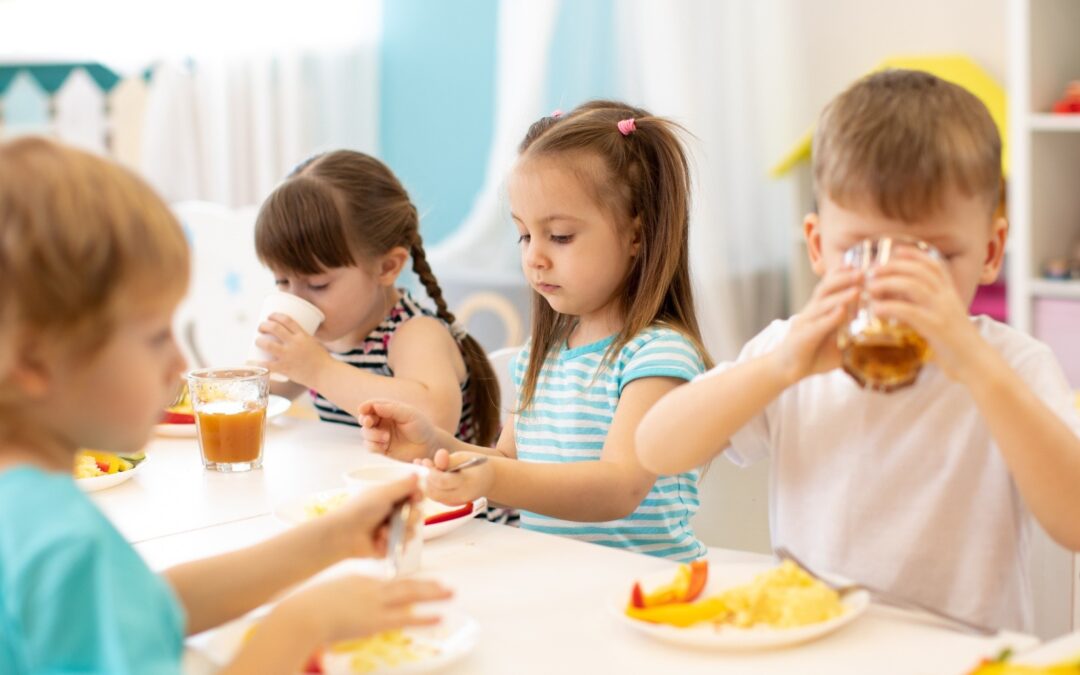
How family-style dining in preschool helps children build independence, confidence, and healthy eating habits.
If you’ve ever sat down for a meal with a preschooler, you know that eating is rarely the only thing happening at the table.
Someone is negotiating over the last strawberry. Someone else is telling a very important story about what happened on the playground. A cup tips slightly too far. A spoon misses its target. Somehow, the conversation shifts from dinosaurs to whether carrots are crunchy or “too crunchy.”
It might feel chaotic in the moment, but those small interactions are doing important work.
Mealtime gives children the chance to practice independence, conversation, patience, and decision-making. These are the kinds of everyday experiences that help children build confidence, not just around food, but in how they interact with the world.
It makes a huge difference when those lessons are intentionally supported through family-style dining in preschool, where children take an active role in serving food, passing dishes, and participating in the social rhythm of the meal.
The goal isn’t just to feed children. It’s to help them grow.
What Is Family-Style Dining in Preschool?
Family-style dining in preschool is exactly what it sounds like. Instead of having meals portioned and handed out to them, children serve themselves from shared dishes at the table.
Teachers guide the process, but children take the lead in many small ways. They pass bowls, scoop their own portions, pour drinks, and help clear their space when the meal is finished.
Those moments may seem simple, but they give children the opportunity to practice important life skills in a relaxed setting.
As Kristen Miller, Director of Education at Celebree School, often explains, children learn best through hands-on experiences. Participating in everyday routines allows them to build confidence while developing practical skills they’ll use far beyond the classroom.
How Family-Style Dining Works in a Preschool Classroom
During family-style dining in preschool, the environment is intentionally set up so children can participate safely and comfortably.
You might notice:
- Child-sized tables and chairs
- Serving bowls placed within reach
- Small pitchers that allow children to pour their own water or milk
- Utensils designed for small hands
Teachers guide the flow of the meal while encouraging children to take part in the process.
Children might help:
- Pass a bowl to the next friend
- Serve themselves a portion
- Ask politely for something they’d like
- Wait their turn while food is passed around
These interactions help children develop social awareness while building independence in a natural, low-pressure way.
The Skills Children Practice During Mealtime
When children participate in family-style dining in preschool, they’re learning far more than table manners.
They are developing a wide range of life skills.
Independence
Serving their own food helps children build confidence in their abilities. Even something as simple as scooping rice onto a plate gives your child a sense of ownership and responsibility.
Social Skills
Meals are naturally social experiences. Children practice:
- Taking turns
- Listening to others
- Asking for what they need
- Participating in conversation
These small exchanges help build communication skills and empathy.
Confidence With Food
Children are more comfortable trying new foods when they feel in control of the process.
Instead of being told what to eat, they have the opportunity to explore foods at their own pace.
Early Academic Skills
Believe it or not, mealtime also introduces early learning concepts. Teachers may encourage children to:
- Count items on their plate
- Notice colors and textures
- Talk about shapes and sizes
Language, observation, and early math skills naturally weave into the conversation.
Why Family-Style Dining Supports Healthy Eating Habits
Children often become more open to different foods when they feel relaxed and included in the experience.
Family-style dining in preschool creates that environment.
Children see their peers trying different foods. They observe teachers modeling healthy eating habits. And because the setting is social and supportive, food becomes something to explore rather than something to resist.
As Miller notes, children learn from the environments and experiences they’re given. When mealtime invites curiosity and participation, children begin to develop healthier, more confident relationships with food.
How You Can Try Family-Style Dining at Home
It’s simple to bring some of these ideas into your own home and make meals feel more collaborative for your child. You might try:
- Placing food in serving bowls instead of plating everything ahead of time
- Letting your child scoop their own portion
- Asking them to pass dishes around the table
- Inviting them to help clear the table after eating
It may take a little longer at first. There may be a few spills along the way.
But giving children small responsibilities during meals builds confidence and encourages participation. Over time, those everyday moments help children develop independence, communication skills, and a healthier relationship with food.
Why These Small Moments Matter
In early childhood, learning often happens in the most ordinary moments.
Meals are one of those moments.
When children participate in family-style dining in preschool, they are practicing life skills that extend well beyond the lunch table. They’re learning how to make choices, how to communicate with others, and how to take responsibility for themselves.
While it might look like a simple meal shared among friends, it’s also an experience that helps children grow into confident, capable individuals.
Curious how everyday moments like mealtime help children build independence and confidence? Connect with a Celebree School near you to see how whole-child learning comes to life throughout the day.