
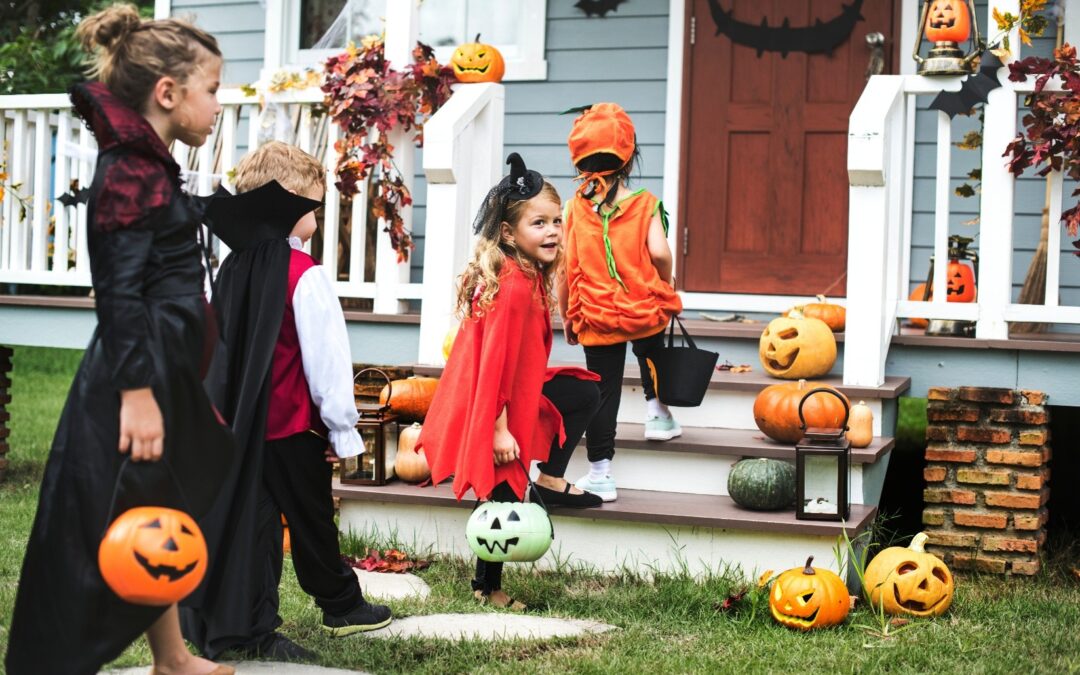
By the third or fourth house on Halloween night, there is a lot going on. For children, trick-or-treating also packs a surprising amount of social practice into one walk around the neighborhood.
They approach people they may not know well, wait while other children take a turn, remember what to say, manage excitement, and figure out what to do when something feels unfamiliar.
For families wondering how to teach kids social skills in ways that make sense outside a lesson or activity, Halloween offers plenty of real-life examples.
Here are five worth noticing:
1. A Doorstep Is a Tiny Social Exchange
Think about what happens at each house.
Your child walks up to someone they may barely know, says a familiar phrase, listens for a response, accepts something, and hopefully remembers to say thank you before heading to the next door.
That sounds simple to an adult. For a preschooler, it can be a lot.
Pediatrician Jenny Radesky, MD, notes in a PBS KIDS guide to preparing children for trick-or-treating that Halloween can be intimidating for shy children and overwhelming for children who have trouble knowing what to say in unfamiliar situations. Practicing the routine ahead of time can help.
Before heading out, you might run through it once at home:
“Knock, say trick or treat, get your candy, say thank you.”
Then see what happens.
Your child may deliver the whole thing proudly. They may whisper. They may hide behind you for the first two houses and warm up later. All of those experiences give them a chance to become a little more comfortable interacting with people outside their usual circle.
2. Waiting for Candy Takes Real Self-Control
A bowl full of candy is sitting three feet away. Five children are ahead of yours.
That is a fairly serious test of patience when you are 4.
Trick-or-treating gives children repeated chances to wait, follow the group, let someone else go first, take an appropriate amount, and move aside when their turn is over.
Turn-taking is an important part of social development. The CDC includes following rules and taking turns with other children among its social-emotional milestones for 5-year-olds.
You will probably still need to help.
A simple “They’re still at the door. We’re next” may work better than a long reminder about patience while your child is staring directly at a bowl of mini chocolate bars.
These little waits are useful practice. Children encounter the same skill when they are standing in line, playing a game, waiting for a swing, or sharing materials with friends.
3. Halloween Gives Feelings Plenty to Work With
Halloween is exciting. It can also be loud, strange, disappointing, and occasionally scary.
A decoration moves when your child did not expect it to. The house with the giant skeleton suddenly feels like a bad idea. A sibling gets a different candy. Someone is tired. Someone is hot inside a costume. Someone has had enough.
This is where self-regulation for kids becomes very real.
You can help your child notice what they need before things completely unravel. Maybe you skip a scary house. Maybe you stop for water. Maybe your child needs to hold your hand for a few minutes or ride in the wagon instead of walking.
Ending the night while everyone is still having fun is also allowed.
At Celebree, social-emotional learning includes helping children recognize emotions, regulate their reactions, solve problems, and communicate what they need. Celebree’s curriculum uses Conscious Discipline to support self-regulation, emotional intelligence, and healthy relationships.
Halloween gives parents plenty of chances to use those same skills in the wild.
4. Children Learn the Rhythm of a Social Routine
Adults know the unwritten rules of trick-or-treating.
Look for the porch light. Wait your turn. Walk up. Knock or ring. Say “trick or treat.” Take the candy you are offered. Say thank you. Head back to the sidewalk.
Young children are still learning how routines like this work.
Going through the steps beforehand can make the evening easier, especially for a child who likes to know what is coming. The PBS KIDS guidance recommends talking through the plan and breaking the experience into simple, memorable steps before children enter an exciting or overwhelming situation.
Once you are out there, your child gets to practice the sequence again and again.
By the fifth house, you may notice they no longer need you to remind them when to move aside. By the tenth, they might be telling a younger sibling what comes next.
5. Respect Also Shows Up
Halloween manners usually bring “please” and “thank you” to mind.
There is more to practice.
Your child can wait while a toddler carefully climbs the front steps. They can take one piece when the sign says “please take one.” They can stay off a neighbor’s garden. They can accept a candy that would never make their personal top 10 without announcing that fact to the person handing it out.
They will also learn that different families might not celebrate Halloween. Respecting that is part of being a good neighbor.
These are small choices. You can point them out without turning the evening into a running lecture. “That was kind of you to wait for that little guy” is plenty.
Let Your Child Participate Their Way
Trick-or-treating carries more communication pressure than you might realize. Children are asked to say the same phrase repeatedly, answer questions about their costume, and speak with people they don’t know.
The American Speech-Language-Hearing Association notes that these interactions can be especially challenging for children with speech or language disorders.
A shy child may want you beside them. Another may wave instead of saying thank you. Someone who happily handled three houses may decide the fourth is enough.
Meet your child where they are.
They will have more fun when they can participate without feeling pushed or forced past what they can manage.
Social Skills Grow Through Everyday Practice
Children practice social skills in all kinds of ordinary places: around the dinner table, on the playground, in the classroom, while playing with siblings, and yes, while carrying a plastic pumpkin through the neighborhood.
At Celebree School, those everyday interactions are part of learning. Children have opportunities to practice communication, turn-taking, problem-solving, emotional regulation, cooperation, and friendship throughout the day.
Learn more about how Celebree supports social, emotional, and early learning through its day care programs.
On Halloween night, your child will probably be thinking much more about the candy than any of this. You may notice a few other things.
They waited while another child went first. They knocked on a door they were nervous to approach. They remembered a thank you without prompting. They decided the house with the fog machine was a hard pass and told you so.
That is a lot to practice on the way to a fun-size chocolate bar.