
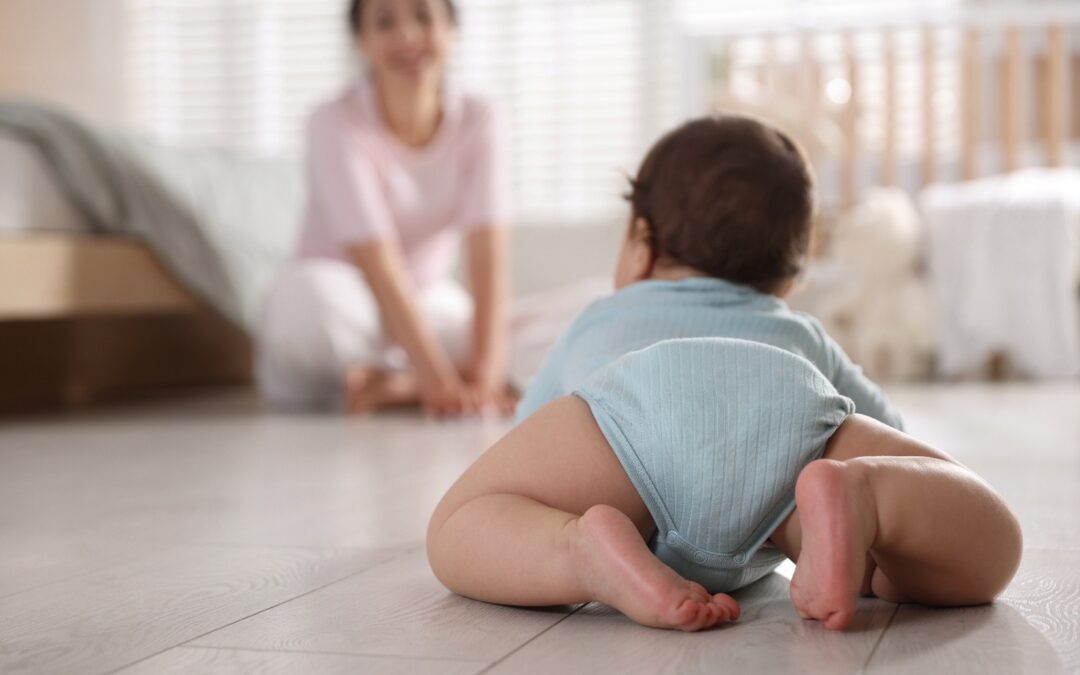
When parents picture crawling, they often imagine a baby moving forward on hands and knees. Babies, however, can be surprisingly inventive once they decide they want to reach a toy, follow you across the room, or explore something just beyond arm’s reach.
So, when do babies start crawling? Many begin traditional hands-and-knees crawling around 7 to 10 months, but there is a broad range. Some start earlier or later, and some use another form of movement instead.
Crawling Does Not Always Look Like Hands and Knees
A baby’s first way of getting from one place to another may look very different from the crawl you expected.
You may see:
- Hands-and-knees crawling: The familiar alternating movement of opposite hands and knees.
- Belly or army crawling: Your baby stays closer to the floor and pulls forward using their arms.
- Bottom scooting: Some babies sit upright and use their legs and bottom to move.
- Backward crawling: Your baby pushes themselves backward before figuring out how to move forward.
- Bear crawling: Your baby moves on hands and feet with their knees lifted off the floor.
- Rolling or pivoting: Some babies rely on rolling, turning, or another method to get where they want to go.
These movement styles do not all have to happen, and they do not need to appear in a certain order.
Why Is My Baby Crawling Backward?
Backward crawling can be confusing to watch, especially when your baby seems determined to reach something in front of them.
It can happen while babies are still figuring out how to coordinate their arms, legs, and weight. They may push strongly through their arms and end up moving backward before they work out how to propel themselves forward.
For some babies, backward movement is temporary. Others may move in a completely different way rather than progressing to a classic crawl.
The important thing is to look beyond one particular movement and notice how your baby is gaining strength, trying new positions, and becoming more capable of exploring their surroundings.
Can Babies Skip Crawling?
Yes. Some babies never use a traditional hands-and-knees crawl.
They may scoot, roll, pull themselves up, begin cruising along furniture, or use another method of getting around before eventually walking.
That does not mean every baby who skips crawling follows the same path. Pulling up, cruising, crawling, and other movements can overlap, and the order may vary from one child to another.
This is one reason crawling is better viewed as part of a larger picture of physical development rather than a single required step that must happen on schedule.
What Matters More Than Crawling Style?
It is natural to notice exactly how your baby moves, especially when their style looks different from another child’s. Try to pay attention to their overall progress as well.
Are they:
- Trying new positions?
- Reaching and shifting their weight?
- Using both sides of their body?
- Becoming stronger or more coordinated?
- Finding new ways to move toward people or objects?
Those changes can tell you more than whether your baby has mastered one specific type of crawl.
If something about your baby’s movement concerns you, talk with their pediatrician. It is especially important to mention a loss of a skill your baby previously had or persistent differences in how they use one side of the body. Your pediatrician can consider your child’s full developmental picture and help determine whether anything needs closer attention.
Give Your Baby Space to Explore Movement
Babies learn a great deal about movement simply by having safe opportunities to use their bodies.
Supervised floor time gives your baby room to roll, reach, push up, shift positions, and experiment with getting from one place to another. Tummy time while your baby is awake also supports the strength used in many early motor skills.
You do not need to correct your baby into a certain crawling style or turn movement into a set of exercises. Stay nearby, offer interesting things to look at or reach toward, and give them time to discover what works.
As mobility increases, take another look at the spaces your baby uses every day. Something that was safely out of reach last week may suddenly be accessible once your baby finds a faster way to move.
New Movements Can Show Up at Daycare
Babies may practice one movement at home and try something completely different during the day.
At Celebree School of National Landing, infant teachers observe children as they play, move, and explore. When a baby begins scooting toward a toy, pushing into a new position, or experimenting with another way to get around, those everyday observations can be shared with families.
That communication matters because you get a fuller picture of what your child is working on across different parts of their day.
It can also be exciting to learn that the unusual little movement you have been seeing at home has suddenly become a very effective way for your baby to cross the classroom.
Follow Your Baby’s Progress, Not Someone Else’s Timeline
Crawling is an exciting change because it gives babies a new way to explore. It can also bring plenty of questions when your child’s movement looks different from what you expected.
There is no single crawling style that every baby has to master. Watch how your child is progressing, give them room to move, and bring concerns to their pediatrician when you have them.
If you are looking for daycare in Arlington, VA, Celebree School of National Landing provides infants with opportunities to move, explore, and learn throughout the day. Schedule a visit to meet our team and learn more about infant care at Celebree.