
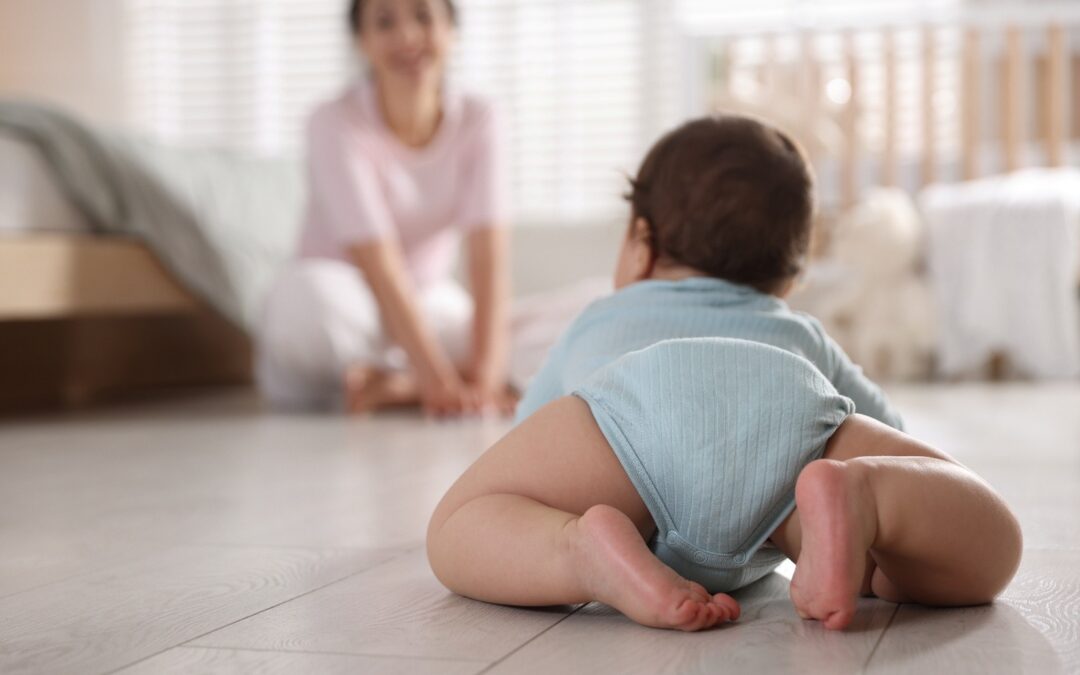
It is easy to picture infant development happening in a set order: first sitting, then crawling, then standing. Babies do not always follow that tidy sequence.
If you are wondering when do babies start crawling, many babies begin traditional hands-and-knees crawling around 7 to 10 months. Around this same period, sitting often becomes steadier and babies get better at moving between positions.
So, does sitting have to come first? Often it does, but there is more overlap between these skills than a milestone chart may suggest.
Do Babies Usually Sit Before They Crawl?
Many babies learn to sit without support before they begin traditional crawling.
Sitting gives babies a stable position for looking around, reaching for toys, turning toward sounds, and using their hands more freely. As their balance improves, they may also start leaning forward, twisting to one side, or figuring out how to get from sitting onto the floor.
Those transitions can eventually lead into crawling or another type of mobility.
Still, the order is not identical for every child. Sitting may be well established for one baby before crawling begins, while another may be experimenting with both during the same stretch of development.
Sitting and Crawling Use Different Kinds of Control
Sitting and crawling may look like separate skills, but they often develop alongside each other.
When sitting, your baby is learning to maintain balance while turning or reaching. Crawling adds the challenge of supporting the body while shifting weight and moving from one place to another.
You may notice your baby practicing the connection between these skills before they ever crawl forward. They might lean out of a seated position, lower themselves onto their hands, pivot, or find their way back into sitting.
That back-and-forth movement can be just as interesting to watch as the first crawl across the room.
What If Crawling Starts While Sitting Is Still Developing?
If your baby begins finding ways to move before sitting looks completely steady, that does not automatically mean the sequence is wrong.
Babies may work on several movement skills at once.
A baby might use their belly to move toward a toy and still need some support while sitting. Another may sit confidently for weeks before showing much interest in getting anywhere.
Rather than focusing only on which skill came first, notice how your baby is gaining more control over their body over time.
Skills Can Overlap
Infant movement does not always happen in separate chapters.
During the same few months, your baby may be learning to sit more steadily, change positions, scoot, crawl, reach farther, or begin experimenting with pulling up.
One skill may appear, disappear for a few days, and then come back stronger. Another may develop alongside it. That overlap is one reason predicting the exact order of milestones can be difficult.
Your baby may be working on more than one new ability even when only one is obvious at first.
Crawling May Not Be the Next Step
Some babies never become traditional hands-and-knees crawlers.
They may belly-crawl, scoot while sitting, roll toward what they want, or use another way to move. A few spend relatively little time crawling before becoming more interested in pulling up and moving while upright.
That does not make sitting unimportant or mean crawling has been “missed.” It simply shows how varied early movement can be.
What Should Parents Watch For?
The order of sitting and crawling is less useful than the broader pattern of how your baby’s movement is changing.
Notice whether your baby is gaining better control, reaching and turning more confidently, moving between positions, or finding new ways to explore the space around them.
If something about your baby’s movement concerns you, talk with their pediatrician. A loss of a previously learned skill or a persistent difference in how your baby uses the two sides of their body is also worth discussing.
You do not need to decide for yourself whether a particular sequence is typical.
Following Physical Development at Celebree School of Carney
At Celebree School of Carney, infant teachers observe physical development throughout the day and provide age-appropriate opportunities for babies to move and explore.
One child may be working on sitting more steadily. Another may be learning how to move from sitting onto the floor. Someone else may already be scooting toward whatever has caught their attention.
Teachers can document those changes and share observations with families while responding to what each child is currently ready to do.
The goal is not to move every baby through the same sequence. It is to give each child room to keep developing.
Watch the Skills Come Together
Sitting often becomes established before traditional crawling, but babies may work on both skills during the same period.
Instead of waiting for one perfect sequence, notice how your baby’s balance, movement, and ability to change positions continue to grow. Those small changes can tell you a great deal about the progress happening along the way.
If you are looking for daycare in Carney, MD, Celebree School of Carney provides infants with opportunities for safe movement, exploration, and individualized development throughout the day. Schedule a visit to meet our team and learn more about infant care at Celebree.