
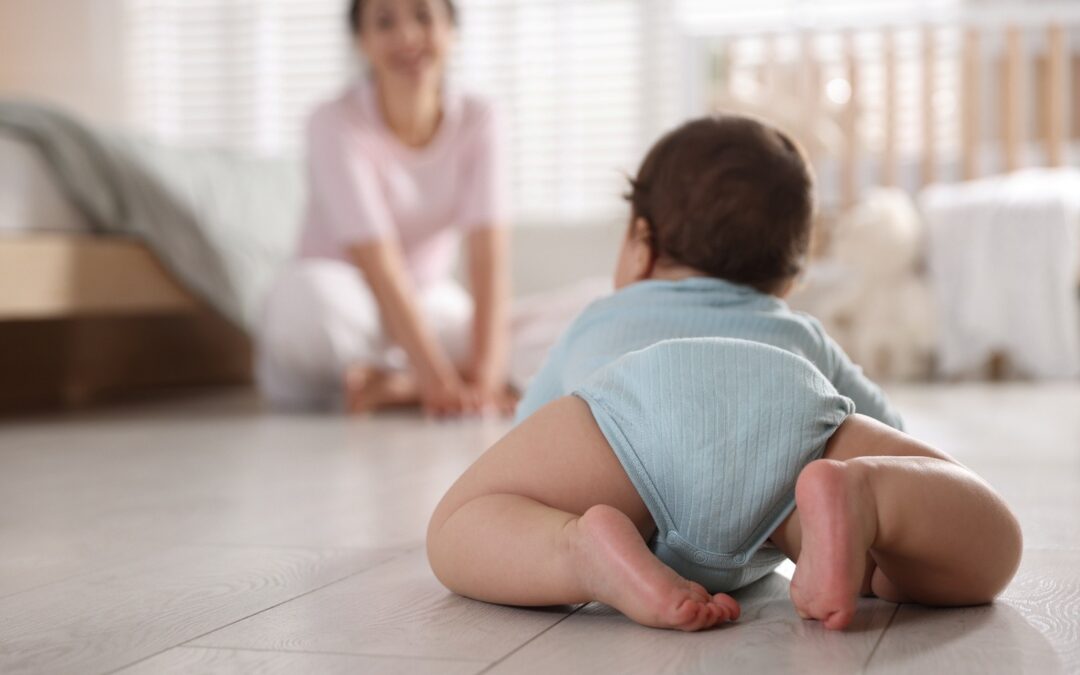
Your baby is starting to move farther across the floor, and suddenly the surface under them gets your attention. The hardwood feels awfully hard. The rug seems thin. Maybe a thick crawling mat starts looking like one more thing you need to add to the house.
In most cases, babies don’t need a special mat to learn how to crawl.
If you’re wondering when do babies start crawling, traditional crawling is commonly mastered between about 7 and 10 months. Some babies scoot, roll, belly crawl, or find another way to get around. Whatever method your baby uses, what matters most is having a safe place where they can move and explore.
What Does a Baby Really Need for Floor Play?
The setup can be pretty simple.
Your baby needs enough room to move, attentive supervision, and a clean surface that works well for your home. That could be a play mat. It could also be a rug or another comfortable floor area.
CDC guidance actually recommends placing toys either on the ground or on a play mat slightly out of reach and encouraging babies to crawl, scoot, or roll toward them. In other words, the mat itself isn’t what makes the activity valuable. The opportunity to move is.
AAP guidance also encourages supervised awake time playing on the floor, both on the tummy and back.
What If You Have Hard Floors?
Hardwood, tile, or another firm floor can make parents wonder whether more padding is necessary.
A rug or play mat may make a designated play area feel more comfortable, especially if the floor is cool or your baby seems happier on a softer surface. But you don’t need to assume that a hard floor automatically prevents a baby from crawling comfortably.
Watch how your baby responds.
If they move freely and seem content, there may be no reason to overhaul the space. If they seem more comfortable on a rug or mat, it’s easy enough to give them one.
The goal isn’t to create the softest possible surface. It’s to provide a clean, appropriate area where your baby can move without unnecessary hazards.
Does a Softer Mat Help Babies Crawl Sooner?
There isn’t a special floor surface that needs to be purchased to make crawling happen.
Floor time gives babies opportunities to reach, push, roll, shift their weight, scoot, and eventually explore whatever type of mobility works for them. AAP guidance encourages placing toys nearby during supervised tummy time so babies can reach and move toward them.
A thicker or more expensive crawling mat doesn’t need to become part of the milestone.
If your baby is happily moving on an ordinary rug or floor area, you don’t need to change it simply because a product is marketed specifically for crawling.
Keep the Play Area Simple
It can be tempting to cover a mat with every toy your baby likes. Leaving a little open space can be useful, too.
Try placing one interesting toy just beyond an easy reach. Your baby might stretch toward it, pivot, roll, scoot, or eventually crawl closer.
CDC recommends this kind of simple setup as one way parents can encourage babies to practice movement. Some attempts will be more successful than others. Your baby may head toward the toy one day and become completely fascinated by their own toes the next.
There doesn’t have to be an agenda attached to floor play.
Your Crawling Baby Probably Won’t Stay on the Mat
A play mat may look like a clearly defined play area to you. Your baby may have other ideas.
Once crawling begins, that neat rectangle on the floor quickly becomes a starting point rather than a boundary. Your baby may head toward the couch, turn toward a doorway, or investigate something several feet beyond the edge.
That’s when it becomes important to look beyond the mat itself.
AAP advises keeping small objects and choking hazards off the floor as babies become mobile and supervising them as they explore.
A safe crawling space needs to account for where your baby can actually go, not just where you intended them to stay.
Clean Floors Matter, Too
Crawling babies spend a lot of time close to the floor. Their hands touch the surface and often end up back near their mouths.
Regular cleaning can help keep the areas where your baby plays free of dirt and debris. AAP also notes that crawling and floor play can increase children’s contact with substances present on household surfaces, another reason to be thoughtful about the products used around them.
You don’t need to make the floor sterile. A reasonably clean, uncluttered area is a much more realistic goal.
Let the Space Change as Your Baby Changes
The setup that worked before your baby became mobile may not work for long afterward.
A few weeks ago, a small blanket might have provided plenty of room. Now your baby may be crossing several feet before you realize how far they’ve traveled.
That changing range is part of what makes the crawling stage so noticeable.
You can expand the play area as needed, move interesting objects around, and reassess what your baby can reach. There’s no need to perfect the entire setup before crawling begins.
Your baby will probably show you very quickly which parts need adjusting.
Making Space for Movement at Celebree School of Pasadena
At Celebree School of Pasadena, infant care includes individualized attention to developmental milestones and opportunities for babies to build physical skills at their own pace. The school describes its infant program as a nurturing environment where daily routines and development are closely supported.
During floor play, one baby may be content reaching for something nearby. Another may roll across the space, while someone else is beginning to crawl toward whatever has caught their attention.
Teachers can notice those changes throughout the day and share them with families. The important part isn’t having a particular mat or piece of crawling equipment. It’s giving babies developmentally appropriate opportunities to move within a supportive environment.
The Best Crawling Space May Be the Simplest One
If your baby is getting ready to crawl, you don’t need to create a perfect floor-play setup before they get started.
A crawling mat can be convenient, particularly if it makes part of your home more comfortable for play. But it isn’t something babies need in order to reach the milestone.
Give your baby a safe place to move, a little room to explore, and something interesting to discover along the way. Families looking for daycare in Pasadena, MD can visit Celebree School of Pasadena to learn more about infant care and the everyday opportunities babies have to move and explore. Contact our team to arrange a visit and see the infant program in person.