
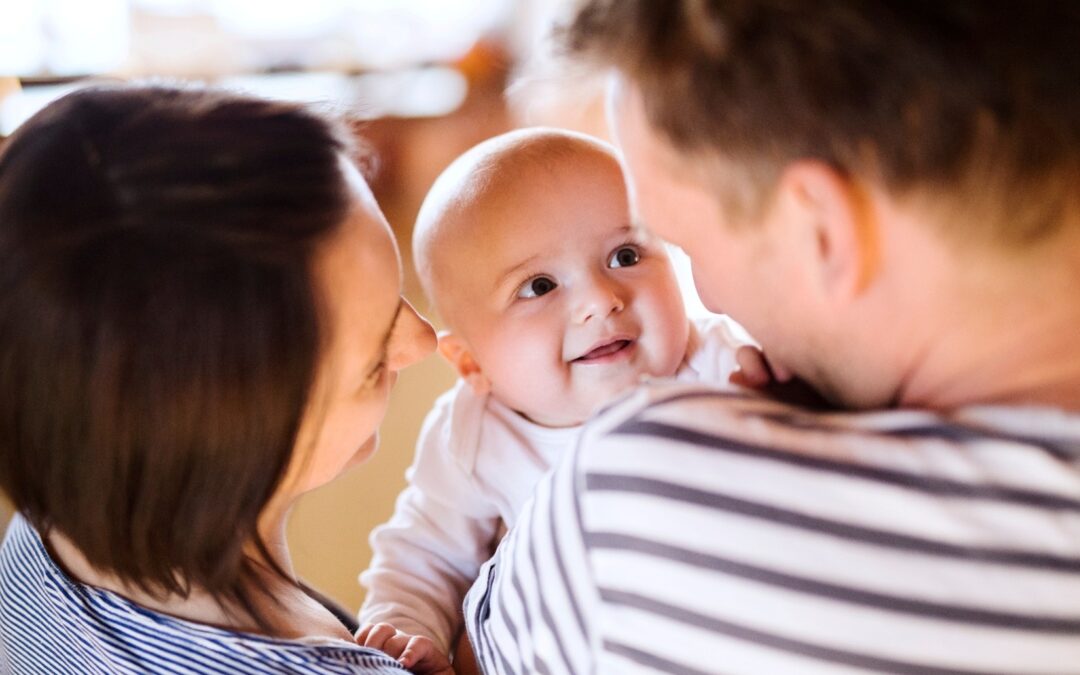
Long before babies use words, they find plenty of ways to communicate. A turn of the head, an outstretched arm, a smile, or an excited kick can all tell you something about what has their attention.
As babies gain more control over their bodies, those interactions change. Reaching becomes more purposeful. Sitting gives them a new view of the room. Mobility lets them move toward people and objects they want. At the same time, coos become babbles, responses become more intentional, and gestures begin to carry meaning.
These baby milestones develop on individual timelines, but looking at movement and communication together offers a useful picture of how much changes during the first year.
The First Months Start With Looking, Listening, and Head Control
During the newborn stage, much of communication happens through crying, facial expressions, body movements, and reactions to sounds or touch.
Around 1 month, babies may briefly focus on nearby faces, react to sounds, and lift or turn their head for short periods.
By about 2 months, many begin smiling when someone talks or smiles at them, making sounds besides crying, watching people move, and briefly holding their head up during tummy time.
Around 3 months, head control often becomes steadier. Babies may coo more, bring their hands toward their face or mouth, and begin swiping or reaching toward something nearby.
Greater control of the head and eyes also gives babies more freedom to follow a face, turn toward a voice, and stay engaged during interaction.
Reaching Gives Babies Another Way to Show Interest
The middle months bring a noticeable shift from simply watching something to trying to interact with it.
Around 4 months, many babies hold their head more steadily, bring their hands to their mouth, swing an arm toward toys, chuckle, and make sounds back when someone talks to them.
By about 5 months, reaching and grasping often become more accurate. Rolling may begin, and babies usually spend more time handling and examining safe objects.
Around 6 months, many reach for something they want, roll, recognize familiar people, laugh, take turns making sounds, and begin sitting with support or while leaning on their hands.
A reach toward a toy is a physical skill, but it also communicates interest. Reaching toward a familiar adult may carry an entirely different message. Before babies have words, their movements often do part of the talking.
When Do Babies Sit Up?
Sitting develops gradually during the middle months of infancy.
Your baby may first need plenty of support, then begin leaning forward onto their hands for balance. As trunk control improves, sitting becomes steadier, and the hands are freer for play.
By around 9 months, many babies sit without support.
That new position changes more than posture. Sitting upright gives babies a different view of the people around them and makes it easier to reach for toys, watch faces, babble during play, and respond to what is happening nearby.
Babbling Makes Interaction More Conversational
Early coos gradually give way to a wider variety of vocal sounds.
When Do Babies Babble?
Babbling commonly becomes more noticeable during the middle of the first year and grows more varied over the months that follow.
You may hear strings of sounds such as “bababa” or “mamama.” Your baby may vocalize, pause while you respond, and then make another sound.
By around 7 to 9 months, these exchanges often feel increasingly conversational even though the sounds are not yet words. Babies are practicing their voices while also learning the back-and-forth rhythm of interaction.
Movement Gives Babies More Ways to Communicate Without Words
As babies gain physical control, their actions often become easier to interpret.
Lifting both arms may mean they want to be picked up. Moving toward a favorite toy shows clear interest. Turning toward a familiar voice shows attention. Reaching toward something just out of range tells you exactly what has caught their eye.
This becomes especially noticeable during the second half of the first year, when sitting, mobility, hand control, and social interaction are all changing quickly.
When Do Babies Crawl?
Many babies become mobile during the second half of the first year, though there is a wide range of timing and style.
Some crawl on hands and knees. Others scoot, creep, roll, or find another way to move around.
Crawling is not a milestone every baby must reach on the same schedule. What mobility does offer is a new way to act on interest. A baby who once had to wait for a toy to be brought closer may now move toward it. They may also make their way toward a familiar caregiver or follow something interesting across the room.
Around 9 Months, Babies Respond in More Ways
By about 9 months, many babies are increasingly active participants in daily interactions.
You may notice your baby:
- Sits without support
- Moves objects from one hand to the other
- Looks when their name is called
- Makes repeated babbling sounds
- Lifts their arms to be picked up
- Searches for an object that falls out of sight
- Uses movement to get closer to people or things that interest them
These abilities show how movement and communication continue to overlap.
When Do Babies Respond to Their Name?
Many babies begin looking toward someone when their name is called by around 9 months.
That response may be a head turn, a quick glance, or a pause in play. It will not necessarily happen every time, especially when your baby is tired or deeply focused on something else.
Over time, the response usually becomes part of a broader pattern of recognizing familiar voices, words, and routines.
Gestures Become More Important Near the First Birthday
During the final months of the first year, babies often have greater control over both large and small movements.
Around 10 months, some begin pulling up, changing positions more easily, and using reaching or other gestures more intentionally.
By about 11 months, cruising along furniture may appear. Babies may also imitate familiar actions and use their hands with increasing precision.
Around 12 months, many babies wave goodbye, understand a familiar word such as “no,” play simple interactive games, pull to stand, move while holding furniture, pick up small objects with the thumb and finger, and use “mama,” “dada,” or another special name meaningfully.
Some babies also take independent steps before their first birthday, while others do not. Walking independently is not required at 12 months.
When Do Babies Wave or Point?
Gestures such as waving and pointing usually emerge during later infancy, but there is no single month when every baby begins using them.
Waving often becomes easier to recognize near the first birthday. Pointing may appear as babies gain better hand control and begin using gestures to direct someone else’s attention toward something interesting.
These movements are physical, but their purpose is increasingly social.
Everyday Play Brings Movement and Communication Together
Babies do not need elaborate activities to practice emerging skills. Floor time, songs, books, simple games, safe toys, and face-to-face conversation provide plenty of opportunities to move and interact.
At daycare in Pasadena, MD, tummy time, sensory experiences, responsive interaction, and everyday play give babies opportunities to move, listen, respond, and communicate as their abilities develop.
A younger baby may lift their head toward a caregiver’s voice. A few months later, that same child may sit and babble during play, reach toward a favorite toy, or move across the floor to get closer to something interesting.
Watch the Pattern, Not a Perfect Timeline
Development does not unfold in exactly the same order for every baby. One child may be highly vocal before becoming mobile. Another may be eager to crawl while gestures and words emerge more gradually.
Milestones are most useful when they help you notice growth over time rather than compare your baby with someone else’s.
Talk with your child’s pediatrician if your baby is not meeting expected milestones, loses a skill they previously had, or if something about their movement, hearing, communication, or interaction concerns you.
Throughout the first year, babies keep finding new ways to make themselves understood. A look becomes a reach. A coo becomes a babble. Movement gives them more ways to participate, and communication becomes richer as their world expands.