
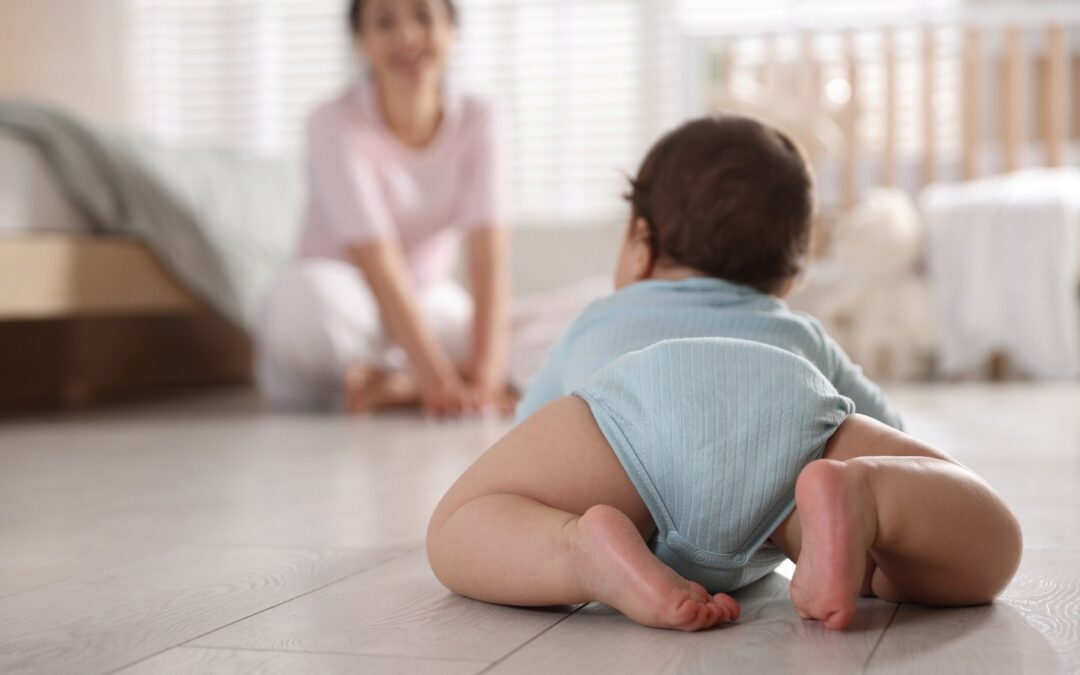
You may picture crawling as hands and knees on the floor. Your baby may have other ideas.
Some babies lift their knees, straighten their legs, and move around on their hands and feet with their bottom in the air. It can look unusual if you were expecting the classic crawl, but this movement has a name: the bear crawl.
So where does it fit into the bigger question of when do babies start crawling? Many babies begin crawling somewhere around 7 to 10 months, although the timing and the way they move can vary quite a bit.
Why Is My Baby Crawling on Hands and Feet?
A bear crawl looks similar to hands-and-knees crawling, except your baby keeps their knees off the floor. The American Academy of Pediatrics includes bear crawling among the different ways babies may get around.
Your child may use this style for a short time, switch between it and another crawl, or simply decide it works well enough to keep using.
Babies are not trying to copy a particular crawling form. They are figuring out how to move their bodies from one place to another, and sometimes the solution they find looks nothing like the one you expected.
Is Bear Crawling Still Crawling?
Yes. Hands-and-knees crawling is only one way babies become mobile.
The AAP also describes belly or commando crawling, bottom scooting, crab crawling, and other movement styles. Some babies even skip traditional crawling altogether.
That variety is useful to keep in mind when you see another child the same age moving differently from yours. One crawling style does not automatically tell you more about a child’s development than another.
Crawling itself is also not currently listed on the CDC’s 9-month milestone checklist. At that age, the CDC focuses on movement skills such as sitting without support and getting into a sitting position.
Does Bear Crawling Lead to Hands-and-Knees Crawling?
It can, but there is no required next step.
Your baby may eventually lower their knees to the floor and use a more traditional crawl. They might also alternate between styles depending on the surface or what they are trying to reach.
For some babies, mobility changes quickly. One week you may see a cautious bear crawl across the rug. Not long after, your child may be pulling up against the couch or cruising along furniture.
That does not mean you need to hurry them toward the next skill. There is plenty happening while your child experiments with the movement they already have.
Let Your Baby Work Out How to Move
A safe stretch of floor gives your baby room to practice without much interference.
Try placing something interesting nearby and see what your child does. They may crawl, roll, scoot, pivot, or change direction several times before reaching it.
You can sit on the floor with them, talk to them, and offer encouragement without trying to position their hands, knees, or feet for them.
The CDC recommends giving babies safe places to explore and placing toys slightly out of reach so they have a reason to move toward them. The point is not to teach a perfect crawl. It is to give your child opportunities to move and explore.
Your Babyproofing May Need an Update
Once your baby has an efficient way to get around, the room can suddenly feel much smaller.
Take another look at cords, stairs, outlets, low shelves, unstable furniture, and small objects within reach. A baby on hands and feet may also move faster than you expect once they get comfortable with the motion.
It helps to check the room from your child’s level. Things adults barely notice can become very interesting when they are six inches from your face.
When Is It Worth Asking Your Pediatrician?
A bear crawl by itself is not a reason to assume something is wrong.
If you notice that your child consistently uses one side of the body differently, seems unusually stiff or floppy, loses a skill they previously had, or something about their movement concerns you, mention it to your pediatrician.
You do not have to decide whether a movement is significant on your own. Your child’s healthcare provider can consider what you are seeing alongside the rest of their development.
Making Space for Movement at Daycare
Babies learn a great deal about their bodies through everyday play. Reaching for a toy, changing position, pushing up from the floor, or finding a new route across the room all give them opportunities to explore movement.
At Celebree School of Cockeysville, infant care includes developmentally appropriate opportunities for physical activity, gross and fine motor experiences, and exploration throughout the day. Teachers also communicate with families about what they observe, helping you stay connected to the changes your child is making.
That may be a new way of getting across the floor, more confidence reaching from a sitting position, or an unexpected bear crawl that suddenly becomes your child’s preferred mode of transportation.
If you are exploring daycare in Cockeysville, MD, Celebree School of Cockeysville provides infant care for families in Cockeysville, Hunt Valley, Sparks, and nearby communities, with room for babies to learn through safe, age-appropriate movement and play.