
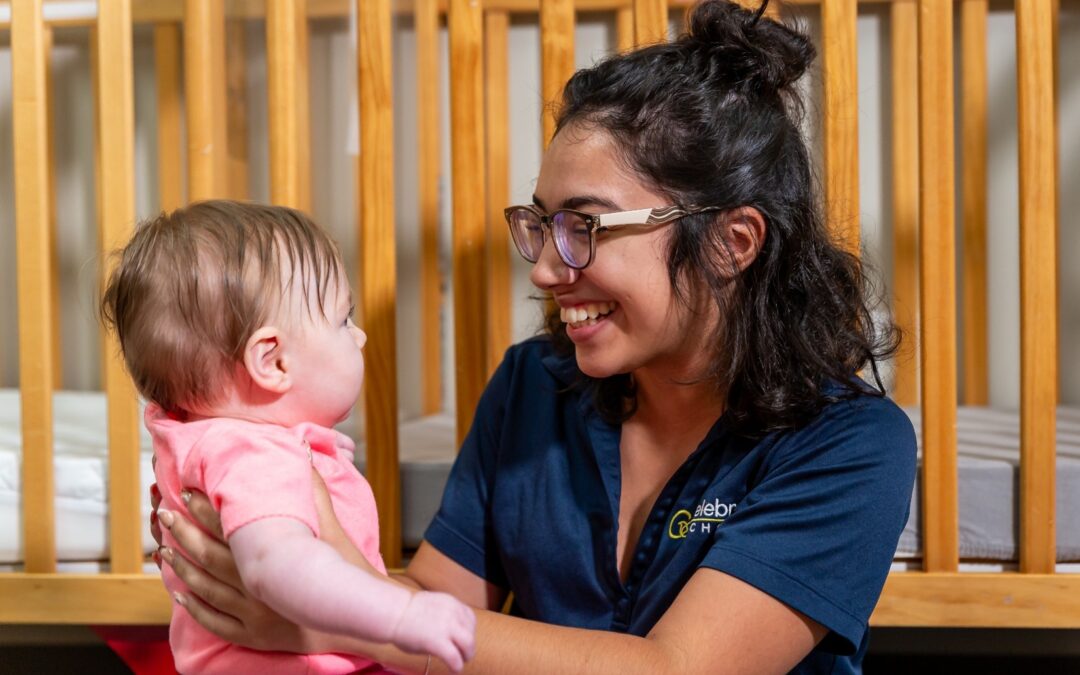
The word “curriculum” probably is not the first thing that comes to mind when you picture a baby at daycare. Infants are not practicing letters or sitting through lessons. Much of their learning happens through things that look wonderfully ordinary: hearing a familiar voice, reaching for a toy, turning the pages of a board book, moving across the floor, or watching what happens when they shake something.
That is part of what makes infant daycare different from programs for older children. Care and learning are closely connected.
At Celebree School of Carney, infant experiences are built around responsive care, developmentally appropriate learning, and the understanding that babies do not all reach new skills on the same timetable.
What Does Curriculum Mean for a Baby?
Infant curriculum begins with how babies naturally learn.
They explore with their senses. They notice faces and voices. They repeat movements. They make sounds and begin discovering that those sounds get a response. As they grow, they become increasingly interested in reaching, rolling, sitting, crawling, grasping, and investigating whatever is safely within reach.
Teachers can support that development through simple but intentional experiences, such as:
- Reading and talking with babies throughout the day
- Singing songs and introducing rhythm and sound
- Providing safe materials with different textures and shapes
- Encouraging age-appropriate movement and floor play
- Responding to gestures, sounds, facial expressions, and emerging communication
- Giving babies time to explore instead of rushing from one activity to another
For infants, these experiences are the curriculum. Learning does not have to look formal to be meaningful.
Babies Don’t All Learn the Same Things at the Same Time
Anyone who has spent time around two babies close in age knows how different their development can look.
One baby may be focused on sitting without support. Another may be trying to pull up. One might be experimenting with sounds, while another is intensely interested in picking up objects and passing them from hand to hand.
An infant classroom needs enough flexibility to recognize those differences.
Celebree uses observation and assessment to help teachers understand where children are developmentally and plan experiences from there. Assessment at this age does not mean sitting a baby down for a test. Teachers gather information through ordinary interactions, play, movement, and observation.
That gives educators a clearer picture of what a child is already doing and where they may be ready for a little more support or challenge.
Everyday Care Is Part of Early Learning
Some of the most important parts of an infant’s day are also the most routine.
A diaper change creates a few quiet minutes for eye contact, conversation, and back-and-forth interaction. During a feeding, a teacher can respond to cues, talk with a baby, and build familiarity. Even getting ready for a nap involves learning the patterns and signals that make the day feel more predictable.
The same is true during play.
A baby reaching for a toy is practicing coordination. Turning toward a teacher’s voice supports attention and communication. Moving across the floor gives infants opportunities to build physical skills while figuring out how their bodies work in space.
For infants, learning is woven into the day rather than confined to a particular activity period.
What Does an Infant Daycare Schedule Look Like?
Parents often want to know what time their baby will eat, nap, play, or participate in activities. It is a practical question, especially when home routines are already taking shape.
Infant classrooms typically have a familiar rhythm, but that does not mean every child follows an identical schedule.
A younger infant may need more frequent naps and feedings. An older baby may stay awake for longer periods and spend more time moving and exploring. Temperament matters too. Babies have their own cues and patterns, and those can change quickly as they grow.
A day in infant daycare may move between feedings, naps, diaper changes, books, music, sensory experiences, movement, teacher interaction, and quiet exploration.
That balance matters. Predictability can help the day feel familiar, while flexibility gives teachers room to respond to the child in front of them rather than the clock on the wall.
What Ages Are Considered Infants in Daycare?
There is no single age cutoff that applies to every infant program.
Celebree’s general program framework places infant care within roughly the first year of life, although exact age ranges can vary according to state licensing requirements and the individual school.
That is worth asking about directly when you are exploring infant daycare in Carney. Families should confirm the current age requirements, classroom transitions, and enrollment availability with the school.
Age also helps shape what the classroom experience looks like. A baby who has recently started attending may need very different experiences from one who is becoming mobile and curious about everything within reach.
Relationships Matter Just as Much as Activities
A thoughtfully planned activity only goes so far if a baby does not feel comfortable with the people around them.
Infants learn through relationships. Teachers begin to recognize the little details that make each child different: how they show they are tired, what helps them settle, which toys capture their attention, or how they communicate that they have had enough.
Those repeated interactions build familiarity.
Celebree’s approach to infant care places emphasis on safety, connection, and emotional development alongside early learning. That means comforting a baby, responding to a cue, or sitting on the floor and talking together is not separate from the educational experience.
It is part of it.
What Should You Notice When You Visit an Infant Classroom?
If you are touring an infant daycare, it can help to look beyond the toys and furniture.
Watch how teachers interact with the babies. Are they talking with them during routines? Do they get down on the floor and engage? Is there room for babies to move and explore safely?
You can also ask how teachers decide which experiences are appropriate for each child and how they adjust as babies gain new skills.
Another useful question is how the school communicates with families. Parents naturally want to know when their baby ate, slept, or had a particularly good day. At Celebree, Tadpoles helps families stay connected through daily information, photos, and messages.
That communication also gives parents a way to share changes happening at home. Sleep patterns shift. Feeding routines change. New skills seem to appear overnight. Keeping teachers informed helps create continuity between home and school.
Learn More About Infant Daycare at Celebree School of Carney
Babies do an extraordinary amount of learning long before that learning looks like school.
They build understanding through movement, repetition, interaction, curiosity, and responsive relationships. A strong infant program makes space for all of that while still meeting the very practical needs of feeding, rest, comfort, and daily care.
If you are exploring infant daycare at Celebree School of Carney, schedule a tour to visit the classroom, meet the educators, and ask how learning and routines would support your baby as they grow.