
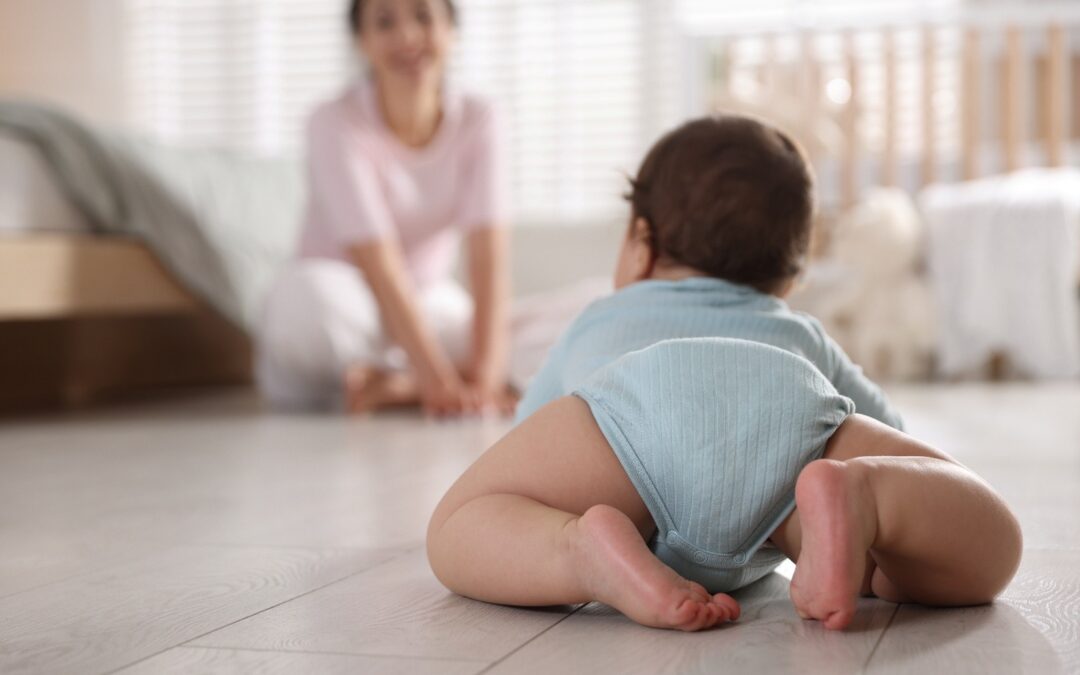
Your baby spots a toy directly in front of them and starts moving with determination. A few seconds later, they’re several feet to the left of it.
Forward clearly wasn’t part of the plan.
If you’re wondering when do babies start crawling, traditional crawling is commonly mastered around 7 to 10 months. The movement does not always look like the familiar hands-and-knees crawl, though. Some babies move backward, sideways, or use a combination of techniques as they learn to get around.
Sideways movement even has a name. The American Academy of Pediatrics includes the crab crawl among several recognized crawling styles.
What Is a Crab Crawl?
A crab crawl describes a baby who moves backward or sideways, often using their hands to help propel themselves.
It can look a little surprising when you’re expecting your baby to head straight toward something. Instead, they may travel diagonally across the play mat or repeatedly end up beside the object they wanted.
That does not mean they aren’t learning to crawl. Your baby has discovered a way to move independently. The route just happens to be less direct.
Does Sideways Crawling Still Count?
Yes. A crab-crawling baby is still figuring out how to move from one place to another.
AAP recognizes several approaches to crawling, including classic hands-and-knees movement, belly crawling, bottom scooting, bear crawling, rolling, and crab crawling.
You do not need to wait until your baby travels straight ahead on hands and knees before recognizing that mobility has begun.
The more useful thing to notice is whether your baby is increasingly able to explore the space around them.
Will My Baby Eventually Crawl Forward?
They may.
A baby who initially moves sideways can later begin traveling forward more consistently. They may also switch among several styles before settling into a movement that works well for them.
There is no standard sequence that says sideways crawling must be followed by traditional crawling within a certain amount of time.
In fact, your baby’s preferred method might change from one day to another.
Tuesday’s sideways crawl could become Wednesday’s belly crawl. By the weekend, they may have figured out how to move forward several feet before changing direction again.
That experimentation is part of discovering how movement works.
You Don’t Need to Keep Redirecting Them
If your baby keeps heading sideways, it can be tempting to turn them around or reposition their arms and legs every time.
You generally do not need to make their crawl travel in a straighter line.
Instead, give your baby a safe area where they can move freely. Put an interesting toy nearby or sit a short distance away and see how they decide to reach the destination.
CDC guidance specifically encourages placing toys slightly out of reach and giving babies opportunities to crawl, scoot, or roll toward them.
Your baby may take the scenic route. They are still getting practice moving through the space on their own.
Crawling Direction Can Change Quickly
Once babies realize they can go somewhere, they often become much more interested in experimenting with where else they can go.
A baby who mostly crab crawls may begin pivoting more easily. They may suddenly figure out forward movement or become faster at the sideways crawl they already know.
They might also start experimenting with completely different positions.
Around this broader period of development, babies can be working on sitting transitions, crawling, pulling up, and eventually standing. These abilities can overlap rather than arriving one at a time.
So, there is no need to treat crab crawling as a stage your baby has to “graduate” from before anything else can happen.
Watch How the Whole Body Is Moving
A sideways crawl by itself has a recognized place among infant movement styles. Still, it is useful to notice how your baby moves overall.
AAP advises that alternative ways of getting around are generally less concerning when babies coordinate both sides of the body and use both arms and legs similarly.
For example, you might notice that your baby travels sideways while crawling but uses both hands readily during play, kicks with both legs, and turns toward either side.
If your baby consistently seems to avoid using one side, loses a skill they previously had, or something about their movement continues to concern you, bring that observation to your pediatrician.
You do not need to determine what caused the movement before asking about it. Simply explain what you are seeing.
Make Room for a Baby Who Can Suddenly Go Places
Regardless of the direction they travel, a crawling baby changes the safety picture at home.
The object that was comfortably out of reach yesterday may no longer be safe today. A baby who moves mostly sideways can also reach areas you might not expect them to head toward.
Take another look around the floor from your baby’s perspective.
Keep small objects and choking hazards out of reach, secure areas that are not safe for exploration, and supervise floor play as your baby’s range expands.
Then give them space to find out where those new movement skills can take them.
Watching New Movement at Celebree School of Tysons-Jones Branch
At Celebree School of Tysons-Jones Branch, infant teachers provide individualized care and opportunities for age-appropriate movement and exploration. The infant program includes physical-development activities such as tummy time, reaching, and grasping, along with recognizing and documenting milestones as they emerge.
That means teachers may notice a baby who has suddenly begun traveling sideways across the play space, another who is belly-crawling toward toys, and another who is still focused on sitting or changing positions.
Those observations can be shared with families through daily communication, giving parents another window into what their baby is practicing while they’re apart.
The goal is not to straighten out an unconventional crawl or predict which skill will happen next. It is to give babies safe opportunities to move while keeping families connected to the changes taking place.
Sideways Can Still Get You Somewhere
A crab crawl may not be the route you expected your baby to take, but babies are remarkably good at finding movement strategies that get them where they want to go.
Give your baby room to experiment and see how their movement changes over time. Today’s sideways trip across the rug may look completely different a few weeks from now.
If you’re looking for daycare in McLean, VA, Celebree School of Tysons-Jones Branch offers individualized infant care with opportunities for movement, exploration, and connection throughout the day. Come see the infant classrooms and meet the team by arranging a visit with the school.