
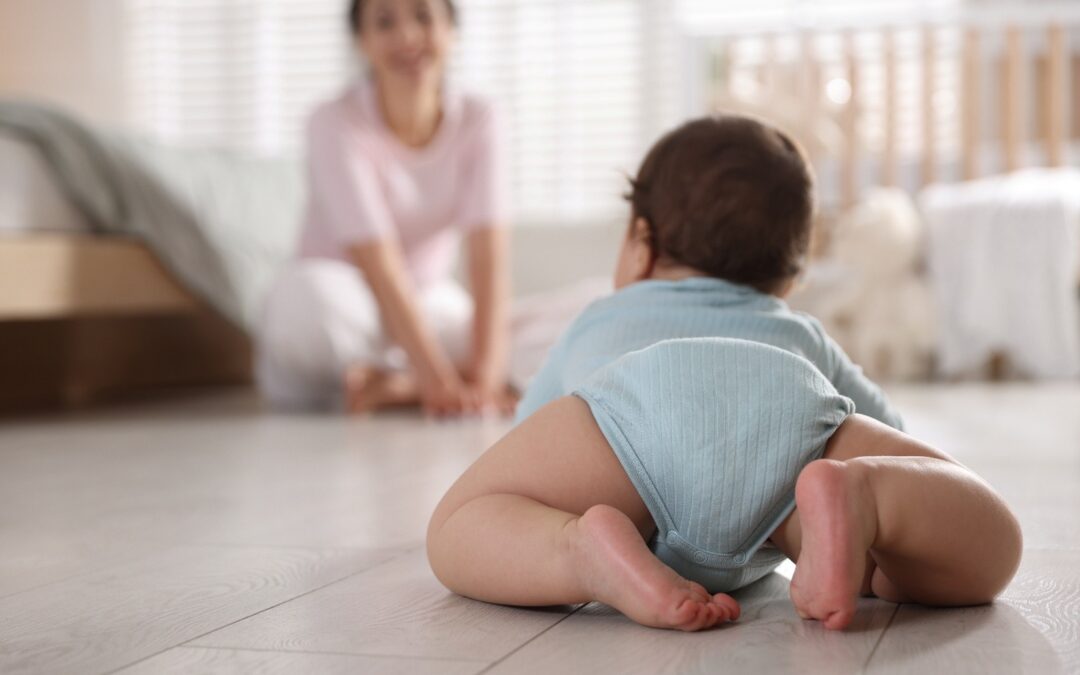
Your baby is 10 months old. You have watched for the rocking, the belly scooting, and that first determined trip across the floor, but crawling still has not happened.
At this point, it is understandable to have questions.
If you are wondering when do babies start crawling, many babies master traditional crawling between about 7 and 10 months. Reaching 10 months without crawling does not automatically mean something is wrong, though. Some babies use other ways to get around, and a few never use a traditional hands-and-knees crawl at all.
Instead of treating 10 months as a deadline, it can be more helpful to look at how your baby’s movement is developing overall.
Ten Months Isn’t a Crawling Deadline
The 7-to-10-month range gives parents a general idea of when crawling commonly appears. It is not a rule that every baby must be crawling by the end of the tenth month.
Your baby might already be moving in another way. Some babies scoot, belly-crawl, roll toward what they want, or combine several strategies.
Others seem more interested in changing positions or beginning to pull themselves upright. So, if traditional crawling has not appeared yet, take a wider look at what your baby is doing rather than focusing on one missing movement.
Start With Sitting and Position Changes
By 10 months, sitting can offer useful context.
Can your baby sit independently? Can they get themselves into sitting rather than needing to be placed there every time? Do they shift from sitting toward the floor to reach something?
Current CDC guidance includes getting into a sitting position and sitting without support among its 9-month movement milestones. Crawling itself is not on that list.
Position changes can tell you a lot about how your baby is gaining control over their body, even if they are not moving across the room yet.
Is Your Baby Finding Another Way Around?
A baby may be mobile without using a classic crawl.
Perhaps yours moves across the floor on their belly. Maybe they roll toward a toy, scoot while seated, or pivot until the object they want is within reach.
Those movements count as useful information when you are considering the bigger developmental picture.
You may also notice that your baby’s preferred method changes. A belly crawl might become faster. Scooting may give way to pulling up. A baby who seemed uninterested in going anywhere last week may suddenly start exploring much more of the room.
Mobility does not have to follow one route.
Notice How Your Baby Uses Both Sides
As you watch your baby move, pay attention to the whole body.
Does your baby generally reach with both arms? Use both legs? Shift weight in different directions? Roll or turn toward either side?
An occasional awkward movement may not mean much on its own. Babies are still figuring out how their bodies work.
A persistent difference is more useful to note. If one side consistently seems to do more of the work, one arm or leg is rarely used, or something about the movement keeps catching your attention, bring that observation to your pediatrician.
You do not need to know what it means before asking.
Give Movement Room Without Turning It Into Practice
By 10 months, parents may start feeling pressure to “work on crawling.”
You do not need a training schedule.
Give your baby safe floor space where they can reach, roll, shift positions, scoot, or try to move toward something interesting. Put a favorite toy nearby or sit a short distance away and let your baby decide how to close the gap.
Sometimes they will try. Sometimes they will find an easier solution. The opportunity to move is more important than making a baby practice one particular technique.
What Should You Bring Up With the Pediatrician?
Not crawling at 10 months by itself does not tell you that there is a developmental problem.
Still, this is a reasonable time to talk through questions about movement rather than waiting for another birthday or an arbitrary crawling deadline.
Bring up concerns such as:
- Not sitting independently
- Losing a skill your baby previously had
- Consistently favoring one side of the body
- Unusual stiffness or floppiness
- Very little movement or interest in changing positions
You should also speak up if you simply feel uneasy about something you have been noticing.
A parent does not have to prove that a concern is medically significant before mentioning it. Describe what you see. Your pediatrician can consider that information alongside your baby’s other skills and developmental history.
You Don’t Need to Wait Until 12 Months to Ask
Once a baby reaches 10 months without crawling, it can be tempting to search for the next deadline.
“Should I wait until 11 months?” “What if they’re still not crawling at a year?”
That can turn the next few months into a countdown.
If you already have a question, ask it now. Your pediatrician may tell you that what you are seeing fits within your baby’s development, or they may want to look more closely at a particular movement.
Either way, you gain more from a conversation than from waiting for the calendar to answer the question for you.
Following Movement at Celebree School of Rockville
At Celebree School of Rockville, infant teachers observe the everyday physical changes that happen as babies grow and become more active.
One 10-month-old may be crawling throughout the classroom. Another might belly-crawl toward toys, while someone else is becoming more confident moving from sitting onto the floor.
Teachers can share those observations with families through regular communication.
That may give you helpful details about what your baby does during the day: perhaps they are repositioning themselves more often, reaching farther, or finding a new way to move toward something they want.
Teachers do not diagnose developmental concerns or determine when a baby should crawl. They can, however, provide another set of observations that help families stay connected to what their child is practicing.
Look at More Than the Crawl
By 10 months, it makes sense to notice that traditional crawling has not happened yet. It just should not be the only thing you notice.
Look at sitting, position changes, how your baby uses both sides of the body, and the different ways they may already be exploring their surroundings.
And if something about movement continues to concern you, bring it to your pediatrician now rather than waiting for a particular crawling deadline.
Families exploring daycare in Rockville, MD can visit Celebree School of Rockville to learn more about individualized infant care and the opportunities babies have to move and explore throughout the day. Contact our team to arrange a visit and see the infant program in person.