
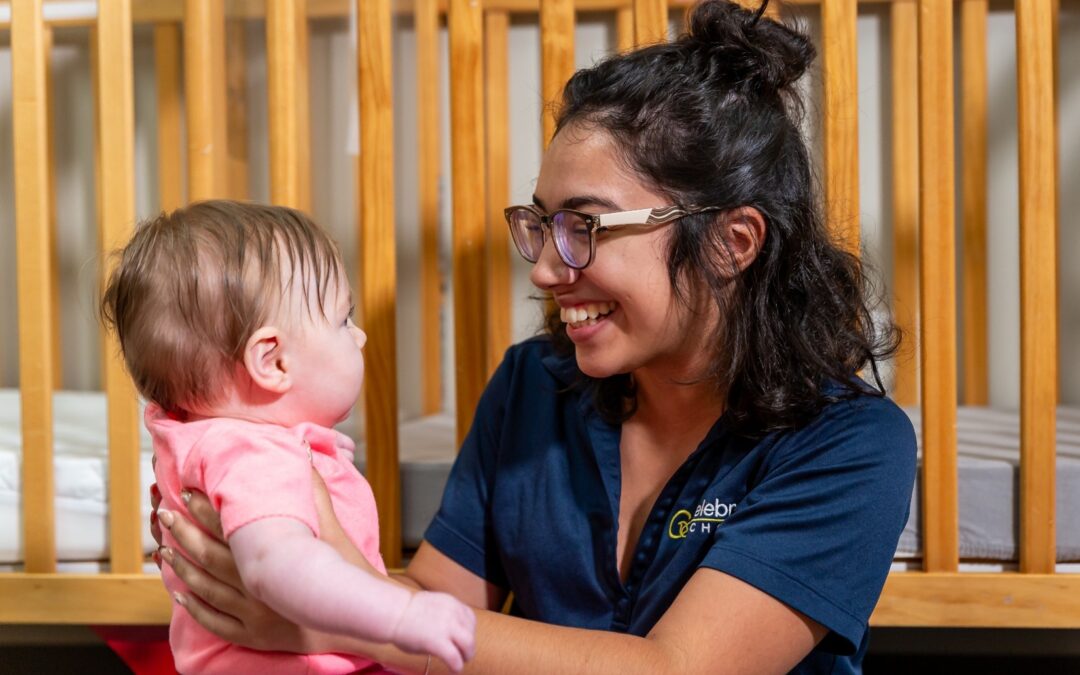
There is no single age when every baby is supposed to start daycare.
For some families, care begins when a parent returns to work. Others may start later because of family schedules, available support, or simply what makes sense at that point in their child’s life. That can leave parents wondering whether there is a “right” time to begin and what infant daycare will actually look like at different ages.
At Celebree School of Pasadena, infant care is built around the understanding that babies change quickly. A child who spends much of the day eating, sleeping, and observing the world may need a very different experience a few months later when they are moving more, communicating in new ways, and eager to explore.
What Age Is Considered an Infant in Daycare?
Infant age ranges are not exactly the same at every daycare.
Celebree generally considers infant care part of the first year of life, but exact age groupings can vary according to state licensing requirements and the individual school. Families should confirm current enrollment ages directly with Celebree School of Pasadena.
That matters because “infant” covers a wide range of development.
A younger baby may need more frequent feedings and naps, while an older infant may spend longer stretches awake and become increasingly interested in movement, toys, sounds, books, and the people around them.
The classroom should be able to respond to those differences rather than expecting every baby to move through the day in the same way.
Is There a Best Age to Start Infant Daycare?
Not really.
There is no universal age that guarantees an easier transition or a better experience. Families start daycare at different points for different reasons, and babies bring their own temperaments, routines, and needs with them.
Instead of trying to find the perfect age, it may be more useful to ask practical questions:
- Does the program serve my baby’s current age?
- How are individual feeding and sleep routines handled?
- How does the classroom change as babies become more mobile?
- How will teachers get to know my child’s cues and preferences?
- How will we communicate as those routines change?
Those questions can tell you much more about what the experience will actually be like.
What Might Daycare Look Like for a Younger Infant?
For a younger baby, much of the day may revolve around feeding, sleep, comfort, and close interaction with teachers.
That does not mean there is little happening.
Teachers can talk and sing with babies, offer opportunities for safe floor movement, introduce books and sounds, respond to facial expressions and early communication, and provide time to look at and explore their surroundings.
Simple experiences matter at this age.
Hearing a familiar voice, tracking an object with their eyes, reaching toward a toy, or spending time on the floor all give babies opportunities to practice emerging skills.
The pace may be quieter than it is for an older infant, but the day is still full of learning.
How Does Infant Daycare Change as Babies Become More Mobile?
A few months can make a remarkable difference during infancy.
As babies grow, they may begin rolling, sitting, crawling, pulling up, grasping objects more deliberately, or showing stronger interest in the people and materials around them.
That naturally changes the classroom experience.
An older infant may spend more time:
- Moving across the floor
- Exploring toys and safe materials
- Manipulating objects with their hands
- Listening to books and songs
- Interacting with teachers and other children
- Experimenting with sounds, gestures, and early communication
There is no expectation that every baby reaches these skills at exactly the same age. The important point is that the environment can evolve with what each child is ready to do.
Do Infant Daycare Schedules Change With Age?
They often do, because babies’ needs change.
A younger infant may sleep more frequently or need feedings at shorter intervals. As babies grow, they may spend longer periods awake and become more interested in active play and exploration.
An infant daycare day can include feeding, naps, diaper changes, floor play, books, music, sensory experiences, movement, and interaction with teachers.
Those pieces do not necessarily happen in the same order for every child.
A predictable rhythm can help the classroom feel familiar, but flexibility is important too. Babies are not particularly interested in following a schedule just because the clock says it is time.
Teachers and families can share information as feeding and sleep patterns shift, which helps the school understand what is currently working for the child.
How Does Infant Curriculum Change as a Baby Develops?
Infant curriculum should grow with the child rather than ask the child to fit a fixed lesson plan.
A younger infant may be building early skills through eye contact, conversation, reaching, listening, and floor movement.
Later, the focus may expand toward more active movement, cause-and-effect play, grasping and manipulating objects, early problem-solving, or increasing communication.
At Celebree, teachers use observation and developmental assessment to help guide learning experiences. Instead of assuming that every baby of a certain age should be doing the same thing, teachers look at what the individual child is already showing them.
That makes it possible to build from emerging skills in a way that feels natural rather than rushed.
How Do Teachers Know When a Baby Is Ready for Something New?
Babies give adults a lot of information when they have the time to watch.
A child who repeatedly reaches toward objects may be ready for more opportunities to grasp and explore. A baby who has become more confident sitting may be interested in a different type of play. New sounds, gestures, movement, and curiosity can all help teachers understand what a child is beginning to work on.
Celebree’s approach uses observation as part of everyday care and learning.
That means development is not treated like a checklist that every child has to complete on the same timetable. Teachers can respond to what they see and adjust experiences as babies grow.
Expect Routines to Keep Changing
One thing parents can count on during infancy is change.
A nap schedule that worked last month may suddenly look different. A baby may begin eating differently, staying awake longer, or becoming much more interested in moving around the room.
That is why communication between home and school matters.
Celebree uses Tadpoles to help families stay informed through daily information, photos, and messages. Parents can see what happened during the day, while teachers can learn about changes happening at home.
Those updates help everyone stay on the same page even when the baby seems to be rewriting the routine every few weeks.
Learn More About Infant Daycare at Celebree School of Pasadena
The best time to start daycare is not the same for every family, and infant care should not look exactly the same for every baby.
What matters more is finding a program that can respond as your child grows, from early feeding and sleep routines to increasing movement, curiosity, and communication.
If you are considering infant daycare at Celebree School of Pasadena, schedule a tour to visit the classroom, ask about current age requirements, and learn how teachers support babies through different stages of infancy.