
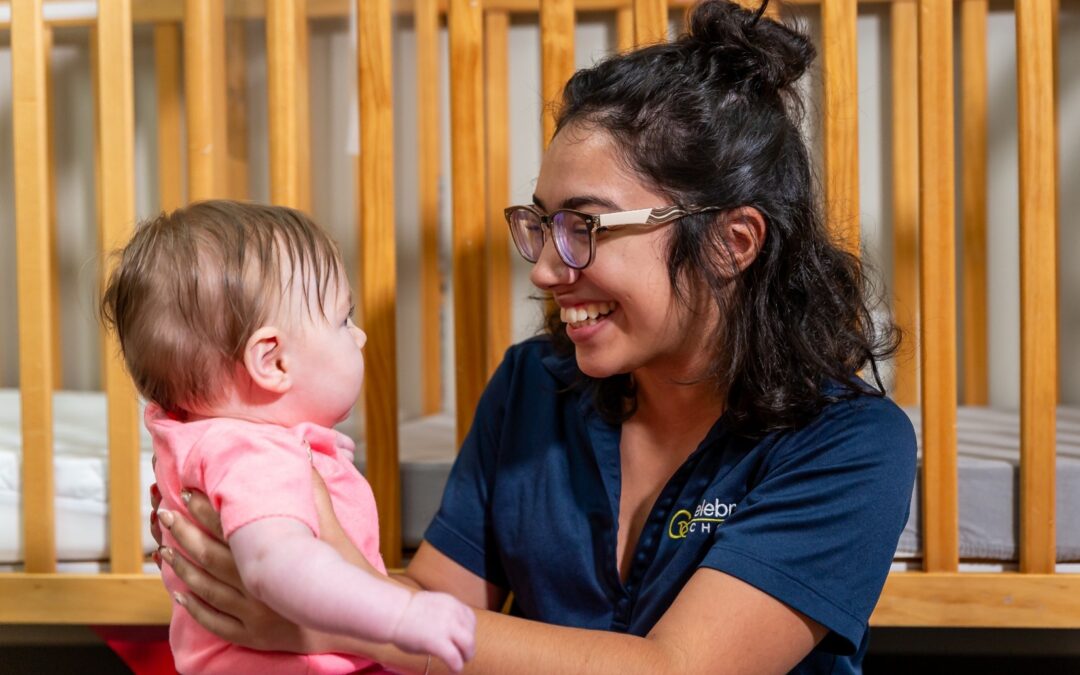
A baby who is 12 or 15 months old is still in the infant program, but their day can look quite different from the experience of a much younger baby.
Feeding, naps, diaper changes, comfort, and close care remain important. At the same time, longer alert periods and new ways of moving and communicating give children additional ways to take part in the classroom.
At Celebree School of North Potomac, infant care is divided into classrooms for babies from 6 weeks to 9 months and from 9 to 18 months.
These age ranges help the school support changing needs across infancy while still allowing each child to develop at their own pace.
Feeding and Sleep Still Shape the Day
Moving into the 9-to-18-month classroom does not mean basic care suddenly becomes less important. Feeding, naps, diapering, comfort, and settling continue to take up part of the day.
Celebree School of North Potomac uses morning check-ins to learn when babies last ate, slept, and were changed. Each infant also has a primary caregiver who becomes familiar with the child’s routines and preferences.
As awake periods stretch, there is simply more time between those care routines for interaction, movement, and play.
Longer Awake Periods Bring More Ways to Participate
With additional alert time, babies have more opportunities to engage with books, language, objects, caregivers, and the environment around them.
Some of that time may be active. A child might move around the room, handle an object, or interact with a teacher.
Other periods may be quieter, such as looking through a book or concentrating on something nearby.
The classroom can offer a wider range of experiences without expecting every infant to participate in the same way.
Movement Changes How Babies Use the Classroom
Physical development looks very different across the infant program. Earlier on, movement may involve reaching, grasping, kicking, turning, or changing position on the floor.
By the later infant months, children often have additional ways to get closer to something that interests them, handle objects, and explore their surroundings.
Celebree School of North Potomac includes gross and fine motor experiences within infant care.
Teachers can provide appropriate opportunities based on what each child is already doing without treating movement as a list of skills that must happen by a certain age.
Communication Becomes Easier to See
Babies communicate long before they can hold a conversation. During the later infant months, sounds, gestures, facial expressions, attention, and simple signs often give caregivers additional clues about what a child wants or finds interesting.
Celebree School of North Potomac includes language development and simple sign language within the infant program.
A gesture toward an object, a response to a familiar phrase, or excitement during a favorite book can all become part of everyday interaction.
Curriculum Adapts to How Children Engage
Infant curriculum does not suddenly become formal in the older classroom. Learning still happens through play, language, movement, interaction, and everyday care.
The difference is that children now have additional ways to participate. They may handle materials differently, move toward something that interests them, respond to simple language, or spend longer with a book or play experience.
Teachers use what they observe to guide developmentally appropriate opportunities rather than expecting identical responses from everyone in the room.
Individual Routines Still Matter From 9 to 18 Months
A more active classroom does not mean everyone follows one schedule. Children still have individual feeding, sleep, comfort, and care needs.
At any given point, someone may be resting while another child eats. Elsewhere in the room, an infant might be playing or spending time with a caregiver.
Celebree School of North Potomac continues to use individual care plans and regular family communication throughout the infant program.
The age range provides structure without making every child’s day look alike.
Teachers Gain More Context Over Time
Regular time together gives caregivers a better sense of the child’s usual patterns. They become familiar with preferred ways of settling, recurring interests, communication styles, and how the child typically spends alert periods.
That context can be helpful as infants become increasingly expressive and active. A teacher who already knows what is typical for a child has a stronger point of reference when something new begins showing up in the classroom.
Daily Updates Begin to Include More of the Awake Day
Celebree School of North Potomac provides evening reports that include meals, diaper changes, naps, and play. For a very young infant, feeding and sleep may make up much of what parents want to know.
Later, families may also hear about movement, interaction, play, or something that held their child’s attention.
The practical care details remain important, but parents begin getting a broader picture of how their baby spent the hours between drop-off and pickup.
What Should Parents Expect From the Older Infant Classroom?
The 9-to-18-month classroom is still infant care. Feeding, naps, diapering, comfort, and individual routines remain part of the experience.
There is also more room for children to move, communicate, interact, and explore as their abilities and interests develop.
Parents should expect those opportunities to expand without assuming every infant will reach the same skills or follow the same timeline.
Explore Infant Daycare at Celebree School of North Potomac
If you are exploring infant daycare at Celebree School of North Potomac, ask how the 6-week–9-month and 9–18-month classrooms differ in everyday practice and how teachers continue to support individual routines within each room.
Celebree School of North Potomac welcomes families from North Potomac, Potomac, Gaithersburg, Rockville, and surrounding communities who want to learn more about the infant program.