
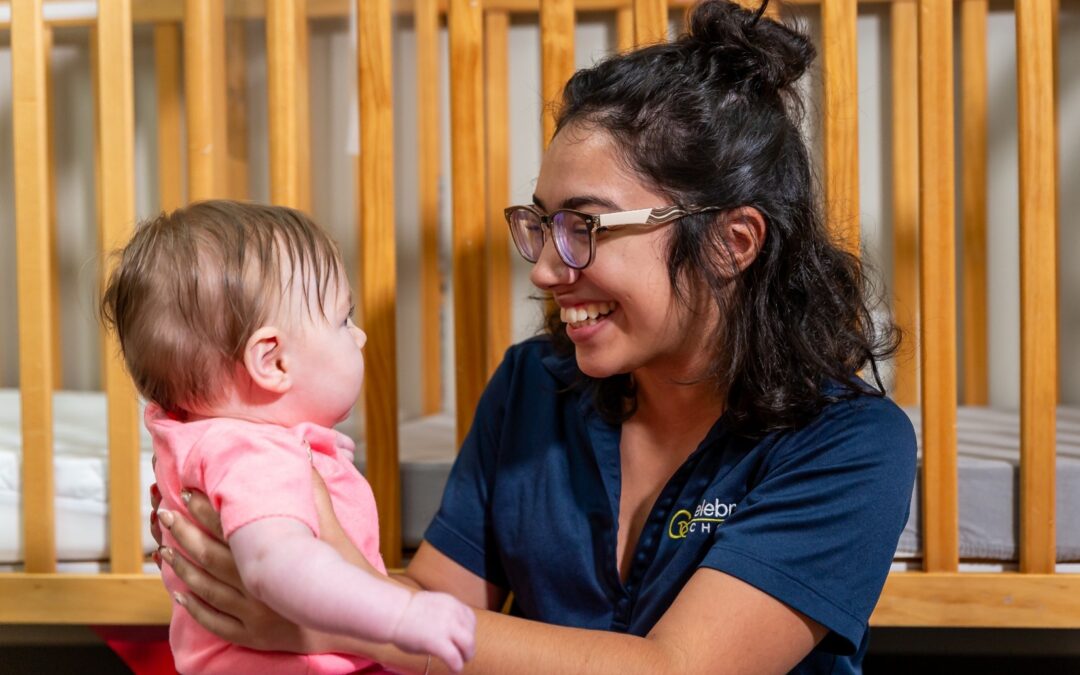
When parents think about infant daycare, activities and curriculum may come to mind. But much of the experience is also very practical.
Babies need to be fed, changed, comforted, helped to rest, and given time to move, play, and interact.
At Celebree School of Middletown, infant daycare begins at 6 weeks and continues through 18 months. Those everyday needs sit alongside opportunities for early learning throughout the infant program.
Infant Care Begins as Early as 6 Weeks
Celebree School of Middletown has infant classrooms for babies from 6 weeks to 9 months and from 9 to 18 months. That age range covers a period when feeding, sleep, movement, communication, and interests can shift considerably.
A very young baby may spend more time resting and receiving close attention. Later in infancy, longer alert periods often create more opportunities for movement, play, and exploration.
The age groups provide structure while still allowing for different schedules, needs, and abilities within each classroom.
The Morning Starts With Information From Home
What happened before drop-off matters. At morning check-in, families can share when their baby last ate, slept, and was changed. Those details help teachers understand where the child is in their morning when they arrive.
A shared infant room does not mean every child is hungry, tired, or ready to play at the same time. Feeding, rest, comfort, and awake times usually unfold differently from one baby to another.
Feeding, Diapering, Sleep, and Comfort Take Up Real Time
A significant part of infant daycare involves meeting basic needs.
At Celebree School of Middletown, babies are held during feedings and rocked to sleep. Meals, diaper changes, naps, and play are also included in the information shared with families.
These are not just tasks to get through before an activity begins. For infants, feeding, settling, changing, and comforting make up a substantial part of the time spent at school.
Everyday Routines Include Plenty of Interaction
A diaper change may include conversation. A feeding gives a teacher time to notice sounds and expressions. Settling for rest helps the teacher learn what tends to comfort the child.
These moments give teachers regular opportunities to become familiar with each baby without separating interaction from the practical parts of caregiving.
For infants, attention from a familiar adult is often woven into the routine itself.
What Happens Between Feeding, Naps, and Diaper Changes?
When children are rested and alert, there is room for movement, language, play, and exploration.
Celebree School of Middletown incorporates personal and social development, language, physical development, gross and fine motor experiences, and simple sign language into infant care.
That might mean listening to a book or song, moving on the floor, exploring an age-appropriate object, hearing familiar words, or engaging with a teacher.
Some alert periods are active. Others involve more watching and listening.
What Does Curriculum Mean for a Baby?
Infant curriculum does not resemble a formal preschool lesson. Learning is woven into play, movement, language, interaction, and familiar routines.
Teachers observe what interests children, how they respond, and how they currently participate. Those observations help inform developmentally appropriate experiences.
A shared book, a simple sign used during care, an interesting object, or time moving and exploring can all support early learning.
Children do not need to complete the same activity or reach the same skill on the same timetable.
The Mix Changes Across Infancy
Earlier in infancy, feeding, sleep, comfort, and close attention often take up more of the schedule. As alert periods lengthen, there is usually more room for play, movement, language, and exploration.
The practical needs remain. Their place within the day simply shifts as the child grows. That flexibility is important in a program serving babies across such a wide age range.
Parents Get Both the Practical Details and the Bigger Picture
Celebree School of Middletown provides evening information about meal times, diaper changes, naps, and play. Parents can see how the basic needs were handled and get a sense of what their child did while awake.
Those details make it easier to understand how feeding, rest, play, and other parts of the classroom experience unfolded between drop-off and pickup.
What Can Parents Expect From Infant Daycare?
Infant daycare includes feeding, diapering, sleep, comfort, individual schedules, movement, interaction, play, early learning, and regular communication with families.
The hands-on care is not separate from the rest of the program. It is a large part of what infant daycare actually involves.
Around those routines, babies also have opportunities to engage with people, language, movement, and the classroom in ways that make sense for their age and current abilities.
Explore Infant Daycare at Celebree School of Middletown
Learn more about infant daycare at Celebree School of Middletown and visit the classroom to see how feeding, rest, diapering, play, and early learning come together during the infant day.