
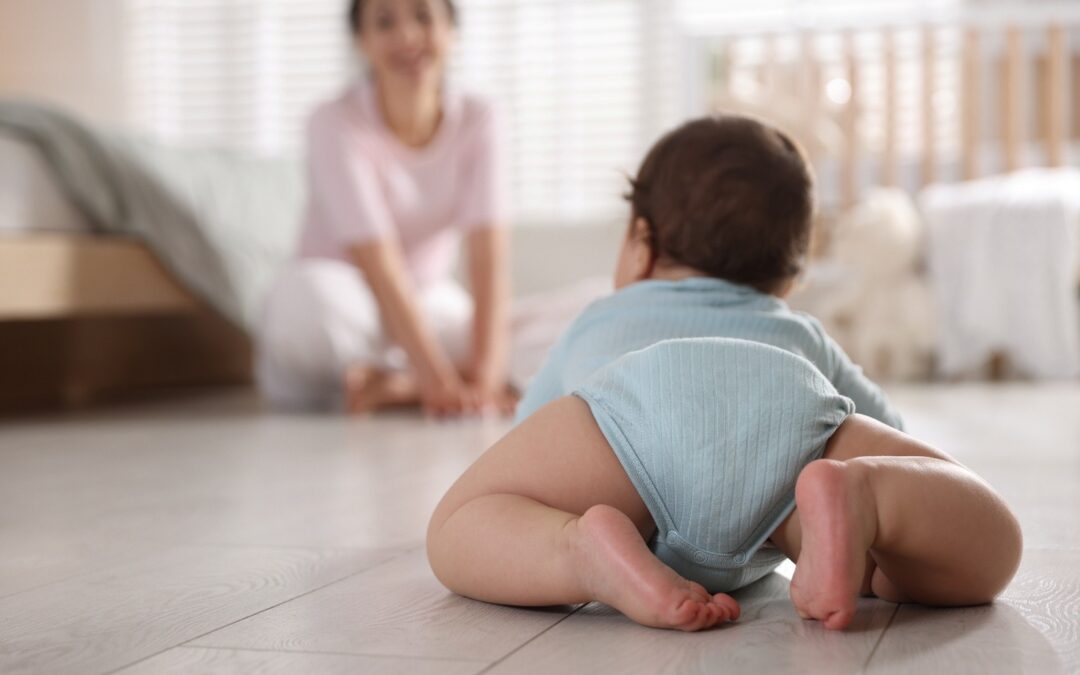
Your baby sees a toy on the other side of the rug. Instead of getting onto their hands and knees, they roll once. Then again. A few more rolls later, they have reached exactly what they wanted.
It may not look like the crawling you expected, but your baby has certainly figured out how to travel. If you are wondering when do babies start crawling, many babies begin traditional crawling around 7 to 10 months.
Babies can also discover other ways to move independently, and the American Academy of Pediatrics specifically recognizes rolling from place to place as one crawling style.
Rolling Over and Rolling to Get Somewhere Are Different
Rolling is one of the movement skills babies begin practicing earlier in infancy.
At first, a roll may simply take your baby from their back to their belly or the other way around. Later, you may notice something more deliberate happening.
Your baby looks toward a toy, turns their body, rolls closer, pauses, and rolls again. Now the movement has a destination.
That change from occasionally rolling over to intentionally rolling across the floor can be easy to miss until you realize your baby is suddenly reaching places that used to be well beyond their range.
Does Rolling Count as Crawling?
AAP includes a “rolling crawl” among several recognized crawling styles. Babies who use this method reach their destination by rolling from one place to another.
So, if your baby is deliberately using rolling as transportation, they have found a way to become independently mobile.
That does not mean every roll should be labeled crawling. A baby rolling over during ordinary play is simply practicing a movement skill.
The difference is the purpose behind it. A baby who repeatedly rolls across the room to reach something is using that movement to get somewhere.
Why Does My Baby Keep Rolling Instead of Crawling?
Sometimes the simplest explanation is that rolling works. Your baby already knows how to do it, and it gets them closer to the person or object that caught their attention.
There is no need to assume one particular physical reason is behind the choice. Babies experiment with different movements, and a strategy that works well may become the one they use most often for a while.
Another baby the same age might prefer belly crawling. Someone else may scoot while seated or move directly onto hands and knees.
Your baby’s solution may simply look different.
Will Rolling Eventually Turn Into Crawling?
It might, but there is no required sequence.
A baby who rolls to get around may eventually begin belly crawling or moving on hands and knees. They might also use several styles during the same period.
Rolling does not have to be viewed as a temporary habit that needs correcting before your baby can move on to another skill.
Watch what happens as your baby’s movement options expand. Maybe they begin changing positions more easily. Perhaps they start sitting up independently after reaching their destination or experimenting with pulling themselves higher during floor play.
The next change may not be the one you predicted.
Give Your Baby Room to Choose the Route
If rolling gets your baby to the toy, you do not need to place them back at the starting point and encourage them to crawl there instead.
Safe floor play gives babies room to decide how they want to move.
Place an interesting object nearby and see what happens. Your baby may reach, roll, scoot, pivot, or try something completely new.
Current CDC guidance actually recommends putting toys slightly out of reach and encouraging babies to crawl, scoot, or roll toward them.
The point is to create opportunities for movement, not require one particular route across the floor.
Notice How Mobility Is Expanding
Once parents begin waiting for crawling, it can become easy to overlook other progress. Instead, notice what your baby can do now that they could not do a few weeks ago.
Maybe they are covering more distance with their rolls. Perhaps they can change direction instead of simply continuing in a straight line. They may be transitioning into sitting more easily or becoming much more deliberate about reaching a particular object.
Those changes tell you that your baby’s relationship with the space around them is changing, even if traditional crawling has not appeared.
When Is It Worth Asking the Pediatrician?
Rolling as a way to travel is a recognized mobility style, so it should not automatically be treated as a warning sign. At the same time, parents should bring broader movement concerns to their child’s pediatrician.
Talk with the doctor if your baby loses a skill they previously had, consistently seems to avoid using one side of the body, has very limited movement overall, or something about their development continues to concern you.
CDC also advises parents to speak with their child’s doctor whenever they have concerns about development rather than waiting for a specific milestone deadline.
You do not need to figure out what a movement means medically before asking about it. Describe what you see and let your pediatrician consider it within the larger developmental picture.
Watching Mobility at Celebree School of Middletown
At Celebree School of Middletown, infant care includes opportunities for physical development and exploration within a nurturing daily routine. The school’s current day care program emphasizes sensory-rich activities, individualized support, and development that follows each child’s pace.
That means movement may look very different from one infant to another.
A teacher may notice that a baby who once rolled only during play now uses several rolls to reach something across the floor. Another child may be belly crawling, while someone else is beginning to move on hands and knees.
Sharing those everyday observations helps families stay connected to what their baby is practicing during the day without placing pressure on a particular crawling style or timeline.
Let Mobility Look Like Your Baby’s Mobility
A baby does not have to cross the floor on hands and knees for you to recognize that something important has changed.
If rolling has become your baby’s preferred transportation, give them safe room to use it and notice how their movement develops from there.
Families exploring daycare in Middletown, DE can visit Celebree School of Middletown to learn more about infant care and the everyday opportunities babies have to move and explore. Contact the school to find a convenient time to visit and see the infant program firsthand.