
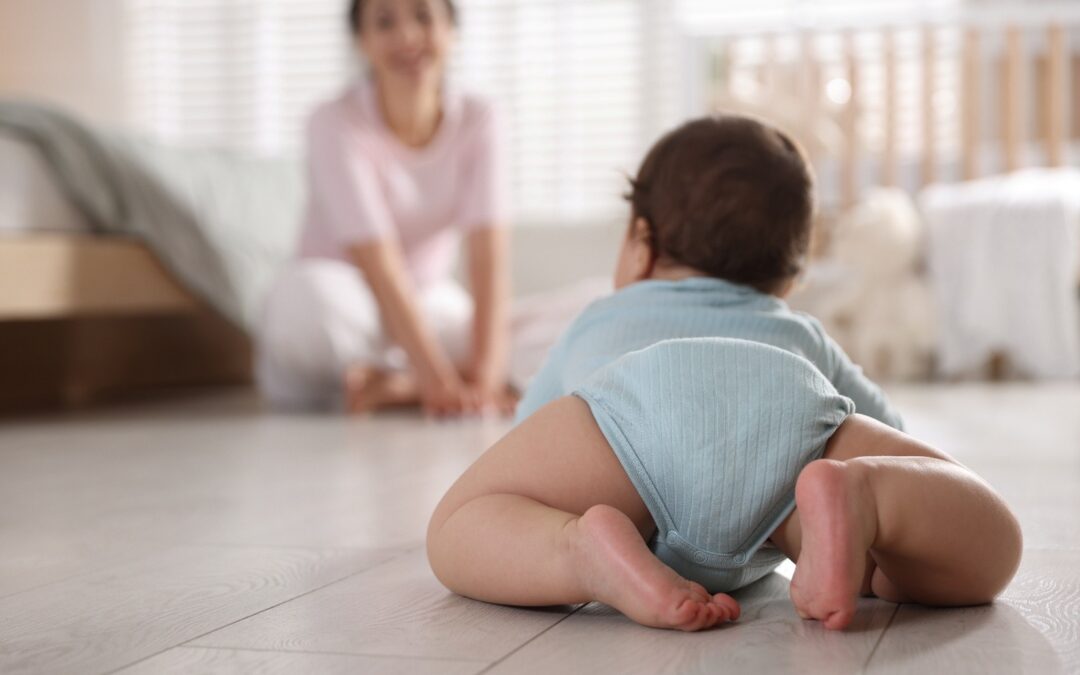
Your baby sees something interesting a few feet away and starts working to get there. Maybe they push forward on their belly, scoot, shift onto their hands and knees, or try several movements before making any real progress.
If you are wondering when do babies start crawling, many babies begin traditional hands-and-knees crawling around 7 to 10 months. Some become mobile earlier or later, and the first movement they manage on their own may not look like the classic crawl you expected.
The bigger change is that your baby is beginning to figure out how to get somewhere without being carried or repositioned.
What Does Crawling on Their Own Actually Mean?
Parents often think of independent crawling as a baby smoothly crossing the room on hands and knees.
Early mobility can be much less polished.
Your baby may move only a few inches at first. They may get somewhere after several tries, pause frequently, or use a combination of rolling, scooting, and pushing.
What matters is that the movement is coming from your baby.
They are beginning to initiate the action, adjust their body, and find a way to move toward something that interests them.
The First Independent Movement May Be Small
The first time your baby gets somewhere on their own may be easy to miss.
Maybe the toy that was just out of reach is suddenly in their hands. Perhaps they shift forward enough to close a small gap or turn and scoot toward you.
Those short distances can gradually become longer as your baby gains control.
You do not need to wait until they can cross the room before recognizing that mobility is taking shape.
Crawling Doesn’t Have to Look Traditional
Hands-and-knees crawling is only one way babies travel.
Some move on their bellies. Others scoot while sitting, roll deliberately toward an object, or use several different movements depending on the situation.
A baby may also change methods over time.
So, if your child can get themselves from one place to another, that movement is worth noticing even if it does not match the picture you had in mind when you imagined “crawling.”
Do Babies Need Help Learning to Crawl?
Parents can support movement without physically teaching the crawling pattern.
Safe floor time gives babies room to reach, roll, scoot, turn, and try moving toward something on their own. A favorite toy placed nearby may provide a reason to make the effort.
There is no need to repeatedly move your baby’s arms and legs for them or rush the process. Stay nearby, keep the space safe, and give them time to experiment.
Sometimes the most useful thing you can do is leave enough room for your baby to figure out what works.
One Day May Look Different From the Next
A baby who crosses the play mat today may spend much of tomorrow sitting in one spot. That does not necessarily mean the new skill disappeared.
Emerging abilities can be inconsistent at first. Your baby may repeat a movement when they are motivated by a particular toy or person, then choose something else during the next play session.
Look at what is changing over days and weeks rather than expecting every new ability to become reliable immediately.
Crawling Is Not a Required 9-Month Milestone
Parents sometimes worry when their baby reaches 9 months without crawling independently.
The CDC’s current 9-month milestone checklist includes movement skills such as getting into a sitting position and sitting without support. Crawling itself is not included on that list.
That does not make crawling unimportant. It simply reflects the amount of variation in how and when babies become mobile.
If your baby’s movement concerns you, share what you are seeing with their pediatrician. A loss of a skill they had previously developed or a persistent difference in how they use the two sides of their body is also worth discussing.
Noticing New Skills at Celebree School of Herndon-West Reston
At Celebree School of Herndon-West Reston, infant teachers observe changes in physical development throughout the day while providing babies with safe opportunities to move and explore.
A teacher may notice that your baby reached a toy independently, crossed part of the play space in a new way, or began initiating movement more often.
Those everyday observations can be shared with families so parents and teachers can follow development together. Sometimes a new skill first appears at home. Other times, a teacher may notice a small change during the school day.
Ongoing communication helps connect those pieces without turning development into a race toward the next milestone.
Give Independent Movement Time to Grow
The first stages of crawling may be brief, inconsistent, or difficult to recognize.
Your baby does not need to move far or use one particular technique for that growing independence to matter. Give them safe opportunities to explore, watch how their movement changes over time, and let the skill take shape at its own pace.
If you are looking for daycare in Herndon – West Reston, VA, Celebree School of Herndon-West Reston offers individualized infant care with plenty of opportunities for movement and exploration. Contact us to arrange a tour and see our infant program in person.