
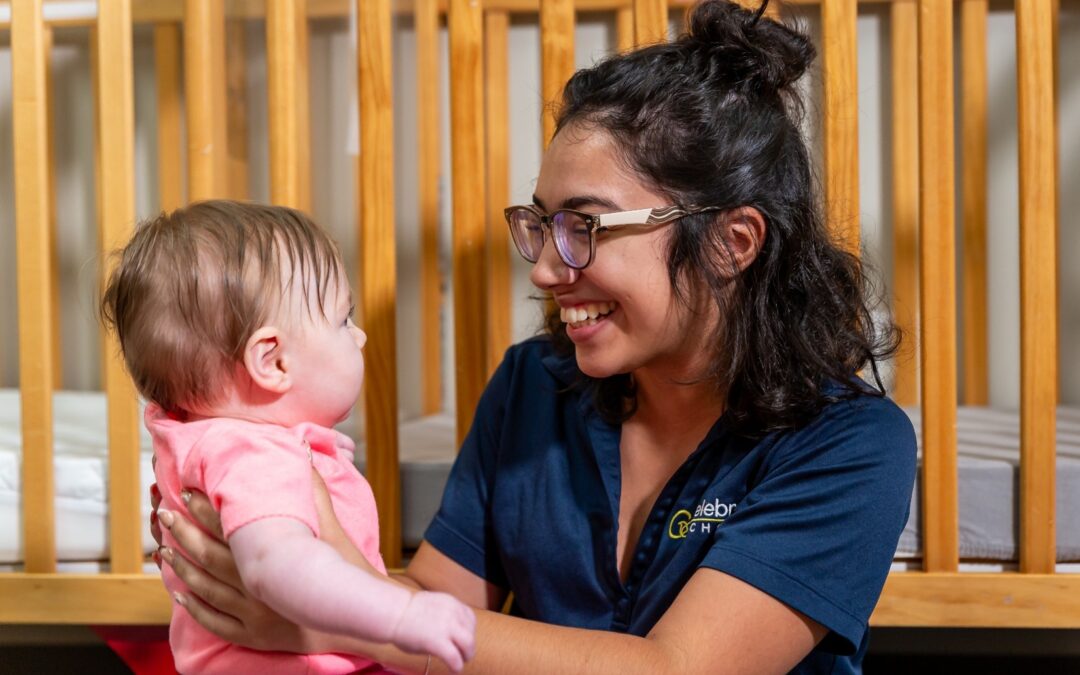
Babies are learning long before they can follow directions in a classroom.
They listen to voices, watch faces, reach for objects, repeat movements, and begin to recognize what feels familiar. At the same time, they still need plenty of feeding, sleep, diapering, comfort, and close care.
At Celebree School of Herndon-West Reston, infant daycare begins at 6 weeks and continues through 18 months. Early learning is part of the experience, but it happens alongside the everyday needs of being a baby.
Infant Daycare Begins as Early as 6 Weeks
Celebree School of Herndon-West Reston has infant classrooms for babies from 6 weeks to 9 months and from 9 to 18 months.
A very young baby and a child nearing the end of the infant program will often use the classroom in different ways.
Feeding and sleep needs change. Awake time gets longer. Babies gain new ways to move, communicate, play, and show what interests them.
The age groups provide helpful structure while leaving room for each child’s own routine and pace.
Feeding, Sleep, and Comfort Come First When They Are Needed
A hungry or tired baby needs care before anything else.
Celebree School of Herndon-West Reston builds infant care around individual feeding, sleep, and play routines. Bottles, naps, diaper changes, settling, and comfort are all regular parts of the day.
Every minute does not need to be filled with an activity. Sometimes what a baby needs most is a feeding, a nap, or a little extra comfort from a familiar teacher.
The Morning Starts With What Happened at Home
Families can share when their baby last ate, slept, and was changed before arriving. Those details help teachers understand how the morning has already gone and what the child may need next.
A baby who recently ate might be ready for some awake time. Another may arrive tired and need rest first.
That information helps the school day pick up from where the morning at home left off instead of starting everyone on the same schedule.
What Do Babies Do While They Are Awake?
Awake time gives babies opportunities to move, listen, look around, play, and spend time with teachers.
At Celebree School of Herndon-West Reston, that can include floor play, tummy time, music, simple signs, stories, and age-appropriate toys to explore.
A baby might reach for an object, listen to a familiar song, watch what is happening nearby, or respond to words and gestures from a teacher.
Some stretches are active. Others are quieter, with more time spent watching and listening. Both have a place in an infant’s day.
What Does Infant Curriculum Actually Look Like?
Infant curriculum looks much simpler than a preschool lesson.
A book, song, simple sign, interesting toy, conversation, or chance to practice a movement can all be part of early learning.
Teachers pay attention to what children are noticing and enjoying. If a baby repeatedly reaches for a certain kind of toy, responds to a song, or becomes interested in a new movement, there may be opportunities to return to that experience.
Repeating something familiar is valuable too. Babies often benefit from hearing the same words, revisiting a favorite toy, or practicing a movement again and again.
Learning at this age can look very ordinary because it is woven into play, care, and interaction throughout the day.
Learning Changes as Babies Grow
Earlier in infancy, much of a baby’s learning may come through watching, listening, reaching, and close interaction. As awake time gets longer and movement expands, there are more ways to explore toys, communicate preferences, make choices, and take part in play.
The experiences teachers offer can change along with those growing abilities. What matters is that the opportunities make sense for the child who is in the classroom now, whether they are quietly watching or actively moving from one interest to the next.
Familiar Teachers Learn What Interests Your Baby
Regular time with familiar teachers helps them learn more than a baby’s feeding and sleep routine.
They begin to notice what catches the child’s attention, which songs or toys they return to, what helps them settle, and how they communicate what they want or need.
That familiarity gives teachers useful information when choosing books, toys, movement, or other experiences to offer during awake time.
It also keeps early learning connected to the individual child rather than treating every infant in the room exactly alike.
Families Still Need the Everyday Details
Parents want to know more than what their baby played with or learned.
Celebree School of Herndon-West Reston provides information about meals, naps, diaper changes, and playtime at the end of the day.
Those details help families understand how feeding and sleep went, when their baby was changed, and what they enjoyed while awake.
The practical parts of infant care remain just as important as books, songs, movement, and play.
What Can Parents Expect From Infant Daycare?
Infant daycare includes feeding, sleep, diapering, comfort, individual routines, awake time, movement, play, early learning, familiar teachers, and regular communication with families.
For babies, learning does not need to look formal to be meaningful.
At Celebree School of Herndon-West Reston, children have opportunities to listen, move, explore, interact, and practice growing skills while teachers continue meeting the everyday needs that shape their time at school.
Explore Infant Daycare at Celebree School of Herndon-West Reston
Learn more about infant daycare at Celebree School of Herndon-West Reston and visit the infant classroom to see how everyday care, play, and early learning come together.