
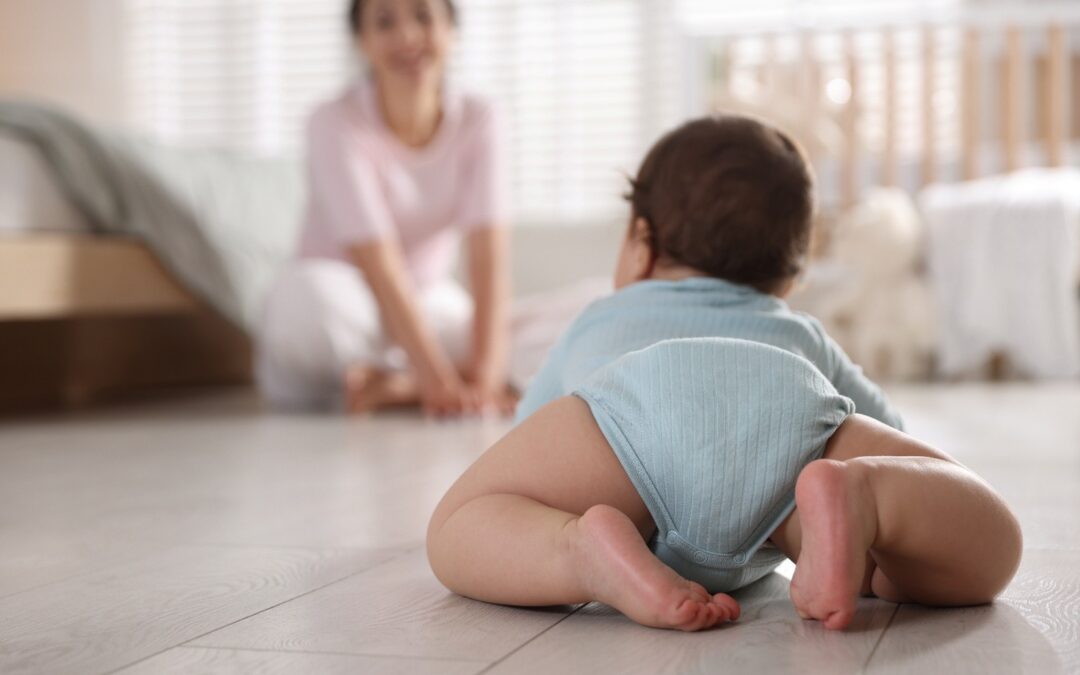
Your baby spots a toy across the floor, pushes hard to reach it, and somehow ends up farther away. Backward crawling can be a surprising part of learning to move, especially when your child seems very determined to head in the opposite direction.
If you are wondering, “when do babies start crawling,” many babies master crawling between about 7 and 10 months. What happens before and during that stage can look quite different from one child to another. Some babies rock on their hands and knees, scoot, belly crawl, or briefly move backward before figuring out how to go forward.
Why Is My Baby Crawling Backward?
Moving backward can happen while your baby is still working out how to coordinate their arms and legs.
The American Academy of Pediatrics explains that babies may initially push themselves backward because their arm muscles are stronger than their legs. With time and practice, many figure out how to propel themselves forward toward whatever has caught their attention.
From your baby’s point of view, though, backward movement is still movement. They are learning how shifting their weight, pushing against the floor, and changing body position affects where they go.
That can lead to some mildly frustrating moments when the toy they want keeps getting farther away.
Does Crawling Backward Mean Forward Crawling Is Next?
It might be part of the process, but there is no reliable countdown from backward crawling to forward crawling.
Your child may spend some time moving backward before changing direction. Another baby may belly crawl, scoot, roll toward what they want, or move between several methods.
Crawling is also not currently included on the CDC’s 9-month milestone checklist. At 9 months, movement milestones include sitting without support and getting into a sitting position.
That is helpful context when you are tempted to compare your child with another baby who appears to have crawling completely figured out. Babies can approach mobility in noticeably different ways.
How Does Your Baby Figure Out Forward Movement?
Mostly through practice.
Floor time gives your child opportunities to reach, push, shift their weight, and discover what happens when they move an arm or leg differently. You may see plenty of trial and error before those movements start working together.
If your baby is interested in a particular toy, you can place it nearby and give them a chance to work toward it. Stay close, talk to them, and let them experiment instead of constantly repositioning their body for them.
There is no need to turn crawling into a lesson. Your child is already doing plenty of problem-solving while they work out how to get from here to there.
Make Sure Their New Route Is a Safe One
Even backward movement can suddenly take your baby somewhere you were not expecting.
Once your child starts covering more of the floor, look at the room from their level. Secure stairs, cords, unstable furniture, outlets, and small objects that could become choking hazards. Something that seemed safely out of reach a few days ago may now be part of your baby’s exploration zone.
And once forward crawling clicks, that zone can expand quickly.
When Should You Mention Movement to Your Pediatrician?
An occasional unusual-looking crawl does not tell you by itself that something is wrong.
The AAP advises paying attention to whether your baby is coordinating both sides of the body and using both arms and legs. The CDC also encourages families to speak with their child’s healthcare provider if a child loses a skill they previously had or if something about their development concerns you.
You do not need to diagnose what you are seeing at home. If a movement pattern keeps catching your attention, bringing it up with your pediatrician gives you a chance to discuss it in the context of your child’s overall development.
New Skills Can Show Up Anywhere, Including Daycare
Your baby does not save new discoveries for when everyone is watching at home. A new way of moving may first appear while they are playing on the floor, reaching for something interesting, or exploring during the day.
At Celebree School of Fallston, the infant program includes attention to physical development along with gross and fine motor activities. Teachers also communicate with families through morning and evening check-ins, helping you stay connected to what your child experienced during the day.
That everyday communication can be especially meaningful during the first year, when your baby may seem to pick up a new skill overnight. Teachers can share what they notice during play while giving your child safe, developmentally appropriate opportunities to move and explore.
If you are searching for daycare in Fallston, MD, you can learn more about Celebree School of Fallston and how our infant teachers support your child’s early experiences as they become increasingly curious about the world around them.