
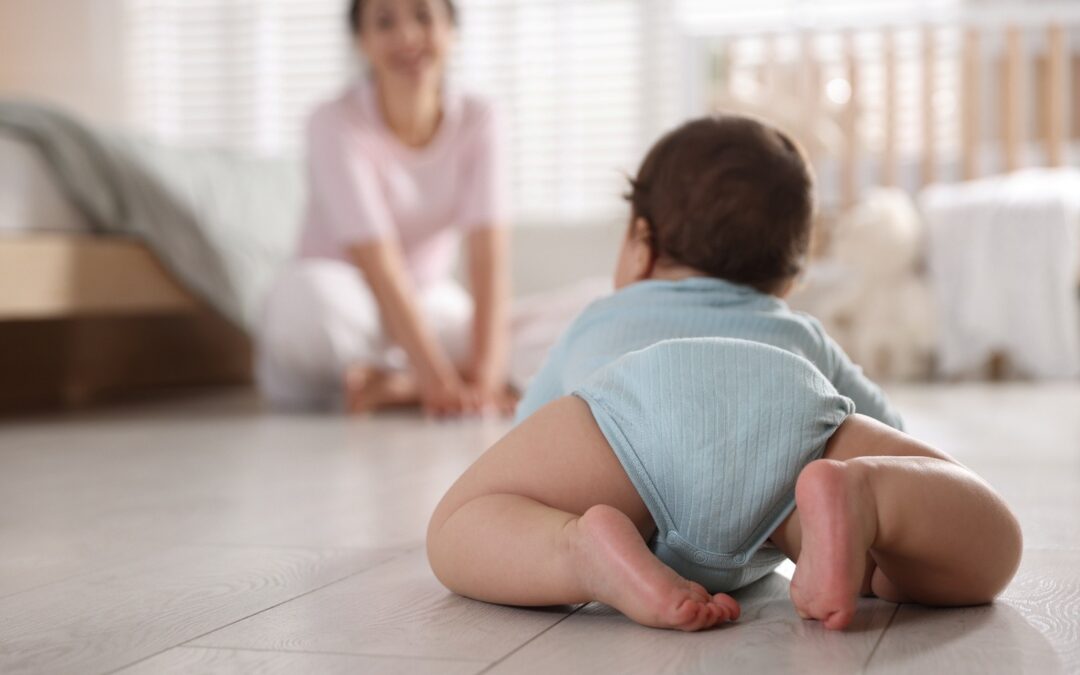
Crawling often looks simple from the outside. A baby gets on hands and knees, moves forward, and suddenly the whole house feels different.
In reality, there can be quite a bit of experimenting before that happens. If you are wondering when do babies start crawling, many begin around 7 to 10 months. The path there, though, does not usually follow one neat sequence.
Are There Really Stages of Crawling?
There are common movements babies may try as they become more mobile, but they are better thought of as possibilities than required stages.
One baby may spend weeks rocking on hands and knees. Another may skip that entirely and start belly crawling. A third may scoot or roll before ever attempting a traditional crawl.
Development can be much less orderly than the charts make it look.
Movement Starts Before Crawling Does
Long before a baby crosses the floor, they are learning how movement works.
During floor play, you may notice your baby pushing up through their arms, turning toward something interesting, reaching farther, or shifting their body to one side.
These smaller movements help babies explore what happens when they change position or put their weight somewhere new.
Reaching Can Turn Into Weight Shifting
A favorite toy can make things interesting very quickly.
Your baby may lean farther than usual, place one hand down for balance, twist at the waist, or stretch until the rest of their body has to join in.
Sometimes that effort turns into a pivot or scoot. Other times, your baby simply sits back up and tries again later.
There does not have to be an obvious next step.
Rocking on Hands and Knees May Come Next, or Not
Some babies get onto all fours and rock forward and backward before crawling.
It can look like forward movement is about to happen any second, but a baby may stay in this phase for a while. Another child may never spend much time rocking at all.
Getting onto hands and knees can be one part of the process, but it is not a checkpoint every baby has to pass.
Sometimes Babies Go Backward First
A baby trying very hard to reach something may accidentally move farther away from it.
Backward movement can happen while babies are still figuring out how to coordinate their arms, legs, and weight shifts.
It may be surprising, and sometimes frustrating for the baby, but it can still be part of learning how their body moves across the floor.
Forward crawling may come later, or your baby may discover a completely different way to travel.
The First Crawl May Not Be Hands and Knees
Traditional crawling is only one possibility.
Some babies move along their bellies. Others scoot, roll, or combine several styles depending on where they are trying to go.
Your baby may switch methods over time or stick with one that works well for them. There is no need to guide every movement toward a textbook crawl simply because that is what you expected to see.
Do These Movements Have to Happen in Order?
No. A baby does not need to complete a list of pre-crawling stages before moving forward. Some movements may overlap. Others may never appear at all.
Instead of asking, “Which stage are we in?” it can be more helpful to ask, “What is my baby figuring out now?” That might be stronger pushing, steadier sitting, a new way to turn, or an unexpected trip across the floor.
Watch Progress Without Keeping Score
Crawling timelines can be helpful, but they should not turn everyday play into a checklist.
Notice how your baby is changing over time. If they lose a skill they previously had, consistently favor one side of the body, seem unusually stiff or floppy, or something about their movement concerns you, talk with your pediatrician.
You do not need to wait for a particular “stage” before asking a question.
Small Experiments Add Up at Day Care
Babies rarely move from one stage to another in a way that is easy to label. Progress may show up as a longer reach, a new way to shift position, or a sudden attempt to get closer to something interesting.
At Celebree School of Chester Springs, infant care includes age-appropriate physical development, gross and fine motor experiences, and hands-on exploration throughout the day. Teachers can also share the small changes they notice with families as babies become more comfortable moving in new ways.
That makes day care in Chester Springs, PA, another place where everyday play can offer plenty of chances for movement, discovery, and connection.