
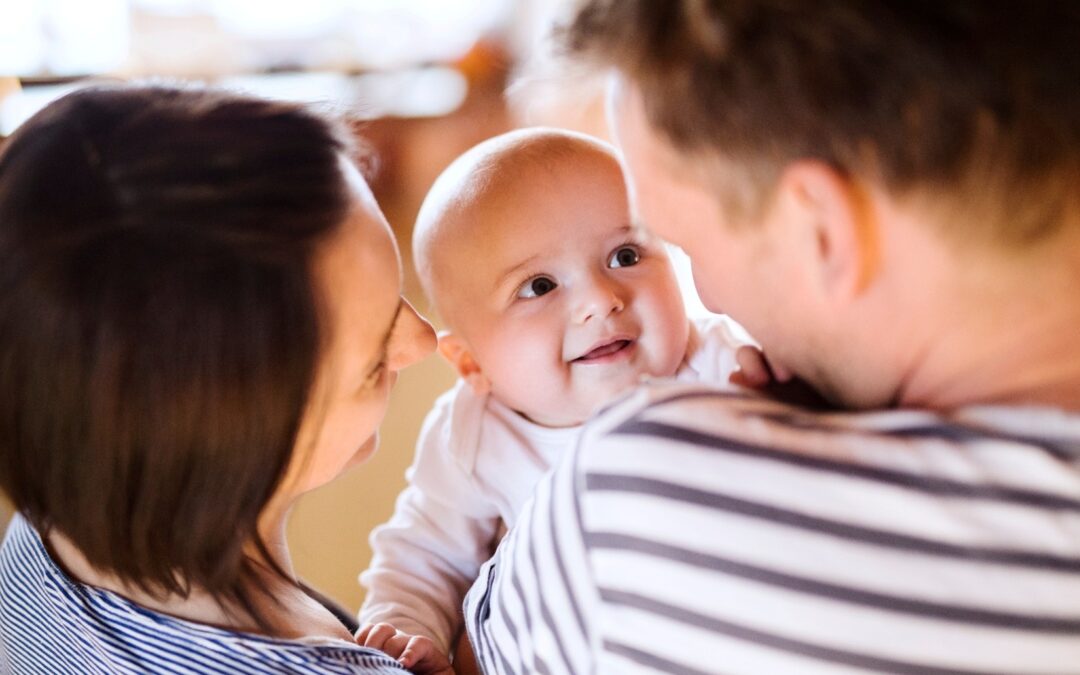
Around 4 months, many parents notice that their baby seems much more interested in what is happening around them.
A baby who once spent most awake time being held, fed, or quietly watching may now smile to get your attention, make sounds back to you, reach toward toys, bring their hands to their mouth, and hold their head with much more control.
These changes do not arrive all at once, and every baby develops on an individual timeline. Looking at baby milestones across the first year gives you a useful sense of what may emerge next without treating any particular age as a deadline.
Before 4 Months: Early Skills Begin Taking Shape
The first few months lay the groundwork for many of the changes that become easier to see around 4 months.
At about 1 month, babies are still adjusting to the world outside the womb. You may notice brief periods of looking at your face, reactions to sounds, and short attempts to lift or turn the head during tummy time.
By around 2 months, many babies smile when someone talks or smiles at them, make sounds besides crying, watch people move, and briefly hold their head up while lying on their tummy.
Around 3 months, head control often becomes steadier. Babies may keep their hands open more often, bring them toward the face or mouth, and begin swiping or reaching toward something interesting.
Then comes the 4-month stage, when several of those early abilities start becoming much more obvious.
What Are Common 4-Month-Old Milestones?
Around 4 months, many babies are becoming more social, vocal, and physically active.
You may notice your baby:
- Holds their head more steadily without support
- Brings their hands to their mouth
- Holds a toy placed in their hand
- Swings an arm toward toys
- Pushes up onto the elbows or forearms during tummy time
- Makes sounds back during interaction
- Smiles to get your attention
- Chuckles during playful interaction
- Watches their own hands with growing interest
Some babies will do several of these things earlier, while others need more time.
What makes this stage feel different is how interactive many of the changes are. Your baby is not only noticing more. They are beginning to do more with what they notice.
When Do Babies Start Laughing?
One of the most memorable changes around this stage is the move from smiling toward chuckling and, eventually, fuller laughter.
Early chuckles often begin around the 4-month period, although timing varies. A silly sound, familiar face, playful voice, or gentle game may suddenly get a reaction that was not there a few weeks earlier.
Laughter is also a social milestone. Your baby is responding to another person and participating more actively in the exchange.
Reaching Becomes More Purposeful
During the earliest months, babies may move their arms toward objects without much accuracy.
Around 3 to 4 months, reaching often becomes more deliberate. A baby may see a toy, swing an arm toward it, and eventually manage to make contact or hold on.
When Do Babies Reach for Things?
Purposeful reaching commonly starts developing during the early to middle months of infancy.
At first, your baby may miss the object entirely. With practice, their eyes, shoulders, arms, and hands begin working together more effectively.
By the months that follow, reaching usually becomes more accurate, and babies spend much more time holding, turning, shaking, and mouthing safe objects.
What About Rolling Over?
Rolling is another milestone many parents begin watching for around this time, but it has a wide developmental range.
When Do Babies Roll Over?
Rolling often emerges during the middle months of the first year.
Some babies roll from tummy to back first. Others go from back to tummy. A baby may even surprise you with one roll and then not repeat it for several days.
By around 6 months, many babies are rolling from tummy to back, but not every baby follows the same path or timing.
The important thing to remember is that rolling develops alongside growing head, shoulder, trunk, and leg control. It is not a skill that suddenly appears because the calendar reaches a certain month.
What Changes After 4 Months?
The months after the 4-month mark tend to bring more control, mobility, communication, and curiosity.
Around 5 to 6 Months
Many babies become more accurate at reaching and grasping. They may roll more often, explore objects with the hands and mouth, laugh more readily, and experiment with a wider variety of sounds.
By around 6 months, many babies recognize familiar people, take turns making sounds, reach for objects they want, roll from tummy to back, push up with straight arms during tummy time, and begin sitting while leaning on their hands for support.
Around 7 to 9 Months
Sitting often becomes steadier during this period. Babies may transfer objects from one hand to the other, babble frequently, and begin moving around by rolling, scooting, creeping, crawling, or another method.
By around 9 months, many babies sit without support, look when their name is called, make repeated sounds such as “mamamama” or “babababa,” lift their arms to be picked up, and look for objects that fall out of sight.
Around 10 to 12 Months
Near the first birthday, babies often have many more ways to interact with people and their surroundings.
They may pull to stand, move along furniture, wave, play simple games, put objects into containers, use gestures, and show clearer understanding of familiar words.
By around 12 months, many babies call a parent “mama,” “dada,” or another special name, understand “no,” pull to stand, and walk while holding onto furniture.
Some babies also take independent steps before the first birthday. Others do not, and that can still fall within typical development.
Why 4 Months Can Feel Like Such a Big Change
Four months is not a finish line. It is simply a point when several early abilities often become easier to see at the same time.
Better head control changes tummy time. More purposeful hand movements change play. Social smiling and chuckling make interaction feel more reciprocal. New sounds make those face-to-face moments feel more like early conversations.
The baby you knew at 2 months may suddenly seem much more engaged, even though all of those changes have been building gradually.
Supporting Development Through Everyday Interaction
Babies do not need complicated activities to practice emerging skills.
Tummy time, floor play, talking, singing, reading, and placing safe toys within reach all give babies opportunities to move, look, listen, and interact.
At daycare in Annapolis, MD, infant care includes responsive interaction, sensory experiences, floor time, and familiar routines that give babies regular opportunities to explore at their current stage of development.
For a 4-month-old, that may mean time to push up during tummy time, watch a caregiver’s face, listen to songs, or reach toward an interesting toy. A few months later, those same kinds of experiences may involve sitting, grasping, babbling, or moving around the room.
What If Your Baby Is Not Doing Everything Yet?
Milestones are guideposts, not a scorecard.
Some babies show strong interest in movement before communication. Others are highly social and vocal while physical skills develop more gradually.
Talk with your child’s pediatrician if your baby is not meeting expected milestones, loses a skill they previously had, or if something about their movement, hearing, communication, or interaction concerns you.
Around 4 months, development often becomes easier to notice because babies have more ways to show what they are learning. From there, the rest of the first year brings even more opportunities to move, explore, communicate, and connect.