
Before a baby begins daycare, parents often have plenty of practical questions.
Will feeding and naps follow a set classroom schedule? What happens while the baby is awake? What does curriculum even mean at this age? And how will you know what happened after drop-off?
At Celebree School of Alexandria, infant daycare begins at 6 weeks and continues through 18 months. Feeding, sleep, diapering, comfort, play, movement, early learning, and family communication are all part of the program.
Understanding those basics ahead of time makes it easier to picture what care will actually look like.
Infant Daycare Begins as Early as 6 Weeks
Celebree School of Alexandria has infant classrooms for babies from 6 weeks to 9 months and from 9 to 18 months.
That age span covers a wide range of feeding and sleep patterns, communication, movement, and interests.
A very young infant often spends more time resting and receiving close care. Later in infancy, longer alert periods create additional opportunities for movement, play, and interaction.
The classroom groups provide structure while leaving room for each child’s own pace and routine.
You Do Not Need to Create a Perfect Daycare Schedule First
Babies do not need to arrive already following a standard classroom timetable.
During morning check-in, families share when their baby last ate, slept, and was changed. Teachers begin with that current information rather than assuming everyone needs a bottle or nap at the same time.
Feeding, rest, comfort, and alert periods remain connected to the child’s individual needs.
For parents preparing for daycare, that means the goal is not to reshape the baby’s entire routine beforehand. It is more useful to keep teachers informed about what is happening now.
Everyday Care Takes Up a Large Part of the Day
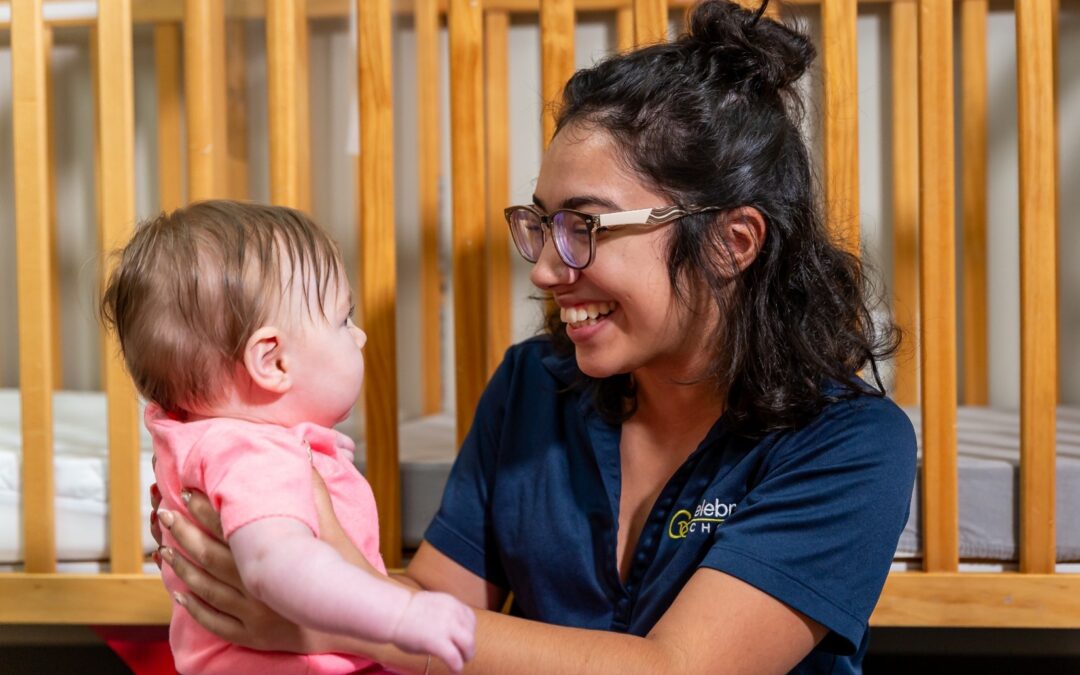
Feeding, naps, diaper changes, settling, and comfort are substantial parts of infant daycare. At Celebree School of Alexandria, babies are held during feedings and rocked at naptime.
These moments also give teachers time to talk with children, respond to sounds and expressions, and become familiar with how they communicate and settle.
For infants, caregiving and interaction are often happening at the same time.
What Happens When Babies Are Awake?
Alert periods leave room for movement, language, play, and time with caregivers.
Celebree School of Alexandria incorporates personal and social development, language, physical development, gross and fine motor experiences, and simple sign language into infant care.
A baby might listen to a book or song, move on the floor, explore an age-appropriate object, or respond to familiar words and gestures.
What that looks like will vary with age, interest, and current abilities. Infant awake time does not need to follow one activity plan for the entire room.
What Does Curriculum Mean for an Infant?
Infant curriculum looks very different from a formal preschool lesson. At Celebree, early learning is woven into play, movement, language, interaction, and familiar care routines.
Teachers observe what children are doing, what holds their attention, and how they participate. Those observations help inform developmentally appropriate experiences.
Celebree School uses Creative Curriculum and Teaching Strategies GOLD to support planning and ongoing observation.
A shared book, a familiar song, a simple sign, or time exploring an object can all be part of learning without turning the infant classroom into an academic setting.
Teachers Get to Know More Than a Baby’s Age
Age is helpful, but it does not tell teachers how a particular child eats, sleeps, settles, communicates, or spends alert periods.
Families provide much of that context when care begins and continue sharing updates as routines change.
Each infant at Celebree School of Alexandria also has a primary caregiver who becomes more familiar with the child through regular time together.
That gives the classroom team a better understanding of the individual baby rather than relying only on what might be typical for a certain age.
The Infant Experience Evolves Over Time
A baby who starts daycare at 6 weeks will likely interact with the classroom differently several months later.
Feeding, sleep, and close care often occupy more time early on. As alert periods lengthen and children gain new ways to move or communicate, play and exploration become a larger part of the picture.
There is no single developmental timetable the classroom needs every baby to follow. Care continues to reflect what the child needs now while providing appropriate opportunities to engage and learn.
Parents Stay Informed After Drop-Off
Parents are not there to see every feeding, nap, diaper change, or moment of play.
Celebree School of Alexandria provides evening reports with information about mealtimes, diaper changes, naps, and play activities. Families can also receive daily notes, photos, and updates about routines and learning.
Those details help fill in the hours between drop-off and pickup.
They also provide useful information for the evening, especially when feeding or sleep looked different from what happened at home.
What Is Helpful to Know Before the First Day?
Parents do not need to have every part of daycare figured out before care begins.
It helps to understand the program’s age range, know that feeding and sleep remain individualized, and be prepared to share current information with teachers.
It is also useful to know that everyday care and early learning overlap throughout the infant program rather than happening in separate blocks.
Visiting the classroom beforehand can make all of this much easier to picture and give families a clearer sense of what the school day will look like.
Explore Infant Daycare at Celebree School of Alexandria
Learn more about infant daycare at Celebree School of Alexandria and visit the infant classroom to see how feeding, rest, play, early learning, and family communication come together before your baby begins.