
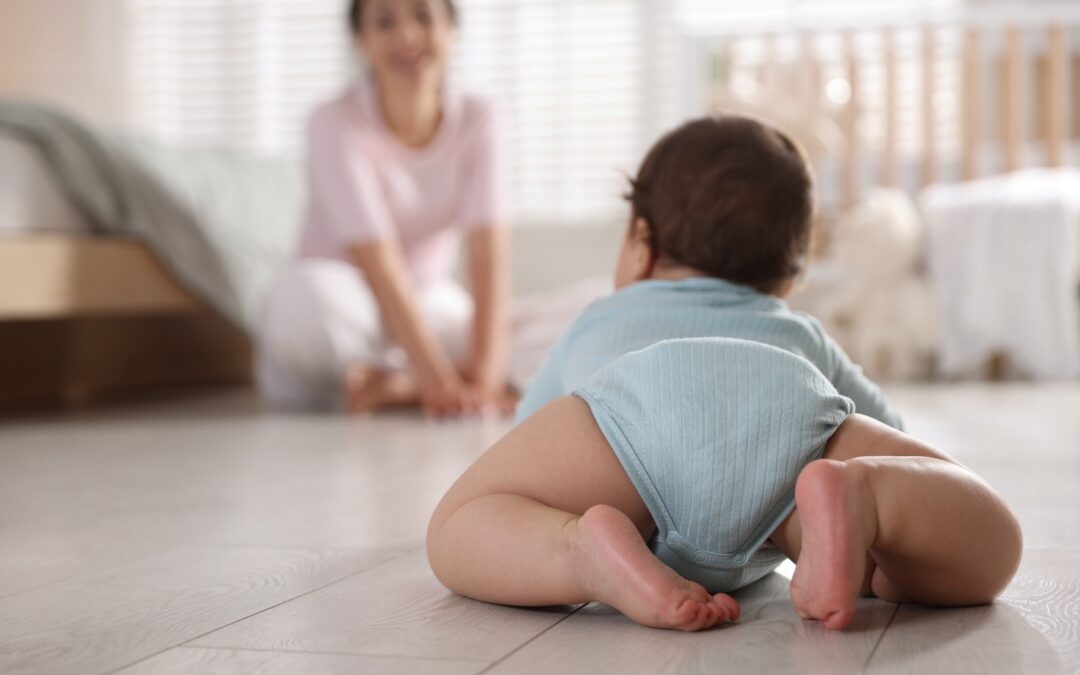
You were ready for crawling across the room. You may not have been ready for your baby to head straight for the couch cushion, a low step, or anything else that looks climbable.
Once babies realize they can get somewhere on their own, their ambitions can grow quickly.
If you’re wondering when do babies start crawling, traditional crawling is commonly mastered between about 7 and 10 months. Around this same period, babies may also begin pulling up, standing with support, and experimenting with new ways to move. The American Academy of Pediatrics notes that some babies may even climb before they walk.
Crawling Changes Where Babies Want to Go
Early crawling often begins with a straightforward goal: reach the toy, get to a parent, or investigate something nearby. Once babies become more confident, the route itself can become interesting.
A cushion is no longer just something sitting on the floor. It is something to crawl over. Your legs become an obstacle. A low surface may prompt a baby to reach higher, shift their weight, or try to pull themselves up.
This doesn’t mean every crawling baby is about to become a climber. It simply shows how quickly independent mobility can open up new possibilities.
Can Babies Climb Before They Walk?
Yes.
AAP safety guidance specifically warns families that a baby may learn to climb before learning to walk. It also points out how suddenly babies can gain abilities such as crawling, sitting, standing, and reaching things adults assumed were still out of range.
That can be surprising if you think of crawling as a stage that keeps babies close to the floor.
A baby who is still crawling most of the time may already be interested in getting over a low object or pulling higher to see what is above them.
Climbing does not have to wait until independent walking begins.
Climbing Doesn’t Need Its Own Deadline
Parents naturally want to know when new skills are supposed to happen. But climbing is not a milestone that needs to appear by one particular age.
One baby may spend months happily crawling without showing much interest in climbing. Another may immediately begin testing anything with a little height.
Neither tells you much by itself about how quickly a child will walk or what their later physical abilities will look like. Instead of waiting for climbing to appear, notice how your baby’s movement options are expanding.
Crawling Over Things Can Be Part of Play
Once babies become more agile, ordinary floor play can give them opportunities to navigate around and over simple obstacles.
AAP suggests that parents can create a small supervised obstacle course using items such as pillows, boxes, or sofa cushions. The guidance also stresses close supervision because babies may not be able to get themselves out of every position they manage to get into.
This doesn’t need to become climbing practice. A cushion on the floor may be enough to make your baby pause, change direction, crawl around it, or try to get over it. All of those responses give them a chance to experiment with movement.
Stairs Are a Different Kind of Challenge
A staircase can be especially tempting once a baby starts exploring upward. It also requires more caution.
AAP recommends sturdy gates at both the top and bottom of stairs and says babies should not play on staircases unsupervised. Even after a child begins learning how to navigate stairs, gates remain important.
So, while crawling over a low cushion during supervised play can offer an appropriate movement challenge, stairs should not become an open climbing area simply because your baby seems interested.
Start Looking at the Room Vertically
Crawling changes the safety picture in more ways than one.
Before mobility, parents often think about what is lying on the floor. Once climbing and pulling up enter the picture, it helps to look higher.
Can your baby reach something from a standing position that used to be safely above them? Is there furniture they might try to climb? Could pulling on an object cause it to shift or tip?
AAP notes that babies between 6 and 12 months can suddenly reach places and objects adults don’t expect them to access yet.
Your baby’s abilities may change before your mental picture of what they can do catches up.
Give Them Safe Ways to Try New Movement
Babies don’t need elaborate climbing equipment in order to explore.
Supervised floor play gives them plenty to work with. They may crawl around an object, move over a low cushion, shift between sitting and crawling, or pull up on a secure surface.
The goal isn’t to encourage climbing sooner. It is to give your baby room to work with the physical skills they already have.
If they aren’t interested in climbing yet, there’s no need to create a reason for them to be.
Exploring New Movement at Celebree School of Severna Park
At Celebree School of Severna Park, children are encouraged to explore, try new things, and develop at their own pace within a caring environment. The school’s current messaging emphasizes safe routines, attentive supervision, and regular communication with families.
For infants, that can mean seeing mobility change quickly.
A baby who spent last week crawling around something may suddenly be trying to move over it. Another may be more interested in pulling up, while someone else is still working on rolling or sitting.
Teachers can respond to those changing abilities by providing developmentally appropriate opportunities to move and by sharing new observations with families. Celebree’s Severna Park infant care also centers on individualized attention to routines and developmental milestones.
Crawling May Be Only the Beginning
Once your baby becomes mobile, you may discover that getting across the room was only their first idea.
Climbing, pulling up, cruising, and other forms of movement can begin overlapping as babies explore what their bodies can do. Some may even start climbing before they take independent steps.
Give your baby safe opportunities to explore, expect their abilities to change quickly, and adjust the environment as they show you what they can reach next.
If you’re exploring day care in Severna Park, MD, Celebree School of Severna Park offers responsive infant care with room for movement, exploration, and growing independence. Contact the school to arrange a visit and see the infant program in person.