
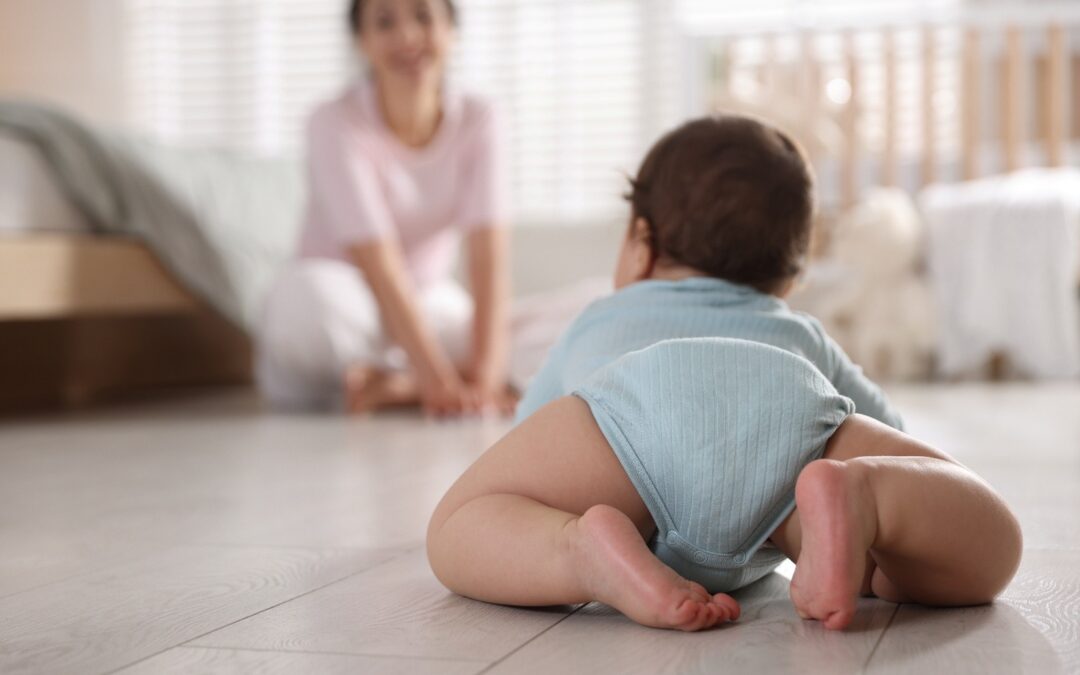
Your baby may be sitting upright one minute and several feet across the floor the next, without ever getting onto hands and knees. Some babies discover that scooting gets them exactly where they want to go.
That can make the usual question, “when do babies start crawling?”, feel a little less straightforward. Crawling is commonly mastered between about 7 and 10 months, but the American Academy of Pediatrics notes that some babies use other ways to get around, including scooting on their bottoms or moving along on their stomachs.
What Does Bottom Scooting Look Like?
A baby who bottom scoots usually stays seated while moving across the floor. Your child may push with a foot, shift their weight from side to side, use their hands for momentum, or develop a technique that is entirely their own.
It may not resemble the crawl you had pictured, but your baby has still figured out something important: how to get closer to the toy, person, or fascinating household object they have their eye on.
Some babies stick with scooting for a while. Others eventually try hands-and-knees crawling or another way of moving.
Does Scooting Count as Crawling?
Scooting and traditional crawling are different movements, but both can help a baby become independently mobile.
The AAP specifically recognizes bottom scooting as one of the alternative ways some babies move instead of crawling on hands and knees. Its guidance places more emphasis on how your baby uses both sides of the body and explores their surroundings than on whether they use one particular crawling style.
Crawling is also not listed as a required 9-month milestone on the CDC’s current checklist. At that age, the CDC includes skills such as getting into a sitting position and sitting without support.
So, a scooting baby does not need to be coached into a more recognizable crawl simply because another child moves differently.
Will a Baby Who Scoots Eventually Crawl?
They might, but not every baby follows that route.
Your child may begin scooting and later try crawling on hands and knees. Another baby may continue scooting until they become more interested in pulling up, standing, and eventually walking.
The way babies move can also change depending on where they are. A child who scoots quickly across a smooth floor may try a different approach on carpet or another surface.
Rather than watching for one required next step, pay attention to how your baby is becoming more confident moving, reaching, changing positions, and exploring.
Give Your Baby Room to Find Their Own Route
You do not need a complicated setup to give your child opportunities to practice movement.
A safe stretch of floor and a few interesting toys can go a long way. The CDC suggests putting toys slightly out of reach and encouraging babies to crawl, scoot, or roll toward them.
You can sit nearby, talk to your baby, or place yourself where they can see you. Then give them a chance to decide how they want to get there.
Once scooting becomes efficient, revisit your babyproofing too. A seated baby who once stayed in one spot can become surprisingly good at crossing a room.
When Should You Ask Your Pediatrician About Scooting?
Bottom scooting by itself does not automatically point to a developmental problem.
The AAP advises looking at how your baby coordinates both sides of the body and whether they are using both arms and legs. If one side seems consistently less involved, your baby’s movement looks unusual to you, or you have another concern, bring it up with your pediatrician.
It is also worth speaking with your child’s doctor if your baby loses a skill they previously had. The CDC encourages parents to share any developmental or movement concerns rather than waiting for a scheduled milestone to pass.
You do not need to decide on your own whether a movement pattern is significant. Your pediatrician can look at it alongside the rest of your child’s development.
Staying Connected as Your Baby Grows at Daycare
New skills do not always appear on cue. Your baby may try something for the first time during an ordinary stretch of floor play while you are somewhere else.
At Celebree School of Northbrook, infant care includes physical development and gross and fine motor activities, along with daily morning and evening communication between families and teachers. Infants are also assigned a primary caregiver, helping create consistency during a period when routines and abilities can change quickly.
Those daily updates can help you stay connected to the small changes happening throughout your baby’s day, whether your child has discovered a new way to scoot toward a toy or is simply becoming more confident exploring the space around them.
If you are looking for daycare in Northbrook, IL, Celebree School of Northbrook provides responsive infant care with opportunities for safe, age-appropriate movement and exploration.