
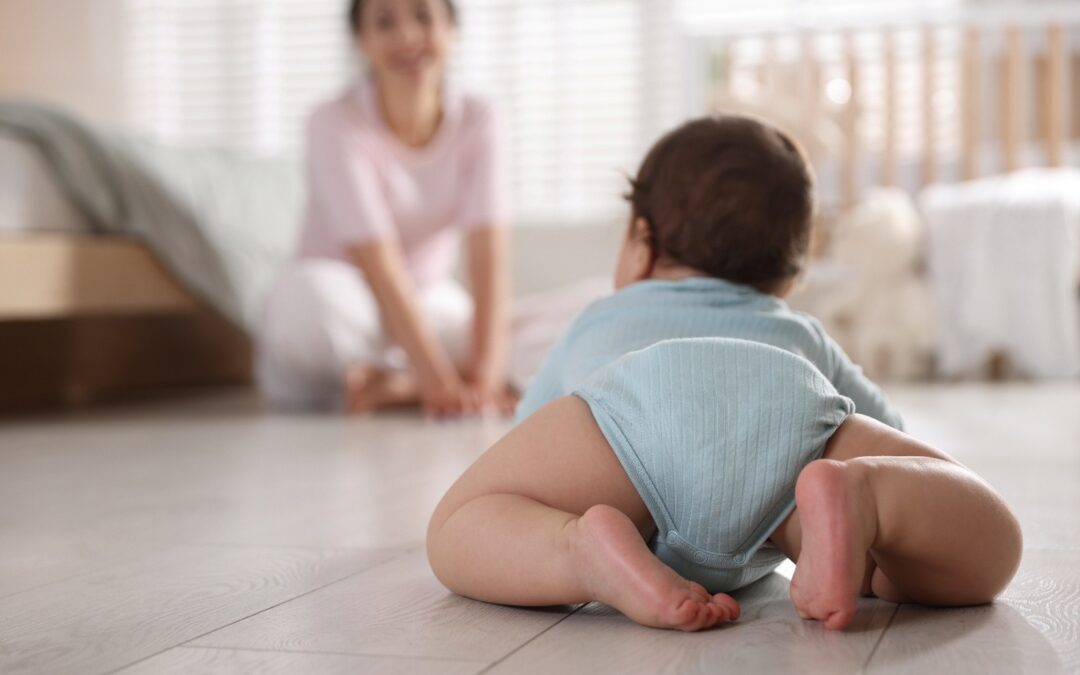
Your baby’s teacher mentions that they scooted across the floor to reach a toy. You are surprised—you have not seen them do that at home yet.
Moments like this are common during a stage when new movement can appear quickly and somewhat unpredictably. If you are wondering when do babies start crawling, many babies begin traditional hands-and-knees crawling around 7 to 10 months. Some start earlier or later, while others scoot, belly-crawl, roll, or find another way to get around.
Crawling may also emerge little by little rather than appearing as one obvious “first.”
New Movement Can Show Up Gradually
A baby may try a new movement once and then seem to forget about it for several days. They might scoot toward one particular toy but stay put during another play session. Rocking on hands and knees may come and go before forward movement ever happens.
That can make early mobility difficult to track by watching for one defining moment.
Instead, notice how your baby’s movement changes over time. They may be reaching farther, shifting positions more easily, turning themselves around, or figuring out how to cover a little more distance than they could before.
Those small changes can be part of a much larger period of physical development.
You May Not See Every New Skill First
For parents whose babies spend part of the week in daycare, a new movement may happen while you are apart.
That can bring mixed feelings. You may wish you had been there, especially for a milestone you have been eagerly waiting to see.
But one attempt during the day does not mean you missed the whole experience.
Babies usually practice new abilities again and again as they become more confident. The first scoot across the classroom may be followed by many more attempts at home. A teacher sharing what they observed simply gives you another window into what your baby is working on.
What Is Helpful to Share Between Home and Daycare?
Good communication can make it easier to follow these changes across your baby’s day. Parents and caregivers may want to share observations such as:
- A new way of changing position
- Scooting, rolling, or moving farther than before
- Getting onto hands and knees
- Beginning to pull up
- Using one movement much more often
- A movement that looks noticeably different from what you usually see
You do not need a formal milestone report every time your baby tries something new. A simple conversation about what happened can help both you and your baby’s teachers notice patterns as skills develop.
Look for Progress Over Time
It is easy to think of crawling as something a baby either does or does not do. In reality, movement often develops through experimentation.
One week your baby may mostly pivot in circles. The next, they may figure out how to move backward. Eventually they may find a method that gets them exactly where they want to go.
Some babies crawl on hands and knees. Others use their bellies, scoot, roll, or rely on another style. A few never spend much time traditional crawling before becoming interested in pulling up and other forms of mobility.
Watching the broader pattern can be more useful than waiting for one exact type of crawl.
When Should You Bring a Question to Your Pediatrician?
Parents and teachers can notice and share how a baby is moving. Developmental concerns, however, belong with your child’s pediatrician.
If something about your baby’s movement worries you, bring it up. You should also talk with their pediatrician if your baby loses a skill they previously had or you notice a persistent difference in how they use the two sides of their body.
You do not need to wait for a particular crawling age before asking a question. Your pediatrician can consider your child’s overall development and help you decide whether anything needs a closer look.
Staying Connected at Celebree School of Mt. Airy
At Celebree School of Mt. Airy, infant teachers observe children as they move, play, and explore throughout the day.
Families also have regular opportunities to share information at drop-off, pickup, and through daily communication. That ongoing exchange can be especially helpful during infancy, when changes sometimes happen faster than expected.
A teacher might mention that your baby moved toward an object for the first time. You may share that they have started trying the same movement at home. Together, those observations provide a fuller picture of what your child is practicing.
Follow the Changes as They Happen
Crawling rarely needs to look like one perfect moment captured on cue.
Your baby may experiment with movement in different ways, in different places, and at different times of day. Watch how those abilities change, stay connected with the people who care for your baby, and ask your pediatrician when something concerns you.
If you are looking for daycare in Mt. Airy, MD, Celebree School of Mt. Airy provides an infant environment where teachers observe development, encourage safe exploration, and keep families informed. Schedule a visit to meet our team and learn more about infant care at Celebree.