
Your content goes here. Edit or remove this text inline or in the module Content settings. You can also style every aspect of this content in the module Design settings and even apply custom CSS to this text in the module Advanced settings.
Your baby may spend weeks getting steadier while sitting, then suddenly start leaning, twisting, reaching, and trying to get somewhere else. That can make it seem as though one skill is naturally leading to the next.
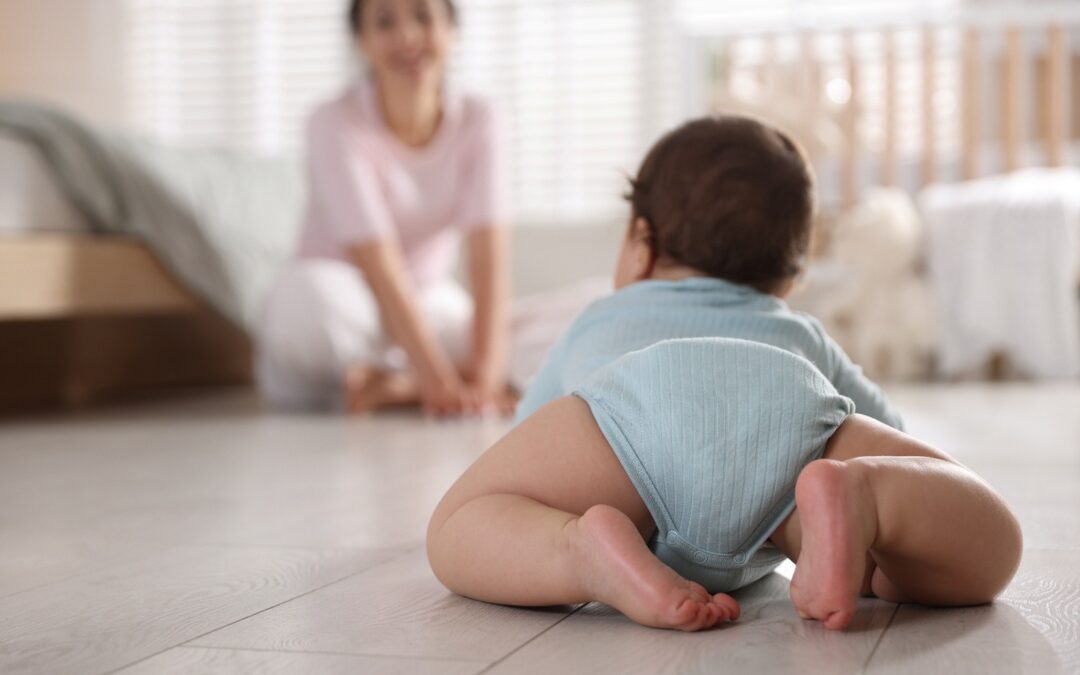
So, when do babies start crawling? Many babies begin somewhere around 7 to 10 months, but sitting and early mobility can overlap in ways that do not always follow the same order.
Do Babies Usually Sit Up Before They Crawl?
Often, yes. Sitting gives babies a new way to balance, reach, turn, and interact with what is around them. Those movements can become part of the bigger picture as they begin figuring out how to get from one place to another. But there is no rule that every baby must master sitting and then move directly into crawling.
Developmental windows overlap. Some babies become confident sitters well before they crawl. Others may begin moving across the floor while their sitting skills are still becoming more stable.
How Does Sitting Connect With Early Movement?
Sitting gives your baby plenty of opportunities to practice balance and weight shifting.
You may notice your child leaning toward a toy, reaching across their body, turning to see something behind them, or using a hand on the floor for support. Over time, those everyday movements can become more confident.
Your baby may eventually lean so far that they move onto their hands, shift onto their tummy, or discover a completely different way to get where they want to go.
It does not need to look graceful. Babies are learning through trial and error.
Can a Baby Crawl Before Sitting Independently?
It can happen.
The age ranges for sitting and crawling overlap, so babies do not always acquire those skills in exactly the same sequence. A child may begin experimenting with forward movement before they are consistently sitting without support.
It is also worth remembering that crawling itself can look different from one baby to another. Hands-and-knees crawling is only one possibility. Babies may move along their stomachs, scoot, roll, or use another approach while becoming more mobile.
That is one reason comparing two babies of the same age rarely gives you the full picture.
Try Not to Turn Development Into a Checklist
It is easy to start mentally checking off skills once babies around you begin sitting, crawling, pulling up, or walking. The problem is that development rarely unfolds that neatly.
Instead of looking for one skill to prove that another should happen next, pay attention to how your baby is changing over time. Are they reaching more confidently? Moving in and out of positions? Becoming more interested in exploring the space around them?
Those everyday changes often tell you more than whether your child followed the same sequence as someone else’s baby.
Give Your Baby Room to Explore
A safe space on the floor gives your child opportunities to sit, reach, roll, pivot, and experiment with movement.
Place a favorite toy nearby and see what happens. Your baby may lean toward it, move onto their hands, roll closer, or decide there is something much more interesting in the opposite direction.
You do not need to position your baby’s body into a crawling pose or rush them from one skill to another. Give them space to work things out while you stay close and keep the environment safe.
As mobility increases, revisit babyproofing too. A child who was staying in one spot yesterday may have very different plans today.
When Should You Ask Your Pediatrician?
Questions about movement are always appropriate to bring up with your child’s pediatrician.
It is especially worth having that conversation if your baby loses a skill they previously had, consistently uses one side of the body differently, seems unusually stiff or floppy, or something about their movement concerns you.
Sitting is also one of the developmental skills pediatricians pay attention to during the first year. If your baby is not sitting independently around 9 months, that is worth discussing with their doctor.
You do not have to decide whether a movement pattern is significant before asking. Your pediatrician can look at what you are seeing in the context of your child’s overall development.
Everyday Movement at Daycare
During the first year, a baby’s movement can change quickly. A child who was mostly sitting and reaching may suddenly begin leaning farther, turning into a new position, or finding a way across the floor.
At Celebree School of Leander at Bryson, infant care includes opportunities for physical development, gross and fine motor experiences, and age-appropriate exploration. Infants have a primary caregiver, and families receive regular morning and evening communication about their child’s day.
That ongoing connection can help you stay part of the small changes happening while your baby is at school. Teachers can share what they notice during everyday play while giving your child room to explore movement at their own pace.
If you are looking for daycare in Leander, TX, Celebree School of Leander at Bryson provides responsive infant care where babies can explore, move, and discover new abilities through everyday experiences.