
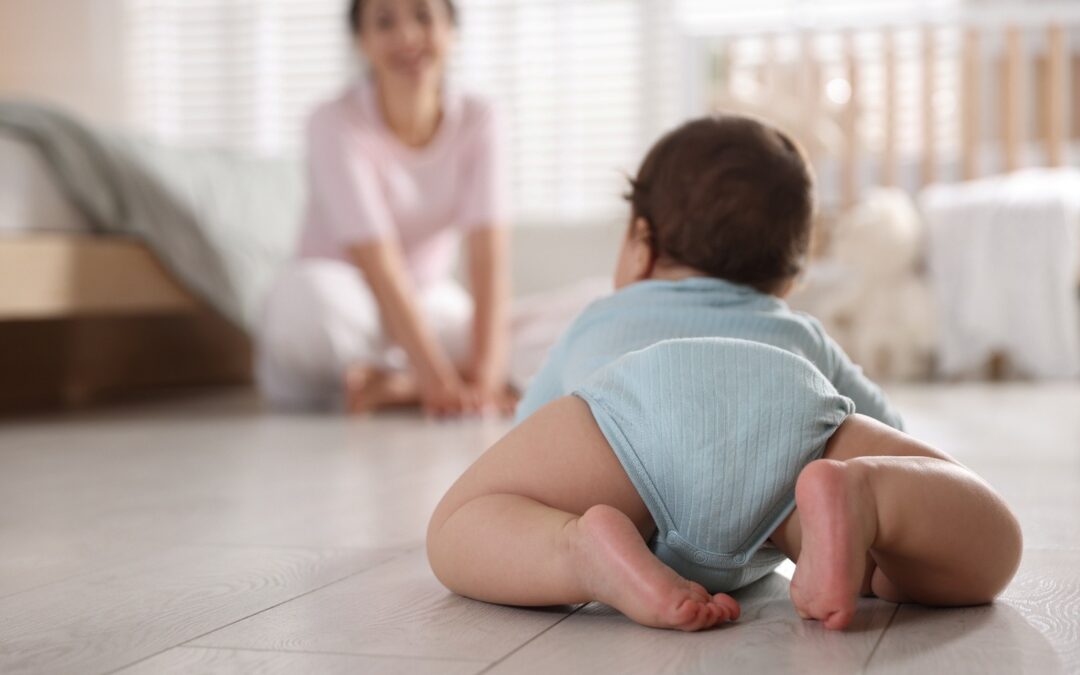
You put your baby down for tummy time facing a favorite toy. A few minutes later, the toy hasn’t moved, but your baby is somehow facing a completely different direction.
They aren’t crawling forward yet. Instead, they’ve figured out how to turn themselves around while staying on their tummy. This circular movement is often called pivoting, and it can be one of the ways babies experiment with mobility before crawling.
If you’re wondering when do babies start crawling, traditional hands-and-knees crawling is commonly mastered around 7 to 10 months. There’s plenty of variation, though, and pivoting doesn’t tell you exactly when forward crawling will arrive.
That Circular Movement Has a Name
When babies pivot, their belly usually remains on the floor while they use their arms and shifting body weight to turn.
Maybe your baby rotates just enough to reach something beside them. Another time, they might make nearly a complete circle.
From an adult perspective, this can look like a very inefficient way to get somewhere. From your baby’s perspective, they’re discovering that moving one part of their body changes where the rest of them ends up.
Why Turn Sideways When the Toy Is Straight Ahead?
Babies have to figure out movement one piece at a time.
They may know exactly what they want but not yet have the coordination to travel directly toward it. Turning their body can be easier than moving forward.
Imagine a toy sitting slightly to your baby’s left. They reach for it but can’t quite get there. By pushing through one arm and shifting their weight, they may discover that their whole body turns closer to it.
That discovery can lead to plenty of experimenting.
The next attempt might turn them in the opposite direction. They may roll instead. They might push backward and look completely surprised by where they ended up.
All of that can happen before their movement begins resembling the crawl you expected to see.
Pivoting Lets Babies Practice Shifting Their Weight
Crawling eventually asks babies to coordinate movement across their arms, legs, and trunk. Pivoting offers an earlier opportunity to experiment with some of that body control.
While turning on the tummy, your baby may place more weight through one arm while reaching with the other. Then they shift again as they continue around.
That doesn’t mean pivoting is a required step before crawling. Some babies may do it frequently, while others barely seem to bother with it.
It’s simply one of the many ways early movement can develop.
Does Pivoting Mean Crawling Is Coming Soon?
Not necessarily.
It’s easy to notice a new movement and assume the next milestone must be right around the corner. Babies rarely follow such a tidy schedule.
One baby may pivot for a short time and soon begin belly crawling. Another may spend weeks rolling and turning before trying something new. Someone else may learn to sit independently and show little interest in traveling anywhere for a while.
The American Academy of Pediatrics recognizes several ways babies may become mobile, including traditional crawling, belly crawling, scooting, rolling, and other variations.
So, enjoy the new skill without treating it as a countdown.
Give Your Baby Something Worth Turning Toward
You don’t need to teach pivoting.
During supervised tummy time or floor play, try putting an interesting object slightly off to one side. Your baby may reach, turn, roll, or decide they aren’t interested at all. You can also sit beside them and become the interesting thing yourself.
There’s no need to move their arms for them or repeatedly guide their body around. Give them room to experiment with the movement they can currently manage.
What If Your Baby Always Turns the Same Way?
When a movement is brand new, one direction may initially seem easier.
Over time, though, you can casually notice how your baby uses both sides of their body. Do they reach with either hand? Turn toward things on both sides? Kick and move both legs during play?
You don’t need to analyze every movement.
If your baby consistently avoids moving toward one side, seems to use one side of the body much less than the other, loses a skill they previously had, or something about their movement concerns you, bring it up with your pediatrician.
You don’t have to determine what’s causing the pattern before asking about it. Simply describing what you repeatedly see can be helpful.
Circles May Eventually Turn Into Forward Movement
One of the fun things about watching babies become mobile is seeing how quickly their strategies change.
Pivoting may give way to pushing backward. Backward movement may eventually become belly crawling. A baby may get onto their hands and knees, rock for a while, sit back down, and try something completely different later.
There doesn’t need to be a smooth progression from one behavior to the next.
That baby who once turned an entire circle trying to reach a toy may eventually crawl straight toward it without giving the movement much thought at all.
Noticing New Movement at Celebree School of Hampstead
At Celebree School of Hampstead, infant care includes individualized attention to physical development, gross- and fine-motor activities, and the recognition and documentation of developmental milestones. Teachers also communicate with families throughout the day about children’s routines and experiences.
Those everyday observations can capture small changes that are easy to miss.
A baby who once stayed mostly in one spot during floor play may begin turning toward a toy. Later, teachers may notice the movement becoming easier or see the baby experiment with rolling, scooting, or another way to travel.
Teachers aren’t there to predict when crawling will happen. They can provide developmentally appropriate opportunities to move, notice what each child is working on, and share those changes with families.
Let Your Baby Figure Out Where They’re Going
Pivoting may look like your baby is taking the scenic route, but it can be an interesting part of discovering how movement works.
Give them room to turn, reach, roll, and explore without worrying about whether each motion looks like the “next stage.” Forward crawling will arrive on its own timetable, and it may not look exactly the way you pictured.
Families looking for day care in Hampstead, MD, can visit Celebree School of Hampstead to see how infant teachers support movement, exploration, and individual development. Come visit the school and get to know the infant program in person.