
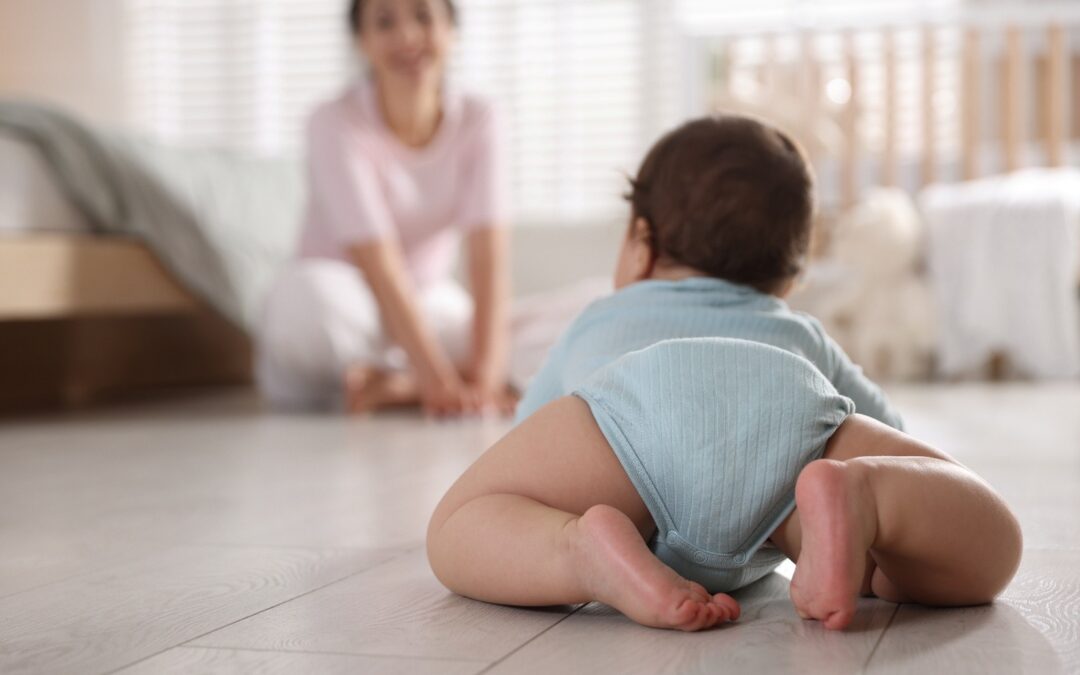
It is hard not to compare when another baby close in age starts crawling before yours. You may find yourself wondering whether your baby is behind or whether you should be doing something differently.
So, when do babies start crawling? Many babies learn traditional hands-and-knees crawling between about 7 and 10 months, but there is a wide range. Some start later, some use another way to get around, and a few never use a classic crawl at all.
Crawling Is Not a 9-Month CDC Milestone
This may be reassuring to know: crawling itself is not included on the CDC’s current 9-month milestone checklist.
At 9 months, the CDC looks at movement skills such as getting into a sitting position and sitting without support. That does not mean crawling is unimportant. It simply means that one baby can be developing physically without following the exact movement pattern you expected.
Look at More Than Whether Your Baby Crawls
If crawling has not started yet, take a broader look at how your baby is moving.
You may notice your baby becoming steadier while sitting, reaching farther for objects, rolling to get somewhere, changing positions, pushing up, scooting, or trying other ways to explore.
Those changes can give you a fuller picture than comparing your baby to a single crawling timeline.
Babies also do not all crawl the same way. Some move on hands and knees, while others belly-crawl, scoot, or develop another method that works for them.
What If My Baby Is 9 or 10 Months and Not Crawling?
Searches like “baby not crawling at 9 months” or “10-month-old not crawling” are common because those ages are when parents often expect crawling to have arrived.
Age alone, however, cannot tell you whether there is a developmental concern.
A baby who is not crawling traditionally may still be learning new ways to sit, reach, shift position, or move around. Some babies simply spend less time crawling before other forms of mobility begin. The American Academy of Pediatrics notes that a few children never crawl at all.
Rather than treating a certain month as a deadline, watch for continued development over time.
When Should You Talk With Your Pediatrician?
You do not need to wait until your child reaches a particular crawling age to ask a question.
If something about your baby’s movement concerns you, bring it up with their pediatrician. The CDC also recommends acting early if a child loses skills they previously had or if you have concerns about their development.
You may also want to mention ongoing differences in how your baby uses the two sides of their body or another movement pattern that does not seem right to you.
Your pediatrician can look at the larger developmental picture, answer your questions, and let you know whether any additional evaluation is appropriate.
What Your Baby’s Teachers May Notice
Babies have plenty of opportunities to move throughout the day, so their teachers may notice changes that are easy to miss at home.
At Celebree School of Forest Hill, the infant program includes a focus on physical development, gross and fine motor experiences, milestone documentation, and regular communication with families.
A teacher might tell you that your baby has started shifting into a new position, moving farther across the floor, or becoming more confident during play. Those observations can give you another view of how your child is progressing.
Teachers can share what they see during the day. When you have a developmental concern, your pediatrician is the right person to help you determine the next step.
Give Your Baby Time and Room to Move
You do not have to spend the day watching the calendar or waiting for the first crawl.
Give your baby safe opportunities to move and explore. Notice the new things they are trying. If something worries you, ask rather than waiting for an arbitrary deadline.
Crawling is one part of a much larger period of physical development, and knowing what to watch can make it easier to enjoy the progress that is already happening.
If you are looking for daycare in Forest Hill, MD, Celebree School of Forest Hill provides an infant environment where teachers observe development, encourage safe exploration, and keep families informed throughout the day. Schedule a Visit to learn more about infant care at Celebree.