
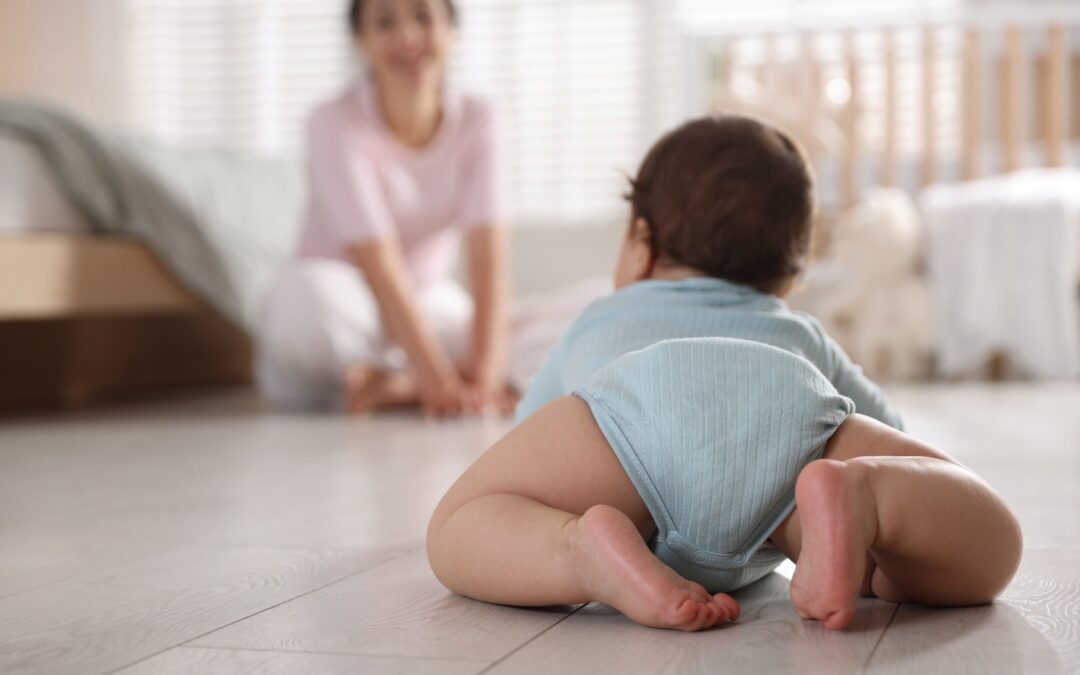
It does not take long online to find videos showing exercises that supposedly help babies crawl sooner. That can leave parents wondering whether they should be doing more.
If you are asking when do babies start crawling, many babies begin traditional hands-and-knees crawling around 7 to 10 months. Others become mobile earlier or later, and some prefer scooting, belly movement, rolling, or another way of getting around.
For most babies, crawling does not need to become a lesson. Everyday opportunities to move and play give them plenty of chances to experiment with what their bodies can do.
Babies Don’t Need a Crawling Lesson
Long before crawling looks coordinated, babies are practicing skills during ordinary play.
They reach for objects, turn toward interesting sounds, shift their weight, roll, sit, push against the floor, and move between positions. Those experiences give them opportunities to build greater control over their movements.
Parents do not need to turn each of those moments into structured crawling practice.
A baby who is interested in reaching something across the mat already has a reason to experiment. Sometimes the most useful thing you can provide is enough safe space to let that happen.
Give Them Something Interesting to Move Toward
Babies tend to be much more motivated by something they actually want than by an adult deciding it is time to practice crawling.
That could be a favorite toy, an interesting object that is safe to explore, or simply you sitting a short distance away. Place something appealing nearby and see what your baby does.
They may reach, roll, scoot, pivot, or attempt to move forward. If they lose interest, there is no need to keep moving the toy farther away or coaxing them to continue.
Play works best when your baby still wants to participate.
Floor Time Gives Babies Options
A safe space on the floor gives babies freedom to use their bodies in ways that are harder in a swing, seat, or other contained space.
Depending on where they are developmentally, your baby may spend that time rolling, sitting, reaching, turning, or starting to travel.
Supervised tummy time also continues to give babies opportunities to push up, look around, and use different muscles while they are awake.
You do not need elaborate equipment. Open space and a few interesting things to explore can offer plenty.
Let Your Baby Move Their Own Body
When a baby looks close to crawling, it can be tempting to place their knees beneath them, move their arms forward, or guide them through the pattern.
You can usually give them room to work it out instead.
Babies learn a great deal from figuring out how their own movements affect where they end up. An attempt may send them sideways. They may push backward instead of forward. They might abandon the effort and sit back up.
Those experiments do not need correcting every time.
Stay nearby, keep the area safe, and allow your baby to initiate the movement whenever possible.
Play May Lead to a Different Kind of Mobility
Even with plenty of floor play, your baby may never use the crawling style you expected.
Some babies move forward on their bellies. Others scoot while sitting, roll with surprising accuracy, or switch between several methods.
Your baby may also use one approach for a while before another becomes easier.
That is another reason crawling does not need to be taught as one specific pattern. Babies can find different ways to become mobile.
Follow What Your Baby Is Interested in Today
There will be days when your baby seems determined to get across the room. There may also be days when they would rather sit and examine one toy for several minutes.
Both can be worthwhile.
Instead of approaching play with a goal of getting your baby to crawl, notice what they are already trying to do. If they keep reaching toward something, give them room. If they are busy practicing a new position, let them spend time there.
Following their interest keeps movement connected to exploration rather than turning it into a task to complete.
When Should You Ask About Movement?
Variation in crawling does not mean parents should ignore concerns.
If something about the way your baby moves worries you, bring those observations to their pediatrician. You should also mention a loss of a skill your baby previously had or a persistent difference in how they use the two sides of their body.
You do not have to decide whether what you are seeing is significant on your own. Describe what your baby is doing and let their pediatrician look at it within the broader picture of development.
Movement Through Play at Celebree School of Fishtown
At Celebree School of Fishtown, infant teachers give babies opportunities to move and explore within everyday play.
One child may be reaching and rolling toward something interesting. Another may be working on sitting more steadily, while a newly mobile baby is discovering how much of the play space they can reach.
Teachers observe those changes and respond to what each baby is ready to try rather than treating crawling as something every infant needs to practice on the same schedule.
Families also receive regular communication about what teachers are noticing throughout the day, helping parents stay connected to new skills as they emerge.
Give Them Time to Figure Out the Movement
Learning to crawl can involve plenty of reaching, wobbling, changing direction, and trying again.
You can support that process without becoming your baby’s crawling coach. Offer safe opportunities to move, make play interesting, and give your baby time to experiment with their own ideas.
If you are exploring daycare in Fishtown, Celebree School of Fishtown provides infants with time and space for movement, play, and age-appropriate exploration. Set up a time to visit and see how our infant classrooms support children throughout these early stages of development.