
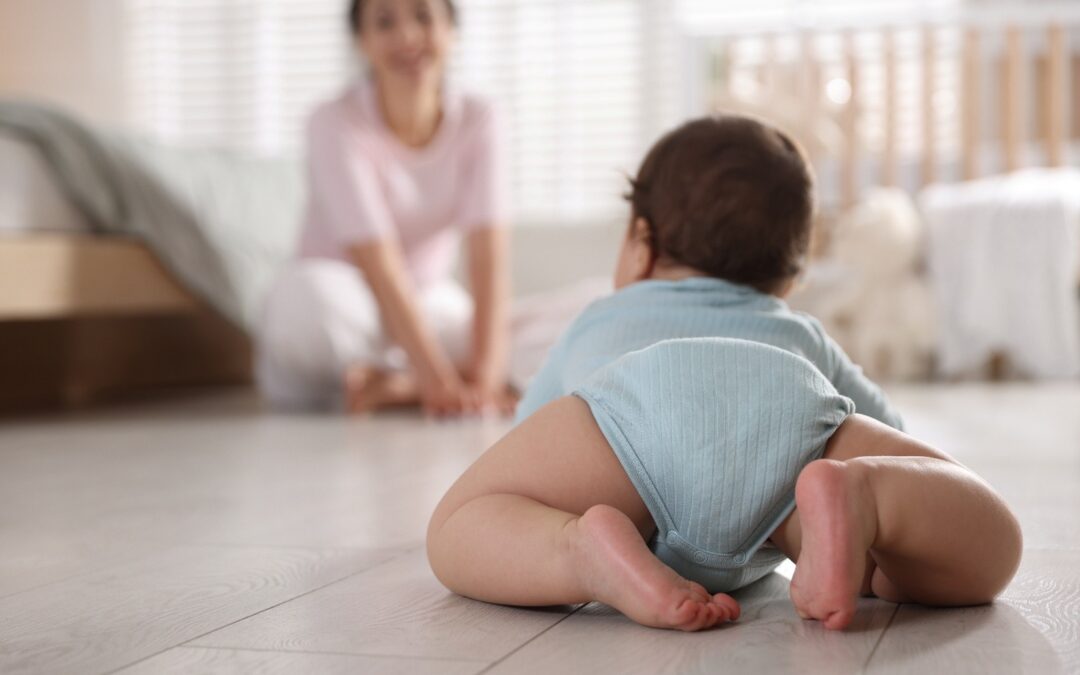
For months, you may have heard the same advice: give your baby plenty of supervised tummy time. Then crawling gets closer, and it is natural to wonder how the two are connected.
If you are asking when do babies start crawling, many babies begin traditional hands-and-knees crawling around 7 to 10 months. Others become mobile earlier or later, and some use scooting, belly movement, rolling, or another method instead.
Tummy time begins much earlier than crawling, but those early opportunities to move can help babies build the physical control they will use as they become more active.
What Is Tummy Time Helping Your Baby Practice?
During supervised tummy time, babies have opportunities to lift and turn their heads, push against the floor, and gradually use more of their upper body and trunk.
At first, that may mean holding the head up for only a short period. As babies grow, you may notice stronger pushing, more reaching, or greater interest in looking around.
Those changes matter because later movement asks babies to control their bodies in increasingly complex ways. Tummy time is one piece of that larger process.
Does Tummy Time Actually Help With Crawling?
Tummy time can support the physical development involved in crawling, but it does not teach a baby one specific crawling pattern.
Think of it as giving your baby experience using their body against the floor.
Over time, those experiences may contribute to abilities such as pushing up, shifting weight, reaching, rolling, and eventually finding ways to move toward something.
That does not mean a baby who gets more tummy time will automatically crawl sooner. Timing still varies widely from child to child.
Tummy Time Looks Different as Babies Grow
Tummy time with a young infant may look very different from floor play a few months later.
Early on, your baby might simply lift their head to look at you.
Later, they may push higher onto their arms, turn toward a toy, reach with one hand, roll out of the position, or pivot on their belly.
Eventually, staying in one place may become the least interesting option.
The baby who once needed encouragement to spend time on their stomach may begin using the floor to explore on their own terms.
What If Your Baby Doesn’t Love Tummy Time?
Some babies are enthusiastic about tummy time. Others make their opinion clear almost immediately.
If your baby becomes frustrated, you do not have to force one long session.
Shorter periods while your baby is awake and supervised can still provide useful movement opportunities. Getting down at their level, talking to them, or placing something interesting nearby may help keep them engaged.
You can also try again at another point in the day when your baby is rested and comfortable. The goal is regular opportunity, not turning tummy time into a battle.
Floor Play Becomes More Important as Mobility Grows
As babies get older, floor time naturally becomes broader than tummy time alone. They may sit, roll, pivot, reach, scoot, or begin crawling during the same play period.
A favorite toy placed nearby can give your baby something worth moving toward. You can sit on the floor with them, talk from a short distance away, or simply let them explore the space around them.
There is no need to constantly guide the movement. Open, supervised floor time allows babies to use whatever skills they are currently developing.
Plenty of Tummy Time Doesn’t Guarantee One Crawling Style
Even babies who have had regular opportunities for tummy time may not use a traditional hands-and-knees crawl. Some move forward on their bellies. Others scoot while sitting, roll intentionally, or combine several methods.
That does not mean tummy time failed to do its job.
Its value is broader than producing one particular movement. It gives babies chances to use their bodies during awake play and build greater physical control over time.
Know When Tummy Time Advice Isn’t Enough
Parents sometimes hear “more tummy time” as a response to almost any question about infant movement.
If something about your baby’s development genuinely concerns you, you do not need to solve it by adding more floor practice on your own.
Talk with your child’s pediatrician if you are worried about how your baby moves, notice a loss of a skill they previously had, or see a persistent difference in how they use the two sides of their body.
Sharing specific observations is more useful than trying to diagnose what you are seeing.
Supporting Early Movement at Celebree School of East Norriton
At Celebree School of East Norriton, infant teachers provide age-appropriate opportunities for movement as part of everyday awake play.
What that looks like depends on the child. One baby may be spending time lifting and reaching during tummy time, while another is sitting, pivoting, or beginning to cross the floor.
Teachers observe those changes and can share what they notice with families so parents have another window into how physical development is progressing.
That communication can also help connect what is happening at school with what families are seeing at home.
Let Floor Time Grow With Your Baby
Tummy time may begin with a few minutes of lifting the head, but it eventually becomes part of a much bigger world of movement.
As your baby grows, give them safe opportunities to use the floor in new ways. They may roll, scoot, crawl, or surprise you with a movement you did not see coming.
If you are exploring daycare in East Norriton, PA, Celebree School of East Norriton supports infant development through individualized care and age-appropriate movement throughout the day. Contact our team to set up a tour and learn more about our infant program.