
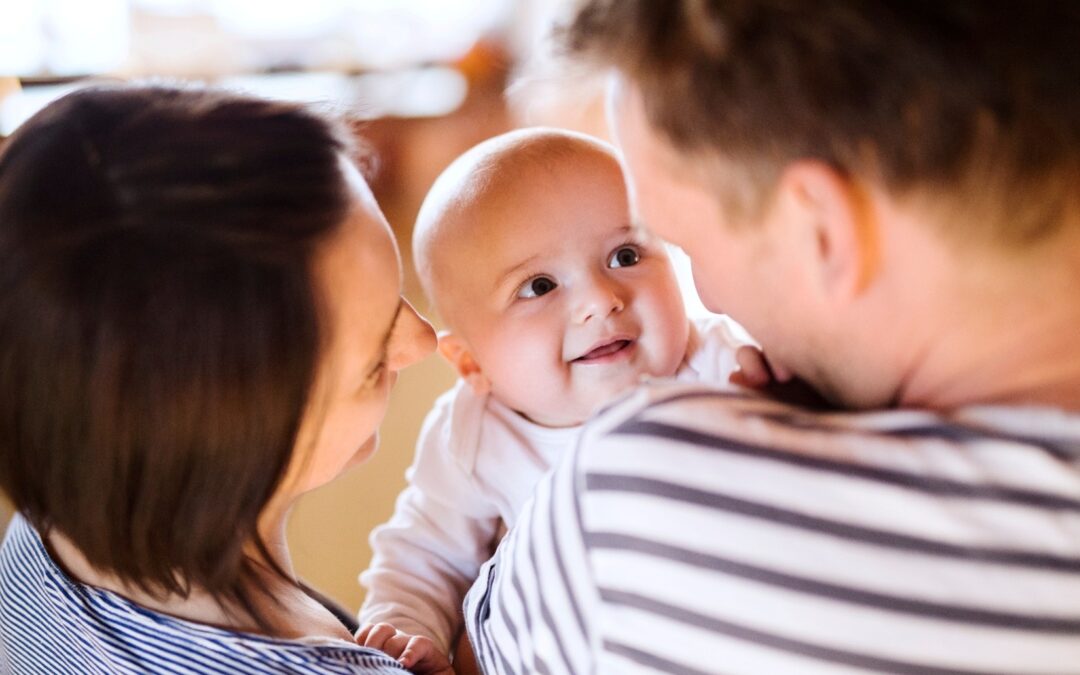
A newborn may quiet when they hear your voice. A few months later, that same baby may smile when you walk into the room, make a sound and wait for you to answer, or turn when they hear their name.
Long before first words, babies are learning how to connect with the people around them. Those changes are part of baby milestones too, alongside physical growth, movement, and exploration.
The CDC uses developmental milestone checkpoints at 2, 4, 6, 9, and 12 months. Babies may reach skills at somewhat different times, so these ages are best treated as guideposts rather than exact deadlines.
Birth Through 3 Months: The Earliest Back-and-Forth
During the newborn stage, much of your baby’s movement is reflexive, but they are already responding to touch, voices, comfort, and close faces.
Around 1 month, your baby may spend more time awake and alert. You may notice them looking more closely at your face or settling when they hear a familiar voice.
By about 2 months, common milestones include:
- Looking at your face
- Smiling when you talk or smile
- Making sounds other than crying
- Reacting to loud noises
- Watching you move
- Holding the head up briefly during tummy time
Around 3 months, smiles and coos may become more frequent. Head control often becomes steadier, and your baby may begin swiping or reaching toward nearby objects.
When Do Babies Start Smiling?
Early smiles can happen during the newborn period, but the social smiles parents tend to recognize usually become more noticeable in the early months.
You may smile, speak, or lean close and see your baby respond with a smile of their own. That simple exchange is one of the first ways interaction starts to feel truly two-way.
4 Through 6 Months: Interaction Becomes More Two-Way
By 4 months, babies often have more ways to respond when you engage with them.
They may chuckle, make sounds back, turn toward your voice, and use facial expressions to hold your attention. Physical changes are happening too, including steadier head control, reaching toward toys, hands to mouth, and pushing up during tummy time.
Around 5 months, vocal play may become more varied. Babies can also become increasingly interested in familiar faces, expressions, and sounds.
By 6 months, common milestones include:
- Laughing
- Taking turns making sounds
- Recognizing familiar people
- Reaching for a toy they want
- Rolling from tummy to back
- Pushing up with straight arms
- Leaning on the hands for support while sitting
Communication at this age is not limited to sounds. Looking toward you, smiling, reaching, and responding to your voice can all be part of the exchange.
7 Through 9 Months: Sounds and Responses Become Easier to Recognize
During the second half of the first year, babies often become increasingly expressive.
Around 7 months, your baby may experiment with different sounds and use facial expressions or body language more clearly with familiar people.
By about 8 months, repeated sound combinations may become more common. Your baby may also show stronger preferences for familiar people, toys, or routines.
At 9 months, common milestones include:
- Looking when their name is called
- Making repeated sounds such as “mamama” or “bababa”
- Showing clear reactions when a familiar person leaves or returns
- Sitting without support
- Moving objects from one hand to the other
- Looking for something that disappears from view
When Do Babies Start Babbling?
Babies experiment with sounds well before true babbling. Repeated syllables often become more noticeable later in infancy, though timing varies.
One of the fun changes during this stage is how vocal play can begin to feel conversational. Your baby makes a sound, you answer, and they respond again.
When Do Babies Respond to Their Name?
Responding to a name often becomes more noticeable later in the first year. You may see your baby turn, look toward you, or pause when they hear it.
As with any single milestone, it is more useful to consider this within the broader picture of how your baby is communicating and responding.
10 Through 12 Months: Gestures Join the Conversation
Toward the first birthday, babies often gain new ways to communicate without using many words.
Around 10 months, you may notice more imitation, reaching, facial expressions, or movement toward people and objects they want.
At about 11 months, familiar words and routines may prompt clearer reactions. Babbling can become more varied and expressive.
By 12 months, common milestones include:
- Waving goodbye
- Playing simple interactive games
- Understanding “no”
- Looking for hidden objects
- Putting objects into containers
- Pulling up to stand
- Walking while holding furniture
- Picking up small objects between the thumb and finger
When Do Babies Start Waving?
Gestures such as waving often appear toward the later part of the first year, although babies do not all begin at the same age.
Waving is one example of how communication expands beyond sounds. A gesture can become another way for your baby to take part in a familiar social routine.
Babies Communicate Without Words
Waiting for a first word can make it easy to overlook how much communication has already been happening.
Your baby may communicate by:
- Looking toward you
- Smiling
- Reaching
- Turning away
- Making sounds
- Changing their facial expression
- Holding out their arms
- Using gestures
Those signals can tell you quite a bit before spoken language arrives.
Conversation With Your Baby Can Be Simple
You do not need special language lessons to encourage interaction.
Talk through an ordinary routine. Pause after your baby makes a sound and give them a chance to respond again. Name something they are looking at. Sing a familiar song or look through a board book together.
Even a diaper change or feeding can become a back-and-forth moment when you respond to your baby’s sounds, expressions, and attention.
The goal is not to push early speech. It is to give your baby plenty of opportunities to experience responsive interaction.
Supporting Connection in Daycare
If your baby spends part of the week in daycare in Columbia, MD, familiar caregivers, responsive interaction, comforting routines, and sensory experiences can provide many opportunities for connection throughout the day.
At Celebree School of Columbia-North, infant care includes nurturing relationships, responsive communication, predictable routines, and opportunities to explore.
For one baby, connection may look like smiling back at a familiar teacher. For another, it may be making sounds during a song, reaching to be picked up, or turning toward a familiar voice.
These everyday exchanges give babies room to communicate in the ways they are ready for.
When to Ask About Communication or Development
Babies develop on different timelines, but questions are still worth discussing.
Talk with your child’s pediatrician if your baby is not meeting expected milestones, loses a skill they previously had, or if you have concerns about how they respond, interact, communicate, move, or develop overall.
You do not need to decide for yourself whether something is a delay before asking.
From a first social smile to babbling, responding to a name, and waving goodbye, babies spend the first year finding new ways to connect. Watching those baby milestones unfold can help you notice just how much communication is already happening before the first real words arrive.