
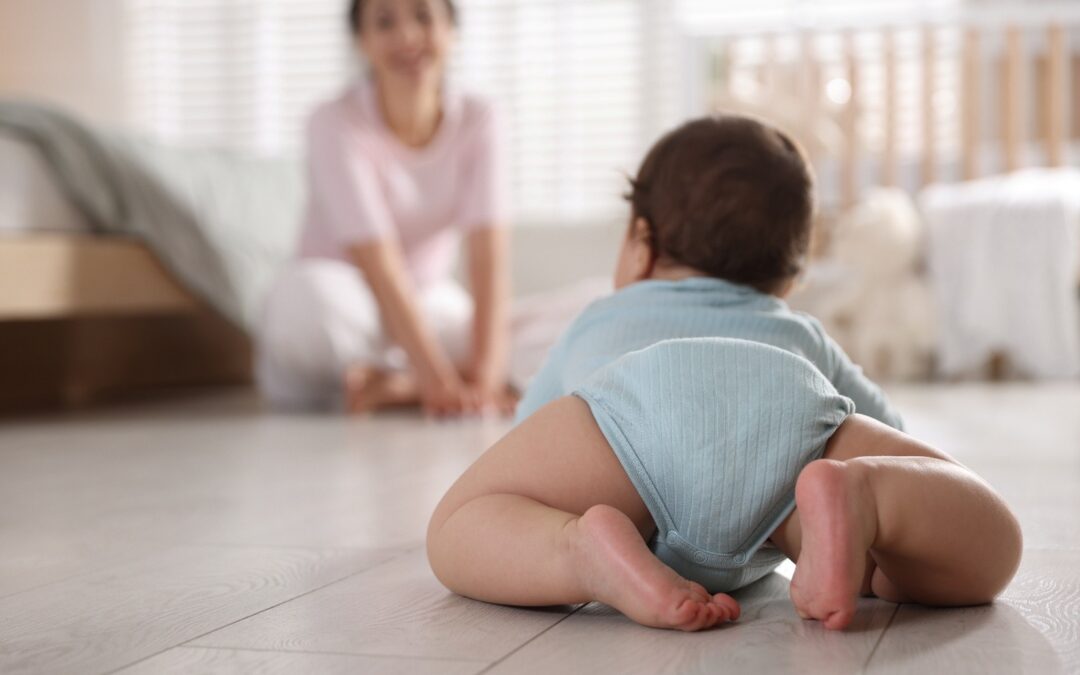
Search for the age when babies start crawling, and you may find several slightly different answers. That can make a simple question feel more confusing than it should.
So, when do babies start crawling? Many babies begin traditional hands-and-knees crawling around 7 to 10 months.
That is a useful reference point, but it is not a deadline. Some babies become mobile sooner, others later, and some use a different way of getting around altogether.
Understanding what that common age range really means can make it easier to follow your baby’s progress without watching the calendar quite so closely.
What Age Do Most Babies Start Crawling?
The 7-to-10-month range is commonly used to describe when babies begin mastering traditional crawling.
That still leaves plenty of room for variation. A baby crawling at 7 months and another beginning closer to 10 months can both be developing within a typical range.
You may also see different ages listed because infant movement does not change according to one fixed schedule.
Crawling develops alongside other abilities, including sitting, reaching, changing positions, and eventually pulling up.
The age itself is only one piece of the picture.
What Does the Crawling Age Range Really Tell You?
Think of an age range as context rather than an appointment on your baby’s calendar. It helps parents understand when a skill often appears, but it cannot tell you which week your baby will begin doing it.
Your baby may spend quite a while figuring out how to shift their weight or move from sitting onto their stomach. Then, seemingly overnight, they cover a few feet. Another baby may begin moving gradually, adding a little more distance each day.
Neither route needs to match a particular month exactly.
A Lot Can Change During These Months
The second half of a baby’s first year can bring noticeable changes in movement.
A baby who once stayed wherever you placed them may begin turning toward something interesting, moving between positions, or figuring out how to get closer to a toy. Crawling may appear during this period, followed at some point by pulling up, standing with support, or moving alongside furniture.
These skills can overlap. Your baby does not have to completely master one before becoming interested in another. That is one reason a single crawling age cannot tell you everything about how mobility is progressing.
What If Crawling Starts Outside the Common Range?
Parents often wonder what it means if their baby falls on either side of the usual range.
An earlier start does not automatically mean a child is advanced. A later start does not automatically mean something is wrong.
Babies develop movement skills differently, and traditional crawling is only one way they may become mobile. Rather than attaching too much meaning to the month crawling begins, watch how your baby’s abilities are changing overall.
Crawling May Not Look Like Hands and Knees
The classic image of crawling is a baby moving forward on both hands and knees. Your baby may have another idea.
Some babies move on their bellies. Others scoot, roll, or combine several different movements to reach whatever interests them. A few spend relatively little time using a traditional crawl.
That means a parent waiting specifically for hands-and-knees crawling could overlook the other ways a baby is becoming more capable and mobile.
Look Beyond the Date on the Calendar
A crawling age can be helpful when you are learning what to expect, but comparison becomes less useful when it starts overshadowing the changes happening right in front of you.
Notice how your baby reaches, changes positions, explores the floor, and becomes more confident using their body. Those observations can give you a much fuller view of progress.
If something about your baby’s movement concerns you, talk with their pediatrician. You should also bring up a loss of a previously learned skill or a persistent difference in how your baby uses the two sides of their body.
You do not have to decide on your own whether something falls inside or outside an expected range.
Watching Development at Celebree School of Bel Air
At Celebree School of Bel Air, infant teachers observe physical development as babies move, play, and explore throughout the day.
One child may be beginning to scoot across the floor. Another may be getting steadier when changing positions. Someone else may have just discovered how quickly crawling can get them to an interesting toy.
Teachers can document those changes and share observations with families while providing age-appropriate opportunities for movement.
The focus is on the child who is developing now, rather than expecting every baby to reach the same skill at the same age.
Use the Range as a Reference
Knowing that many babies begin crawling around 7 to 10 months can give you a helpful sense of what may be ahead. It does not need to become a countdown.
Watch how your baby’s movement develops, enjoy the new abilities that appear along the way, and bring questions to your pediatrician when something concerns you.
If you are looking for daycare in Bel Air, MD, Celebree School of Bel Air provides infants with opportunities for safe movement, exploration, and individualized development throughout the day. Schedule a visit to meet our team and learn more about infant care at Celebree.