
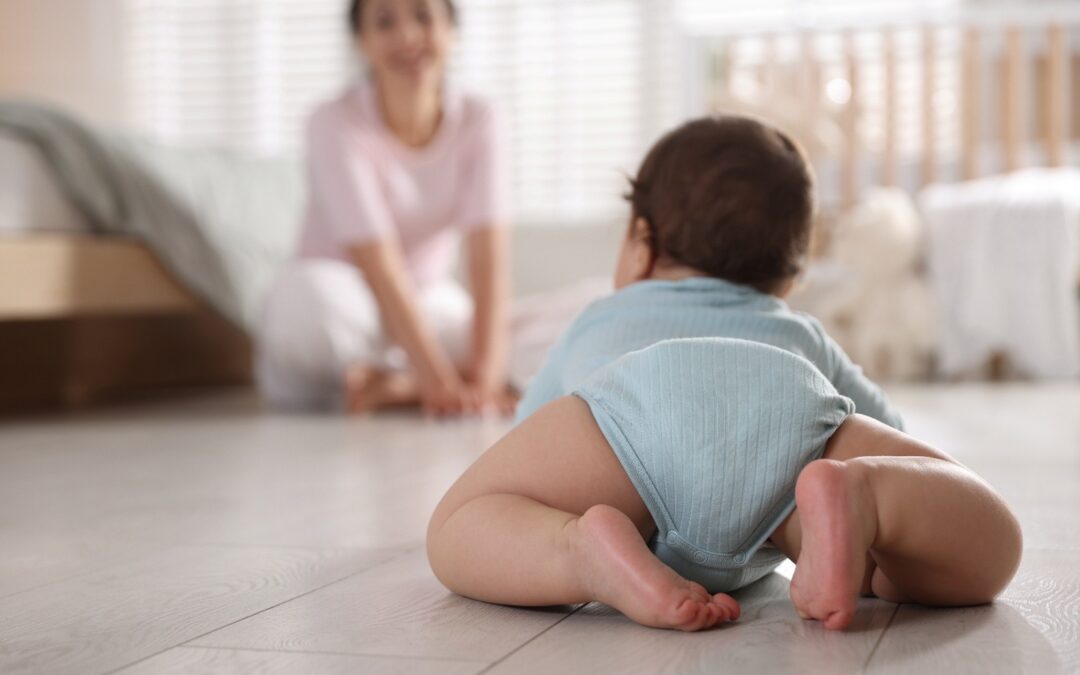
One day, your baby stays more or less where you put them. Then you notice they have turned themselves around on the floor, stretched farther than expected for a toy, or somehow moved several feet while you were looking the other way.
Those small changes can leave you wondering: When do babies start crawling?
Many babies begin crawling on their hands and knees somewhere around 7 to 10 months, but there is plenty of variation. Some start earlier or later. Others use a different way to get around, and a small number of babies never use traditional hands-and-knees crawling before moving on to pulling up, cruising, and walking.
Movement Often Changes Before Crawling Begins
Crawling usually does not appear out of nowhere. Your baby has been building strength, balance, and coordination through many smaller movements along the way.
You may notice changes such as:
- Pushing up more strongly during tummy time
- Reaching for toys while sitting or lying down
- Turning or pivoting on the floor
- Shifting weight from one side of the body to the other
- Getting onto hands and knees
- Rocking forward and backward
- Trying to move toward a person, toy, or other interesting object
These are common examples rather than a checklist your baby needs to complete. One baby may spend weeks rocking on hands and knees. Another may start scooting across the floor without ever doing it.
Crawling May Look Different Than You Expect
The classic image of crawling involves alternating hands and knees, but babies are remarkably creative when they decide they want to get somewhere.
Your baby might belly-crawl or use an “army crawl,” pulling forward with their arms while keeping their stomach closer to the floor. Some babies initially crawl backward. Others scoot on their bottom, roll toward what they want, or use another combination of movements.
You may even see your baby start pulling up on furniture before they have spent much time crawling traditionally.
Pay attention to the broader picture of how your baby is moving and progressing rather than waiting for one exact crawling style to appear.
Give Your Baby Opportunities to Move
Parents often search for ways to “teach” a baby to crawl. In practice, babies benefit from having regular opportunities to explore movement on their own.
Supervised floor play gives your baby room to reach, roll, turn, push up, and experiment with new positions. Tummy time while your baby is awake also helps develop muscles used for many early motor skills.
You can make that time interesting by getting down on the floor with your baby or placing an appealing toy where they can see it. Your voice, face, or an interesting object may give them a reason to reach or try moving in a new way.
There is no need to turn crawling into a daily exercise routine. Give your baby safe opportunities to move and let them figure out what their body can do.
What If Your Baby Isn’t Crawling Yet?
It is easy to compare timelines, especially when another baby of the same age has already started moving across the room.
Crawling develops across a broad range, and traditional hands-and-knees crawling is not a developmental requirement that every baby follows in exactly the same way.
Look at your child’s movement as a whole. Are they becoming stronger? Trying new positions? Reaching, sitting, rolling, scooting, pulling up, or finding other ways to explore?
If something about your baby’s movement concerns you, bring it up with their pediatrician. It is especially important to seek guidance if your baby loses a skill they previously had or you notice persistent differences in how they use the two sides of their body. Your pediatrician can look at your child’s overall development rather than judging progress by crawling alone.
New Skills May Show Up at Daycare, Too
Babies sometimes try a new movement when parents are not there to see it.
A toy across the classroom may suddenly be worth scooting toward. Another child’s activity may catch your baby’s attention. Your baby may discover that shifting their weight a certain way gets them exactly where they want to go.
This is one reason communication between home and daycare can be so helpful during the first year.
At Celebree School of Waverly Woods, teachers observe children’s development throughout the day and share what they notice with families. That might include a new way your baby is moving, growing confidence during floor play, or another change that tells you they are becoming more mobile.
Those observations give you another window into what your child is learning and experimenting with throughout the day.
Get Ready for a More Mobile Baby
Once your baby begins moving independently, their world gets bigger very quickly.
This is a good time to look at familiar spaces from floor level. Cords, small objects, stairs, furniture, cabinets, and items that once seemed safely out of reach may suddenly become accessible.
You may also find that mobility arrives in bursts. A baby who was barely moving forward a few days ago can become surprisingly efficient once they discover a method that works.
Keep providing a safe space to explore, watch how your baby is progressing, and bring questions to your pediatrician when you have them. Crawling is an exciting part of infancy, but it is only one piece of a much larger developmental picture.
If you’re looking for daycare in Woodstock, MD, Celebree School of Waverly Woods provides an infant environment where children have opportunities to move, explore, and develop at their own pace. Schedule a visit to meet our team and learn more about infant care at Celebree.