
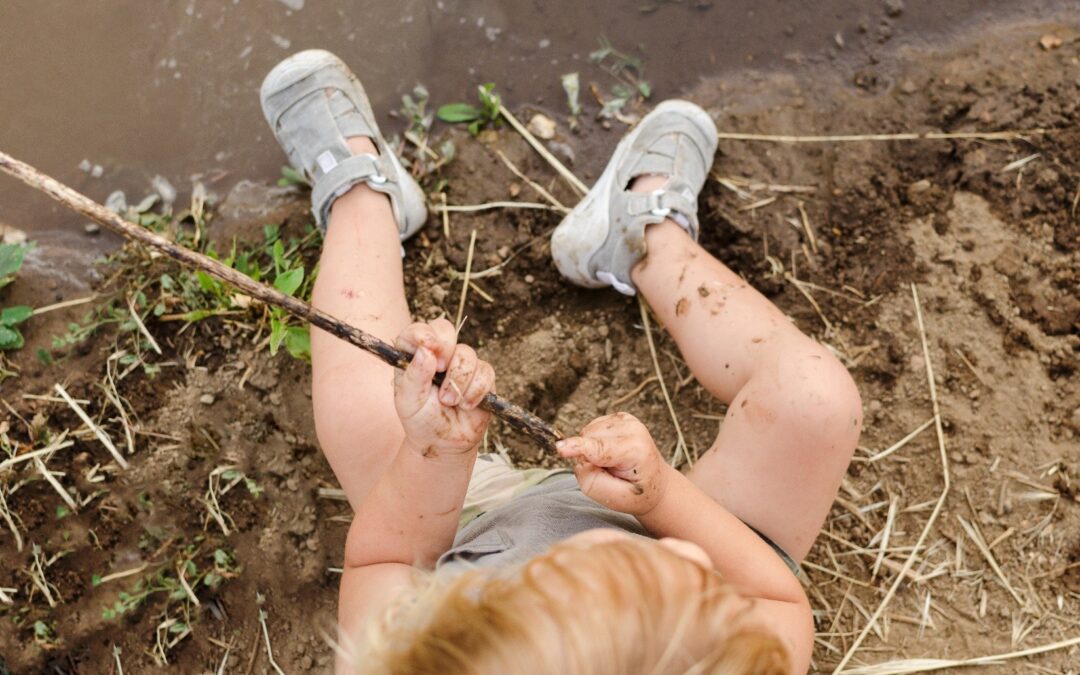
You had a plan.
A quick activity. Something simple. Maybe even contained.
Then suddenly:
- The paint is on their hands
- The paint is on their arms
- The paint is somehow on their face
And now you’re standing there wondering how things escalated so quickly.
If you’ve been there, you’re not alone. Messy play has a way of getting bigger than expected.
It’s also doing more for your child than it might seem in the moment.
Why Kids Lean Into the Mess
Children aren’t trying to make more work for you. They’re exploring. When they:
- Splash in puddles
- Dig in mud
- Spread paint beyond the paper
They’re learning through their senses.
They’re figuring out how things feel, move, and change based on what they do. That kind of hands-on exploration is how young children build understanding.
What Messy Play Is Really Teaching
What looks chaotic on the surface is often very focused underneath.
- Mud play introduces texture, cause and effect, and early science concepts
- Painting supports creativity, fine motor skills, and self-expression
- Water play builds coordination, experimentation, and problem-solving
Children are fully engaged in the process, which is exactly where learning happens.
It Builds Confidence, Too
Messy play gives children freedom. There’s no single “right” way to do it. That freedom allows them to:
- Make choices
- Try new things
- Express themselves without pressure
Over time, that builds confidence and independence.
Yes, It Can Be Inconvenient
Let’s be honest, this is the part that’s hard. You’re thinking about:
- The Cleanup
- The Time
- What Comes Next
Those are real considerations. Messy play doesn’t mean ignoring them. It just means approaching it differently.
Set Clear Expectations Ahead of Time
Children do better when they know what’s allowed. You can set simple boundaries like:
- “It’s okay to make a mess here.”
- “We’re keeping the paint on the table.”
- “We clean up when we’re done.”
Safety is part of that structure, too. Messy play should still happen in a space that’s appropriate and supervised, using materials that are safe for your child. That might mean skipping stagnant water, avoiding unknown substances, or choosing environments where you feel confident letting them explore.
This gives them freedom within structure and keeps the experience both fun and safe.
Plan for the Mess
One small shift makes a big difference. Expect it.
That might look like:
- Choosing a space that’s easier to clean
- Having towels or wipes nearby
- Setting out a change of clothes ahead of time
When you’re prepared, the mess feels more manageable.
Make Cleanup Part of the Activity
Cleanup doesn’t have to feel like a separate task. It can be part of the experience.
In an age-appropriate way, children can:
- Help wipe surfaces
- Put materials away
- Rinse off tools or toys
You’re not looking for perfection. You’re helping them build responsibility.
A simple phrase goes a long way: “It’s okay to make a mess. We always clean up after.”
Have a Clear Next Step
Transitions are easier when they’re predictable. After messy play:
- It’s time to clean up
- It’s time to change clothes
- It’s time for a bath
When children know what comes next, it reduces resistance.
What This Builds Over Time
Messy play supports more than just the moment. Children develop:
- Creativity
- Problem-solving
- Independence
- Confidence in trying new things
They learn that exploration is okay, even when it isn’t perfectly neat.
It’s Not Really About the Mess
The paint washes off.
The mud rinses away.
The puddles dry.
What stays is the experience your child had while they were fully engaged. Those moments build how they think, how they explore, and how they approach learning.
Supporting Exploration in Westminster
If you’re using child care in Westminster, MD, you may see these kinds of experiences happening more often.
At Celebree School of Tech Court, messy play is part of a larger approach to learning through exploration. Children are encouraged to engage, experiment, and discover in ways that feel natural while being thoughtfully guided by teachers.
It may look like a mess. It’s actually a meaningful part of how children learn and grow.