
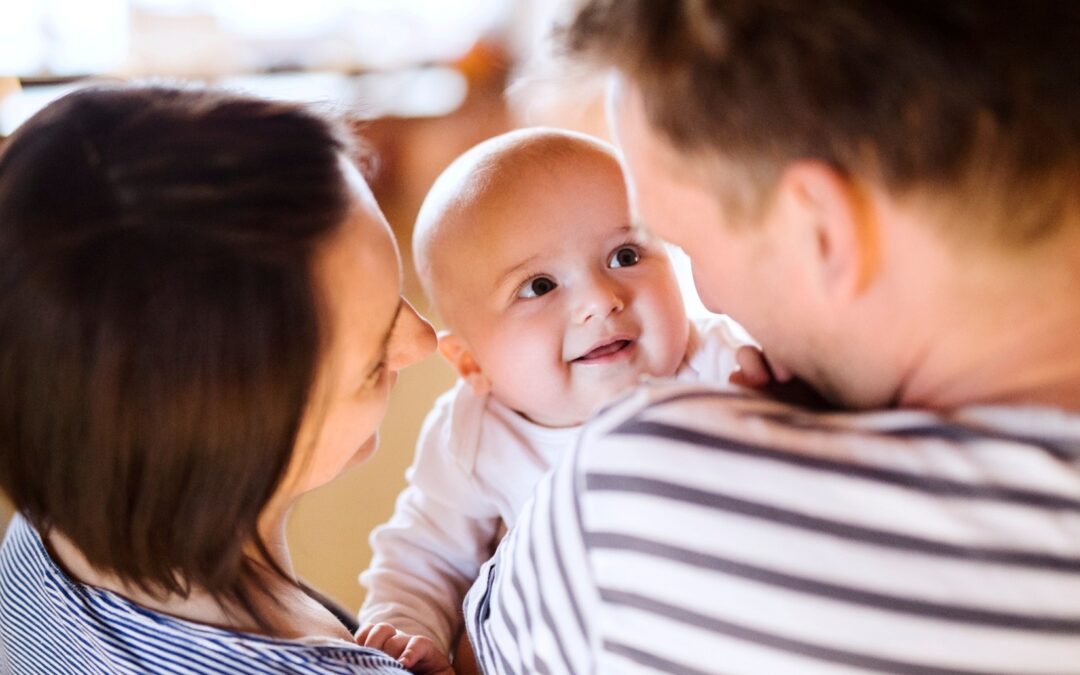
The first few weeks with a newborn can feel like a cycle of feeding, sleeping, diaper changes, and getting to know one another. Then, somewhere around the 2-month mark, you may notice a shift. Your baby watches your face more closely. A smile appears in response to yours. Little sounds begin to join the conversation.
Two months is one of the first developmental checkpoints when these changes may become easier to spot. It is still only one point in a much longer first year, and every baby follows their own timeline.
Why 2 Months Can Feel Like a Big Change
During the newborn stage, many movements are still reflexive and social responses may be subtle. By about 2 months, babies often spend more of their awake time looking, listening, and responding.
You may notice your baby:
- Looking closely at your face
- Smiling when you talk or smile
- Making sounds other than crying
- Watching you as you move
- Looking briefly at a toy
- Holding their head up during tummy time
- Moving both arms and legs
- Opening their hands for short periods
Not every milestone will appear at exactly the same time. The larger change is that your baby may begin to feel a little more engaged with the people and activity around them.
What Happens Before the 2-Month Mark?
Around 1 month, babies are still adapting to the world outside the womb. Their head needs plenty of support, movements may look jerky or unpredictable, and much of the day centers on basic needs.
Even so, development is already underway. Babies begin focusing briefly on nearby faces, reacting to sounds, and practicing head and upper-body movement while awake and supervised.
Those small changes help set the stage for the more noticeable interaction many parents see around the second month.
From 3 to 5 Months, Babies Become More Active
After the early 2-month changes, babies gradually gain more ways to interact with their surroundings.
Around 3 months, you may hear more cooing and notice steadier head control. Babies often bring their hands toward their mouth and may begin swiping toward interesting objects.
By about 4 months, many babies make sounds back when someone talks to them, chuckle, hold a toy placed in their hand, and swing toward nearby toys. Tummy time may also look different as upper-body strength improves.
Around 5 months, reaching often becomes more deliberate. Your baby may spend longer holding, turning, mouthing, or examining safe objects.
The progression is gradual. Something that begins as watching a toy may become swiping toward it and, later, reaching with a clear target in mind.
Around 6 Months, There Is Much More to Do
By the middle of the first year, babies often seem far more involved in what is happening around them.
Around 6 months, many babies laugh, recognize familiar people, reach for toys they want, take turns making sounds, and roll. Sitting may also be emerging, although some babies still need their hands or an adult for support.
This stage often brings together several areas of development at once. Better body control makes it easier to explore toys. More vocalizing creates longer back-and-forth interactions. Greater awareness of familiar people adds another layer to social development.
The Second Half of the Year Brings New Ways to Explore
During 7 and 8 months, babies often become steadier sitters and more confident handling toys. They may reach in different directions, move objects between their hands, or experiment with ways to move across the floor.
Some babies begin crawling during this period. Others scoot, roll, creep, or find another way to get where they want to go.
By around 9 months, many babies sit without support, transfer objects between their hands, make repeated sounds, look when their name is called, search for something that falls out of sight, and lift their arms to be picked up.
At this stage, a baby’s personality may also become easier to see. They may have favorite games, strong reactions to familiar people, or clear opinions about what they want to explore next.
What Changes Between 10 Months and the First Birthday?
The final few months before age 1 often bring more mobility, more precise movements, and clearer communication.
Around 10 months, some babies begin pulling themselves up more often or moving along furniture while holding on. Gestures and repeated sounds may become more purposeful.
By about 11 months, babies may copy familiar actions, handle smaller objects with greater control, and take a more active role in everyday routines.
Around 12 months, many babies:
- Wave goodbye
- Play simple interactive games
- Use “mama,” “dada,” or another special name meaningfully
- Understand a familiar word such as “no”
- Pull to stand
- Move while holding onto furniture
- Pick up small objects with the thumb and pointer finger
Some babies take independent steps before their first birthday, while others continue crawling or cruising. Walking independently is not something every baby does by 12 months.
Early Milestones Grow Through Everyday Interaction
Babies practice developing abilities throughout ordinary parts of the day. Floor play gives them space to move.
Conversations introduce sounds and the rhythm of communication. Familiar songs and routines become recognizable over time. Safe toys offer something to look at, reach for, hold, and investigate.
At daycare in Sudbury, MA, responsive communication, familiar routines, sensory experiences, and time to explore give babies opportunities to use emerging skills throughout the day.
For a 2-month-old, that may look like watching a familiar face or lifting their head during supervised tummy time.
Months later, the same everyday interaction may involve reaching for a toy, sitting to play, babbling back and forth, or moving toward something interesting.
Baby Milestones Are Reference Points, Not a Race
It is easy to compare one baby with another, especially during a year when changes seem to happen constantly. One baby may smile readily at 2 months but take more time with rolling. Another may become mobile early and spend longer developing gestures or sounds.
The useful question is whether your baby is continuing to develop across movement, communication, social interaction, and play over time.
Talk with your child’s pediatrician if your baby is not meeting expected milestones, loses a skill they previously used, or if something about their movement, hearing, communication, or development concerns you.
The 2-month mark may bring some of the first noticeable changes, but it is only the beginning. Over the months that follow, those early looks, smiles, sounds, and movements gradually become a much wider range of ways to explore and connect.