
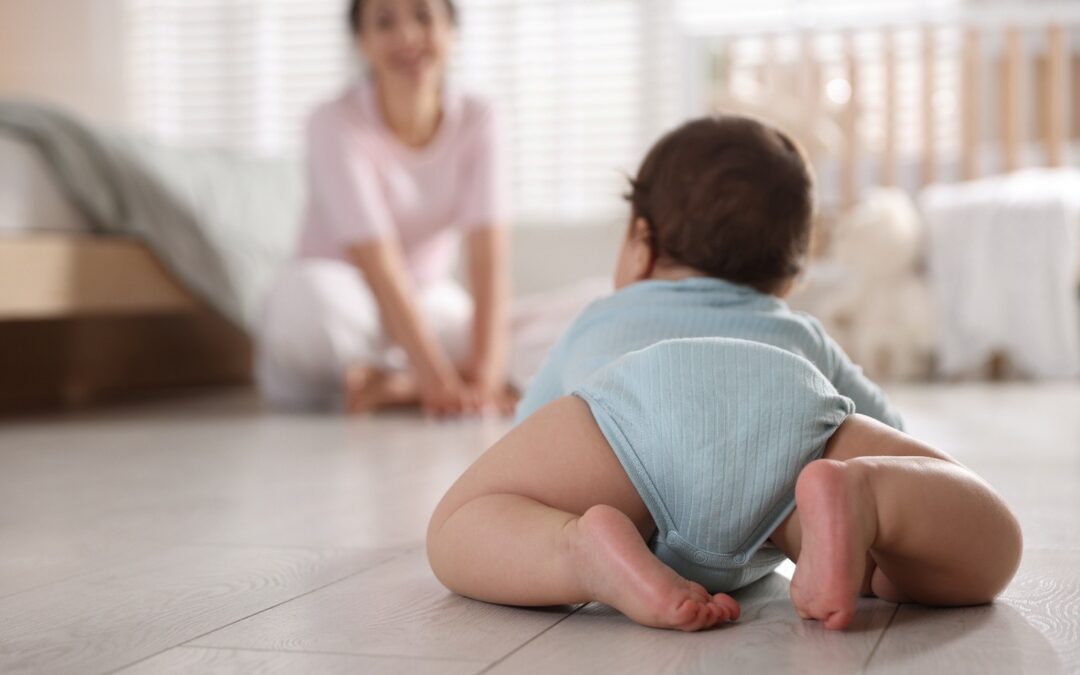
Your baby spots a toy across the floor, pushes with determination, and somehow ends up farther away from it. Backward crawling can look confusing at first, especially when your baby clearly seems interested in moving forward.
But early crawling often involves plenty of trial and error while babies figure out how to coordinate their arms, legs, and weight.
Why Is My Baby Crawling Backward?
Early on, your baby may have more strength or control in their arms than in their legs.
When they push against the floor, that force can send them backward. They may also be learning how to shift their weight and coordinate both sides of the body, so the direction they travel does not always match the direction they intended.
In other words, your baby may already understand the goal even if their body is still working out the route.
When Do Babies Start Crawling?
Many babies begin crawling somewhere around 7 to 10 months, but the first attempts can look very different.
Some babies crawl on hands and knees. Others move on their bellies, scoot, rock, pivot, or go backward before they begin making forward progress.
That variety is one reason the question when do babies start crawling does not have one exact answer. Timing varies, and so does technique.
Does Crawling Backward Mean Forward Crawling Is Next?
It might be part of the process, but there is no way to predict exactly what your baby will do next.
Your child may spend days or weeks moving backward before forward crawling becomes easier. They may also switch to another movement style altogether.
Try not to treat backward crawling like a stage that has to be corrected or completed on a schedule. Watch how your baby is becoming more comfortable moving through the space around them.
What Else Might You Notice?
Backward movement rarely happens in isolation. Around the same time, you may notice your baby:
- Rocking on hands and knees
- Turning or pivoting on the floor
- Reaching farther for toys
- Pushing up through their arms
- Shifting their weight from side to side
- Moving on their belly
These small changes can be easy to overlook when you are waiting for a traditional forward crawl, but they are all part of your baby’s growing interest in movement.
Should You Help Your Baby Turn Around?
You do not need to keep repositioning your baby every time they go backward.
Instead, give them supervised floor time and something interesting nearby to explore. Your baby can experiment with reaching, pushing, changing direction, and figuring out what movements help them get where they want to go.
A favorite toy can offer motivation, but there is no need to turn crawling into a formal exercise.
Once your baby starts moving in any direction, take another look at babyproofing too. Going backward can still bring cords, furniture, small objects, and other parts of the room within reach.
When Should You Ask Your Pediatrician About Movement?
Backward crawling by itself is not automatically a reason for concern.
Still, bring up any movement questions with your child’s pediatrician if your baby consistently uses one side of the body differently, seems unusually stiff or floppy, loses a skill they previously had, or something about their movement worries you.
Your pediatrician can look at what you are noticing alongside your child’s overall development.
Plenty to Discover at Daycare
Once babies realize they can move, even going backward can open up a whole new view of the room.
At Celebree School of Smyrna, infants have opportunities for physical development, gross and fine motor experiences, sensory exploration, and age-appropriate movement throughout the day. Teachers also stay in regular communication with families about the changes they notice.
For a baby experimenting with crawling, that may mean reaching toward something interesting, backing away from it, pivoting to try again, or discovering a new way to move altogether.
If you are looking for daycare in Smyrna, GA, Celebree School of Smyrna provides responsive infant care where babies can explore new abilities at their own pace.