
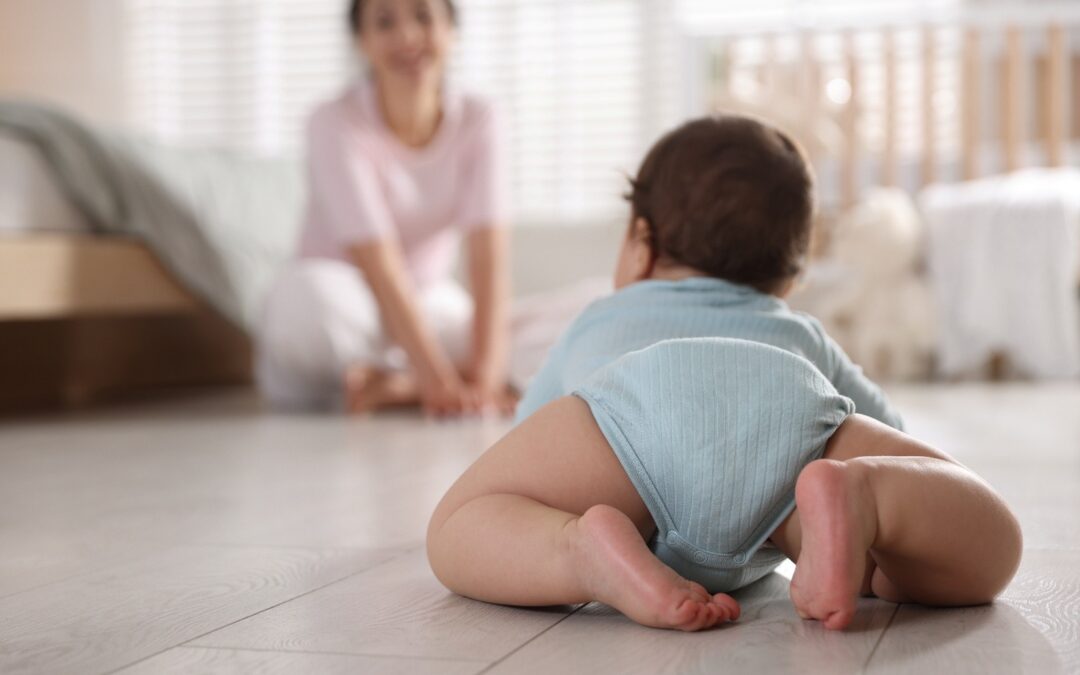
For many parents, crawling brings to mind the classic picture: a baby on hands and knees, moving one arm and the opposite leg forward. But before that motion comes together, you may see plenty of practice that looks much less coordinated.
So, when do babies start crawling on hands and knees? Many babies begin crawling somewhere around 7 to 10 months, although the timing can vary. Some use this traditional style right away, while others belly crawl, scoot, or find another way to get around first.
What Does Hands-and-Knees Crawling Look Like?
During a traditional crawl, your baby supports their weight on their hands and knees and begins coordinating opposite sides of the body as they move forward.
It may look smooth once they get the hang of it, but those first attempts can be anything but.
Your baby might move one knee and then stop. They may reach forward, lose their balance, sit back down, or suddenly decide they would rather roll toward the toy instead.
Those trial-and-error moments are part of figuring out how movement works.
What Might Happen Before the First Forward Crawl?
Before your baby starts making real progress across the floor, you may notice them experimenting with the crawling position. They might:
- Push up onto their hands and knees
- Rock forward and backward
- Shift their weight from one hand to the other
- Reach for a toy while staying on all fours
- Move backward instead of forward
- Drop back onto their belly after a few seconds
None of these signs gives you an exact countdown to crawling. They simply show that your baby is exploring balance, strength, and movement in a new position.
Does Getting on All Fours Mean Crawling Is Close?
It can be a sign that your baby is getting more comfortable in the position, but there is no way to know whether forward crawling will happen tomorrow or several weeks from now.
Some babies spend quite a while rocking on hands and knees before they move forward. Others seem to figure it out almost overnight.
And some babies decide that another style works better.
That is why it helps to watch the bigger pattern of how your child is becoming more mobile rather than focusing on one particular pre-crawling sign.
Does My Baby Have to Crawl This Way?
No. Hands-and-knees crawling is common, but it is not the only way babies learn to get around.
Your child may move along on their belly, scoot while sitting, roll, or switch between different styles. Some babies never spend much time doing a traditional crawl before they become interested in pulling up or standing.
If your baby’s movement looks different from what you expected, you do not need to reposition their arms and legs to create a textbook crawl.
Give them room to explore what their body can do.
Make Floor Time About Discovery
A safe space on the floor gives your baby opportunities to reach, turn, shift their weight, and test new movements.
Place something interesting nearby and let your baby decide how to reach it. One day they may rock on all fours. Another day they may crawl forward a few inches. On another, they may ignore the toy completely.
The goal is not to practice crawling until your baby masters it. It is to give them time and space to move naturally.
As soon as forward movement begins, take another look at babyproofing too. Mobility can make cords, low shelves, stairs, and small objects much more accessible than they were just a few days earlier.
When Should You Ask Your Pediatrician About Movement?
A baby’s crawling style can vary quite a bit, but questions about movement are always worth bringing to your pediatrician if something concerns you.
It is especially important to mention if your baby consistently uses one side of the body differently, seems unusually stiff or floppy, loses a skill they previously had, or you notice another change that does not seem right.
Your pediatrician can look at the way your child is moving as part of their overall development rather than judging one crawling style on its own.
Room to Move and Explore at Daycare
Once babies begin experimenting with hands-and-knees movement, familiar spaces can suddenly feel very different. A toy a few feet away becomes something they may actually be able to reach on their own.
At Celebree School of Plano at Los Rios, infants have opportunities for physical development, gross and fine motor experiences, and age-appropriate exploration throughout the day. Teachers also stay in regular communication with families about the changes and discoveries they notice.
For a baby working toward crawling, that may mean time to reach, shift position, rock, move forward, or simply try again later.
If you are looking for daycare in Plano, TX, Celebree School of Plano at Los Rios provides responsive infant care where babies have room to explore new abilities at their own pace.