
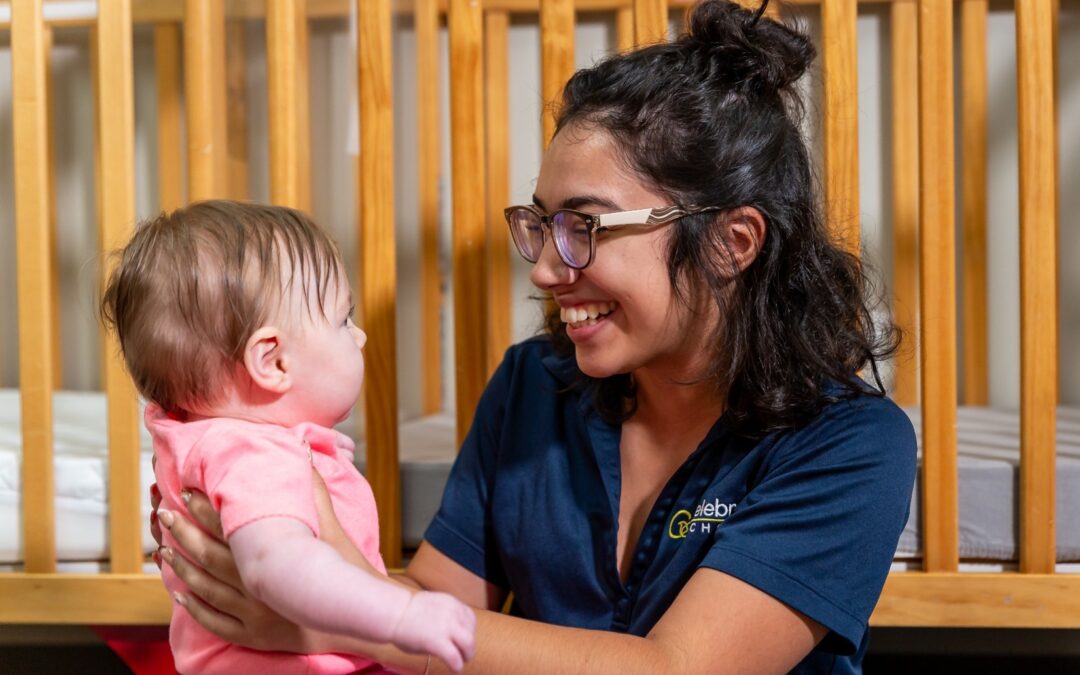
During the earliest weeks and months, much of a baby’s day revolves around feeding and sleep.
Then the stretches in between begin to grow. Your baby has more time to look around, move, respond to people, and become interested in what is happening nearby.
At Celebree School of Plano at Los Rios, infant care begins at 6 weeks. As babies grow, feeding, rest, comfort, interaction, and early learning continue to share the day, but the balance between them gradually shifts.
Feeding and Sleep Still Shape the Day
Longer awake periods do not make feeding and rest any less important.
Celebree School of Plano at Los Rios uses morning check-ins to learn when a baby last ate, slept, and was changed. Infants are also held during feedings and rocked to sleep.
Those details give teachers context for the hours ahead. A child who recently woke from a nap will experience the morning differently from one who is getting tired or approaching another feeding.
As routines develop, feeding and sleep continue to influence when a baby is ready to engage with the classroom.
Awake Time Can Have Different Paces
More time awake does not need to mean a busier schedule.
An alert baby might spend part of that stretch moving on the floor or interacting with a caregiver, then slow down to watch the room, listen to a voice, or concentrate on one object.
Some periods are naturally more active than others. Giving babies time to observe, repeat movements, and stay with something that interests them can be just as appropriate as introducing a new experience.
Movement and Communication Begin to Take Up More of the Day
As babies have longer stretches to engage with their surroundings, teachers see more opportunities for physical and social interaction.
Celebree School of Plano at Los Rios includes physical development, gross and fine motor experiences, language, and personal and social development within infant care.
In practice, that could mean more time moving on the floor, reaching toward safe objects, listening to conversation, responding with sounds, looking at books, or encountering simple signs during familiar routines.
These experiences do not need to follow a milestone checklist. They can reflect what the child is interested in and ready to explore at that point in time.
Teachers Can Build on What Holds a Baby’s Attention
Longer alert periods also give teachers more time to notice what consistently draws a child in.
Perhaps your baby keeps turning toward a certain sound, spends longer examining an object, or becomes especially engaged during conversation.
Those observations can help inform what happens next.
A child interested in movement might be given additional time and space to explore on the floor. Interest in voices could lead naturally to more songs, books, or back-and-forth sounds.
Planning grows from what teachers are seeing instead of requiring every infant to participate in the same experience.
The Balance Changes Across the Infant Program
Celebree School of Plano at Los Rios has separate infant classrooms for babies from 6 weeks to 9 months and from 9 to 18 months.
Earlier in infancy, feeding, sleep, being held, and close interaction often occupy a larger share of the day.
Over time, longer alert periods create more space for movement, communication, objects, books, gestures, and exploration. Feeding and naps may shift along the way as well.
These changes unfold differently for each child, so the experience continues to reflect individual routines rather than one expected timeline.
Daily Updates Can Show How the Day Is Changing
Parents usually want to know when their baby ate and slept, but updates can also reveal how awake time is evolving.
You might hear that your child spent longer moving on the floor, showed particular interest in a book, responded enthusiastically to music, or became focused on something new.
Celebree School of Plano at Los Rios uses evening reports to keep families informed about meals, naps, diaper changes, play, and other parts of the day.
Those details can help parents connect what teachers are noticing at school with changes beginning to appear at home.
What Can Parents Expect as Awake Time Grows?
The infant day gradually makes more room for movement, interaction, communication, and exploration as babies spend longer periods alert.
Feeding, sleep, comfort, and close care remain central throughout infancy. They simply share the day differently as the child grows.
Parents should expect that balance to continue evolving rather than looking exactly the same from one stage or one day to the next.
Explore Infant Daycare at Celebree School of Plano at Los Rios
If you are exploring infant daycare at Celebree School of Plano at Los Rios, visit the classroom and ask how feeding, sleep, awake time, and early learning change across the infant program.
You can also ask how teachers recognize and build on new interests as babies begin spending longer periods awake.