
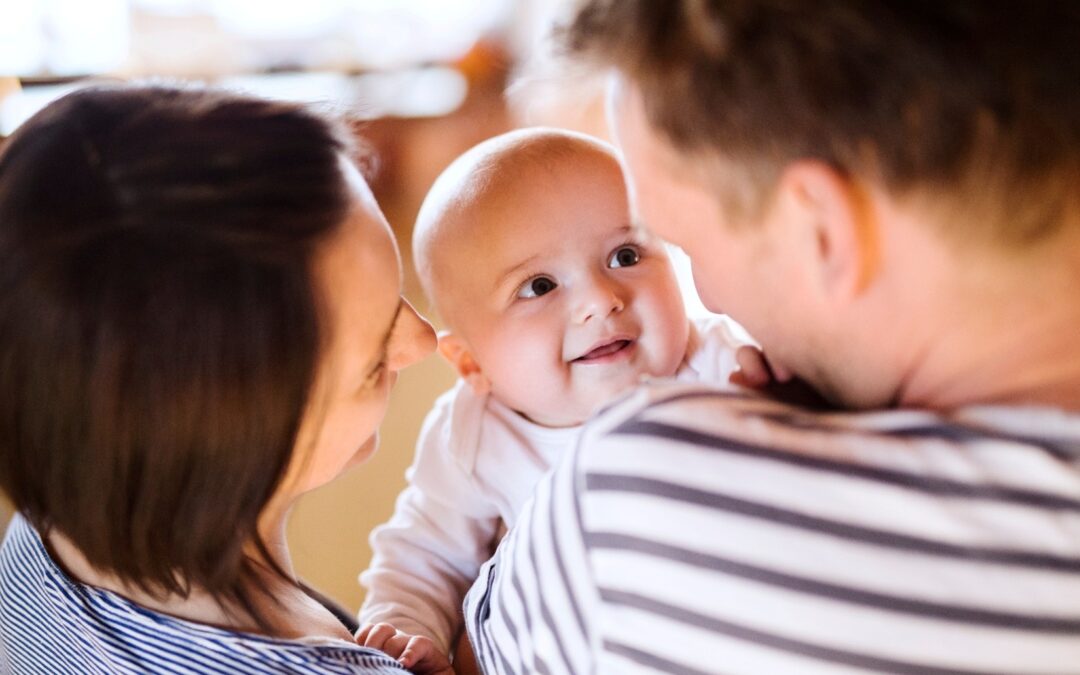
Your baby starts communicating with you long before their first word. A turn toward your voice, a smile in response to yours, or an enthusiastic string of sounds can all be part of the way communication develops during the first year.
Of course, communication is only one part of baby milestones. Movement, social-emotional development, and early thinking skills are changing too. Milestones can help you understand what you may notice along the way, but they are general guideposts rather than deadlines every baby follows on the same schedule.
The CDC uses developmental checkpoints at 2, 4, 6, 9, and 12 months. For the months in between, it can be helpful to think about skills that may gradually emerge as your baby grows.
Birth Through 3 Months: Faces, Voices, and Early Responses
Newborn communication is subtle. Your baby may quiet when held, react to sounds, look toward a nearby face, or show through cries and body movements that they need something.
Around 1 month, longer periods of alertness may give you more opportunities to interact. Your baby may spend more time studying faces or responding to familiar voices.
By about 2 months, common milestones include:
- Looking at your face
- Smiling when you talk or smile
- Making sounds other than crying
- Reacting to loud sounds
- Watching you move
- Holding the head up briefly during tummy time
Around 3 months, you may hear more cooing and see increasingly expressive smiles. Your baby may also begin swiping toward nearby objects while gaining better head and upper-body control.
When Do Babies Start Smiling?
You may see fleeting smiles earlier, but social smiles generally become more noticeable in the early months as babies begin responding more intentionally to faces and voices.
That back-and-forth matters. When your baby smiles and you smile back, they are beginning to experience the simple rhythm of social interaction.
4 Through 6 Months: Interaction Becomes More Two-Way
By the middle of the first year, your baby may seem much more interested in joining the conversation.
Around 4 months, many babies begin chuckling, making sounds back when you talk, turning toward your voice, and smiling to get your attention. Physically, they may hold their head more steadily, reach toward toys, and push up onto their forearms during tummy time.
At about 5 months, vocal play may become more varied. Your baby may experiment with different sounds while also reaching more accurately, grasping objects, rolling, or sitting with support.
By 6 months, common milestones include:
- Laughing
- Taking turns making sounds with you
- Recognizing familiar people
- Reaching for a toy they want
- Rolling from tummy to back
- Pushing up with straight arms
- Leaning on the hands for support while sitting
A simple exchange of sounds can become surprisingly entertaining at this age. Your baby makes a noise, you answer, and they try again. That early turn-taking is part of how communication grows.
7 Through 9 Months: Babbling Starts to Sound More Intentional
During the second half of the first year, babies often become much more expressive.
Around 7 months, you may hear a wider variety of sounds while your baby becomes more attentive to familiar voices. Sitting may become steadier, giving them a new position from which to watch people and explore toys.
By 8 months, repeated sounds may become more common. Your baby may also show stronger preferences for familiar people and routines while experimenting with rolling, scooting, crawling, or another form of movement.
At 9 months, common milestones include:
- Looking when you call their name
- Making repeated sounds such as “mamama” or “bababa”
- Reacting when you leave
- Sitting without support
- Getting into a sitting position
- Moving objects from one hand to the other
- Looking for an object that disappears from view
When Do Babies Start Babbling?
Babbling usually develops gradually. Early coos may become strings of consonant and vowel sounds that start to sound almost conversational.
A baby saying “mamamama” is not necessarily using “mama” as a meaningful word yet. At first, they are often experimenting with how sounds feel and how people react to them.
Babies also develop vocal skills on different timelines, so one child may be highly chatty while another is quieter.
10 Through 12 Months: Gestures Join the Conversation
By 10 months, communication may involve much more than sounds. Your baby may reach toward you to be picked up, gesture toward something interesting, imitate simple actions, or use their voice differently depending on what they want.
Around 11 months, many babies show a growing understanding of familiar words and routines. They may babble with different rhythms, imitate gestures, or clearly react when they hear something they recognize.
By 12 months, common milestones include:
- Waving goodbye
- Playing interactive games
- Understanding “no”
- Looking for hidden objects
- Putting objects into containers
- Pulling up to stand
- Walking while holding furniture
- Picking up small objects with the thumb and finger
Some babies may begin using a meaningful word around this time, while others rely mostly on sounds and gestures. Communication development is broader than the number of words a baby can say by their first birthday.
First Words Are Only One Part of Communication
It is easy to focus on speech because words are easy to recognize as progress. But your baby has been communicating with you for months before words appear.
Looking toward you when you speak, reaching to be picked up, responding to a familiar voice, laughing during a favorite game, and using gestures are all meaningful forms of interaction.
Physical milestones are developing alongside them too. Your baby may be learning to sit, crawl, pull up, or cruise while also figuring out how to make themselves understood.
One child may seem especially vocal while another puts more energy into movement. That variation is normal, and reaching one milestone earlier does not make a child more advanced overall.
Talking With Your Baby Can Be Simple
You do not need special lessons or flash cards to support early communication.
Ordinary conversation gives babies plenty to listen to. You might name what you are doing during a diaper change, talk about the pictures in a board book, sing a familiar song, or respond when your baby coos or babbles.
It can also help to leave a little space for your baby to respond. A pause after you speak gives them the chance to make a sound, smile, gesture, or simply look back at you.
These small exchanges can fit naturally into the routines you are already sharing.
Communication and Connection in Daycare
If your baby spends part of the week in daycare in Wilmington, DE, responsive interaction can continue throughout the day.
At Celebree School of Pike Creek, infant care includes opportunities for sensory exploration, movement, music, language, and play. Familiar routines and responsive caregivers also give babies plenty of chances to hear voices, engage with others, and communicate in the ways they currently know how.
The goal is not to rush your baby toward first words. It is to give them opportunities to interact, explore, and gradually build new ways of connecting with the people around them.
When a Milestone Question Is Worth Asking
There is a wide range of normal development during the first year, but your pediatrician is the right person to ask if something concerns you.
Talk with them if your baby is not meeting expected milestones, loses a skill they previously had, or you have questions about their communication, movement, or overall development.
You do not need to wait until you are certain there is a problem. Your pediatrician can consider your baby’s individual development and help you understand what comes next.
From an early smile to babbling across the room, communication develops through hundreds of small interactions during your baby’s first year. Milestones can help you notice that growth while leaving room for your baby to find their own way of making themselves heard.