
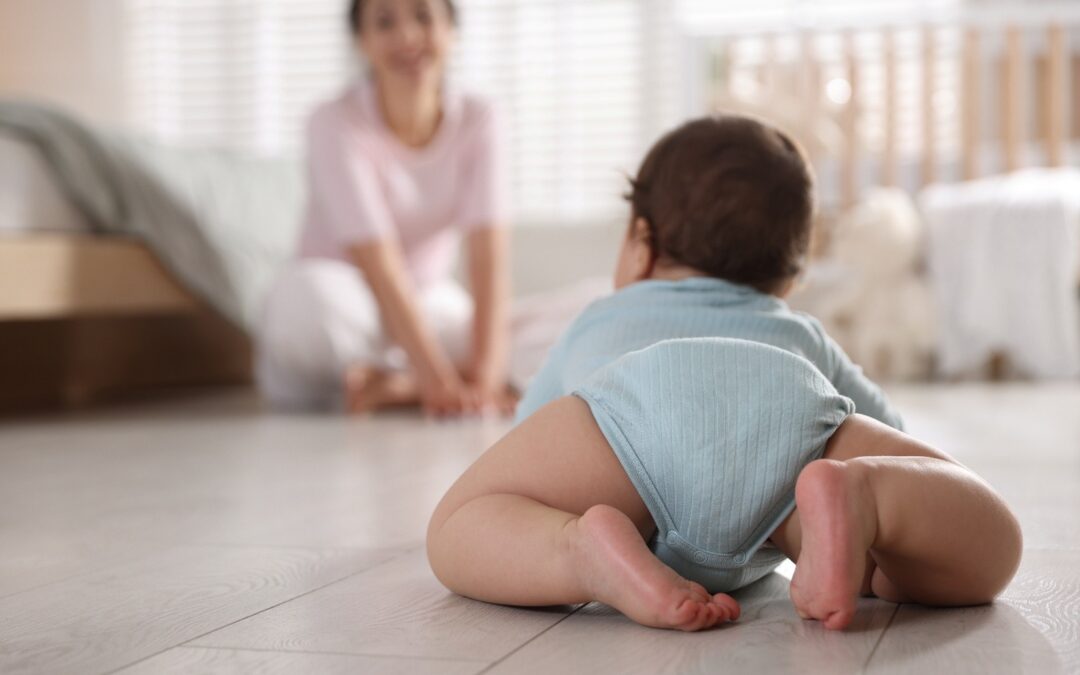
Your baby may not be crawling across the room yet, but somehow they keep ending up in a different spot than where you placed them.
That in-between stage can be full of small changes. If you are wondering when do babies start crawling, many babies begin traditional hands-and-knees crawling around 7 to 10 months. Others become mobile earlier or later, and some scoot, roll, or move on their bellies instead.
There is no single sign that tells you crawling will happen tomorrow. Still, you may start noticing your baby using their body in new ways as movement develops.
Crawling Often Has a Lead-Up
Crawling can seem like a dramatic milestone once a baby is finally crossing the floor, but the work leading up to it is often much quieter.
You may notice better balance, stronger position changes, or more determination to reach something that is just beyond arm’s length.
These changes do not have to happen in a particular order. One baby may spend weeks pivoting and rolling. Another may get onto hands and knees frequently before figuring out forward motion.
The useful part is noticing how movement is changing over time.
Reaching May Involve the Whole Body
Earlier in infancy, reaching might have meant stretching out one arm toward something nearby. As babies gain more control, that reach can become much more ambitious.
Your baby may lean forward, twist from sitting, brace with one hand, or shift their weight because they want the toy sitting just beyond their fingertips.
Sometimes they get it. Sometimes the reach turns into a roll, a flop onto the belly, or an entirely new position. Those moments show your baby experimenting with how to use more of their body to get where they want to go.
Your Baby May Stop Staying in One Place
You put your baby in the middle of the mat and return a moment later to find them facing the opposite direction. They may not be crawling, but they are clearly figuring something out.
Pivoting on the belly, rolling with a destination in mind, turning in circles, or repeatedly repositioning can all make floor play much more active.
Parents often notice this change before they see reliable forward crawling: the baby is no longer simply moving their arms and legs. Their movement starts to take them somewhere.
New Positions May Come More Easily
Another change to watch is how your baby moves between positions.
They may become steadier while sitting, lower themselves toward the floor with greater control, or begin getting into sitting without as much help.
You might also see them push up higher or briefly support themselves in a position they could not manage a few weeks earlier.
These abilities are useful on their own. They also give babies more options for how they move and explore.
Hands and Knees Are One Possibility
Some babies spend time getting onto their hands and knees before crawling.
They may hold the position briefly, rock forward and backward, reach with one hand, then drop back to the floor. Other babies barely do this at all.
Getting onto all fours can be one sign that a baby is experimenting with a new movement pattern, but it is not a required checkpoint. A baby may eventually scoot, belly-crawl, or use another approach instead.
Movement May Start to Look More Intentional
One of the most noticeable shifts comes when your baby seems to have a plan. They spot your phone, a favorite toy, the family pet, or you across the room and begin trying to close the distance.
The result may still be inefficient. They might move sideways, roll part of the way, or stop halfway through to investigate something else.
Even so, there is a difference between random motion and moving with a destination in mind. That growing intention is often one of the most interesting parts of watching mobility emerge.
Don’t Turn the Signs Into a Countdown
Once parents notice several of these changes, it can be tempting to assume crawling must be days away.
Maybe it is. Maybe it isn’t.
A baby may repeat one movement for quite a while before discovering another. They may appear close to crawling and then spend several days focused on sitting or practicing something completely different.
Use these signs as observations, not predictions. They can tell you what your baby is working on now without putting a date on what happens next.
Share Concerns Instead of Waiting for a Deadline
Variation in crawling is common, but parents should still trust themselves when something about movement seems worth asking about.
Talk with your baby’s pediatrician if you have concerns, notice a loss of a previously learned skill, or see an ongoing difference in how your baby uses the two sides of their body.
Specific observations are helpful. You do not need to decide whether a movement is normal before bringing it up.
Noticing the Small Changes at Celebree School of Nottingham
At Celebree School of Nottingham, infant teachers pay attention to the everyday changes that happen between major milestones.
A teacher may notice that your baby reached farther from sitting, turned toward a toy more easily, or began moving across the play space in a new way.
Those details can be shared with families through regular communication, giving parents another perspective on what their baby is practicing during the day.
The goal is not to predict when crawling will happen. It is to notice development as it unfolds and provide age-appropriate opportunities for babies to keep moving and exploring.
Watch for Progress in the Everyday Moments
Crawling may eventually become the obvious milestone everyone notices, but the lead-up is often made up of much smaller changes.
A longer reach. A new way of turning. A successful transition into sitting. One determined attempt to get closer to something interesting.
Those moments can tell you plenty about how your baby’s movement is developing, even before they make it across the room.
If you are looking for day care in Nottingham, MD, Celebree School of Nottingham provides individualized infant care with opportunities for movement, exploration, and development throughout the day. Plan a visit to meet our team and learn more about the infant program.