
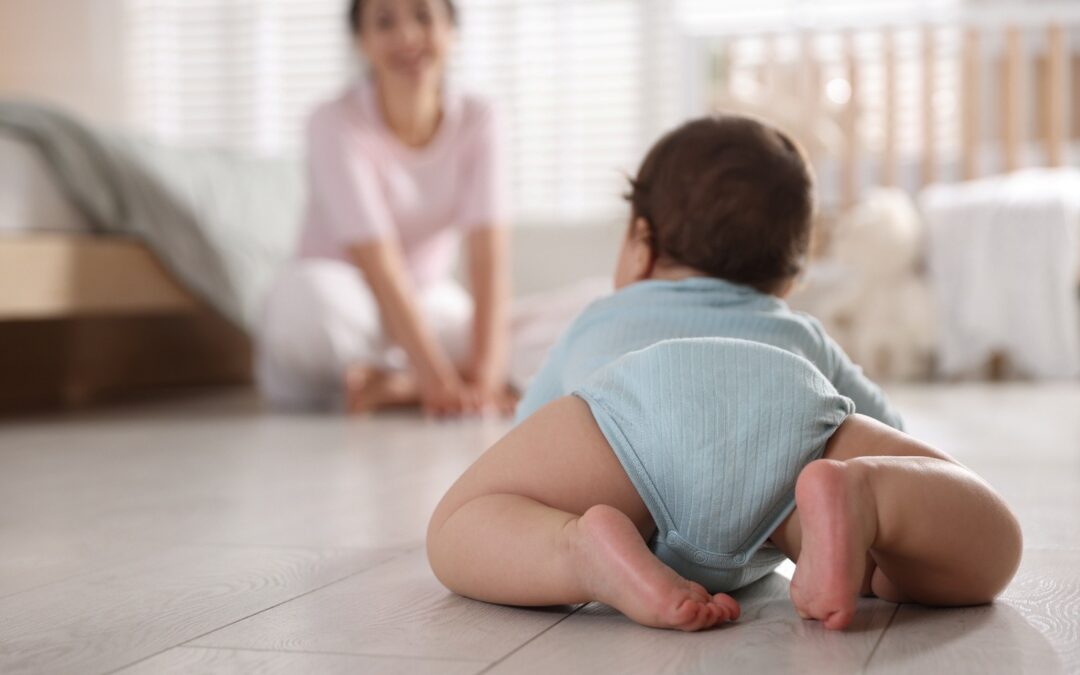
Another baby at the library is already crawling from one end of the play area to the other. Yours is 9 months old, sitting happily beside you with no apparent plans to follow.
It is hard not to compare.
If you are wondering when do babies start crawling, many babies master traditional crawling between about 7 and 10 months. But babies do not all follow the same route to mobility, and not crawling at exactly 9 months does not automatically signal a problem.
In fact, crawling itself is not on the CDC’s current list of 9-month developmental milestones.
Is It Normal for a 9-Month-Old Not to Crawl?
Nine months falls right in the middle of an age range when babies can look remarkably different from one another.
One baby may be crawling quickly. Another might be scooting on their bottom or pulling forward on their belly. A third may be perfectly content to sit and reach for whatever is nearby.
The American Academy of Pediatrics notes that some children never use a traditional crawl at all. They may scoot, move on their stomachs, or find another way to explore before eventually moving toward standing and walking.
So, a 9-month birthday should not become an automatic crawling deadline.
What Does the CDC Look for at 9 Months?
This is where parents can get a clearer picture of what milestone guidance actually says. For movement and physical development, the CDC’s current 9-month checklist includes abilities such as:
- Getting into a sitting position independently
- Sitting without support
- Moving an object from one hand to the other
- Using the fingers to rake food toward the body
Crawling is not included on that checklist.
That does not make crawling unimportant or mean you should ignore other concerns. It simply means that whether your baby crawls by exactly 9 months is not the sole measure of how physical development is progressing.
Notice What Your Baby Is Doing on the Floor
Instead of watching only for hands-and-knees crawling, pay attention to the broader ways your baby is moving.
Maybe they are twisting from sitting to reach something beside them. Perhaps they roll toward a toy, pivot on their stomach, scoot a short distance, or keep trying to move from sitting onto the floor.
Those small changes may not result in a baby crossing the room yet, but they can tell you something about what your child is practicing.
Try to notice movement over time rather than waiting for one particular technique to appear.
Try Not to Let Other Babies Set the Schedule
Comparing babies is almost unavoidable.
You see another child the same age crawling and immediately wonder why yours is not doing the same thing. The comparison feels especially convincing because the ages match.
But two 9-month-olds can be working on very different things.
One may be focused on mobility while another has become much steadier while sitting. Someone else may spend most of their energy babbling, handling objects, or practicing position changes.
A neighboring baby’s crawling date cannot tell you whether your own child’s development is on track.
Your pediatrician can look at a much broader range of skills and developmental history than a side-by-side comparison can.
Give Your Baby Reasons to Move
You do not need to teach a 9-month-old a formal crawling sequence.
Offer safe time on the floor and place something interesting nearby. A favorite toy or familiar person may be enough to prompt an attempt.
The CDC suggests putting toys on the floor slightly out of reach and giving babies opportunities to crawl, scoot, or roll toward them.
Sometimes your baby will make an impressive effort. Other times they may decide the toy simply isn’t worth the trip. Both can be part of ordinary play.
Nine Months Is a Good Time to Ask Questions
Even though crawling is not a required 9-month milestone, this is still an important age for developmental conversations.
The CDC notes that general developmental screening is recommended at 9 months and encourages parents to talk with their child’s doctor about milestones and any concerns.
You do not need to wait until your baby misses a particular crawling deadline before asking something.
Bring it up if your baby is not meeting other milestones, loses a skill they previously had, seems to use one side of the body differently, or something about their movement continues to concern you.
AAP guidance also says to contact the pediatrician if a baby is not sitting independently by 9 months or if you feel your child is not moving normally.
A simple description can be enough to start the conversation: “She’s 9 months and isn’t crawling yet, and this is what I’ve noticed during floor play.”
You Don’t Have to Decide Whether You Should Be Worried
Parents sometimes feel they need to determine whether a concern is serious before mentioning it. You don’t.
If something about your baby’s movement has been on your mind, ask. Your pediatrician can consider what you are seeing alongside other developmental skills, your child’s history, and what they observe during the visit.
That is much more useful than trying to find a single age online that tells you when concern officially begins.
Supporting Development at Celebree School of Montgomeryville
At Celebree School of Montgomeryville, infant teachers provide babies with age-appropriate opportunities to move and explore throughout the day.
One child may already be crawling across the room. Another may be working on getting into sitting, while someone else experiments with scooting, rolling, or reaching farther during floor play.
Teachers can share those everyday observations with families so parents have another view of what their baby is practicing.
The goal is not to predict when crawling will happen. It is to support the baby at their current stage and keep families informed as new skills emerge.
Nine Months Is One Point Along the Way
A 9-month-old who is not crawling may simply be working through mobility on a different timetable or in a different way.
Give your baby room to move, pay attention to what changes from week to week, and keep the conversation open with your pediatrician whenever you have questions.
If you are exploring day care in Montgomeryville, PA, Celebree School of Montgomeryville offers individualized infant care with opportunities for movement, play, and everyday discovery. Reach out to plan a visit and get to know our infant program in person.