
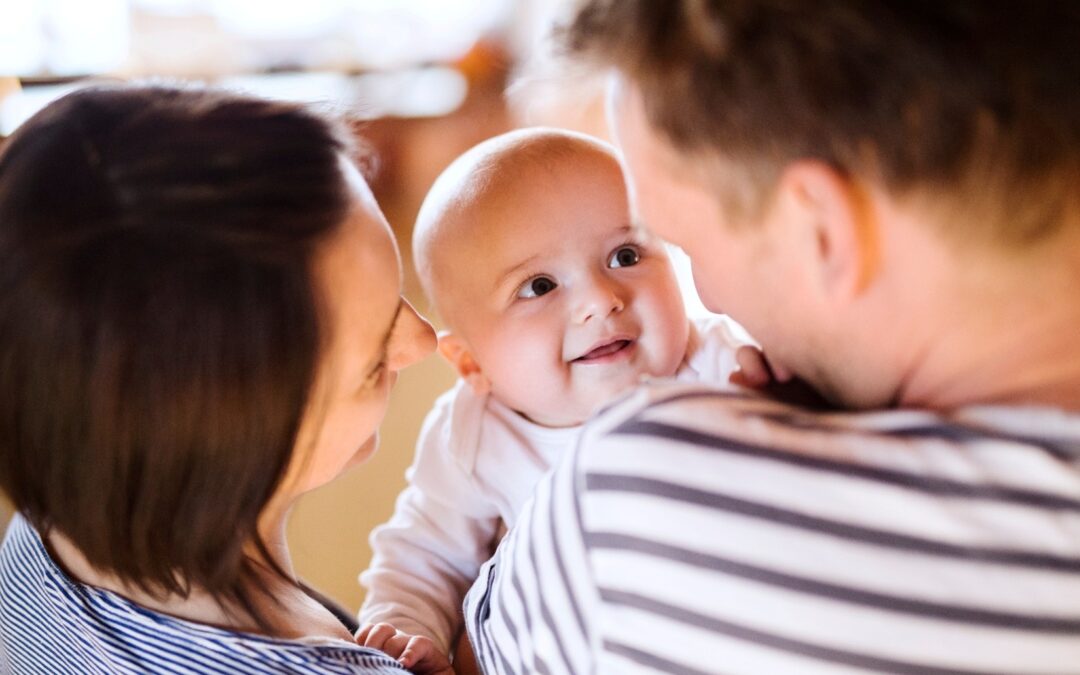
A first roll or attempt to crawl is hard to miss. Other changes can be quieter, like the first time your baby smiles back at you, turns when you call their name, or searches for a toy that disappeared from view.
That is why baby milestones are most helpful when you look beyond physical movement alone. During the first year, babies are also developing new ways to communicate, interact, explore, and respond to the people around them.
The CDC uses formal milestone checkpoints at 2, 4, 6, 9, and 12 months. During the months in between, you may notice new abilities beginning to emerge. Every baby develops on their own timeline, so these milestones are best treated as general guideposts rather than exact deadlines.
Birth Through 3 Months: Responses Become Easier to See
In the newborn stage, much of your baby’s movement is reflexive. Head control is still limited, and early responses often center on touch, sound, feeding, comfort, and close interaction.
Around 1 month, your baby may spend longer stretches awake and alert. You might notice more interest in faces and voices or more active arm and leg movements.
By about 2 months, common milestones include:
- Looking at your face
- Smiling when you talk or smile
- Making sounds other than crying
- Reacting to loud sounds
- Watching you move
- Holding the head up briefly during tummy time
Around 3 months, your baby may coo more often, smile more readily, open their hands more frequently, and begin swiping or reaching toward nearby objects. Head and upper-body control may also become steadier.
Physical growth is only part of what is changing. Your baby is also becoming more socially responsive and finding new ways to engage with you.
4 Through 6 Months: More Ways to Participate
By 4 months, babies often seem much more involved in what is happening around them.
They may hold their head more steadily, reach or swing toward toys, bring their hands to their mouth, and push up on their forearms during tummy time. Socially, you may hear chuckles, coos, or other sounds made in response to you.
Around 5 months, grasping may become more deliberate. Some babies begin rolling during this period or sit with support while becoming increasingly interested in holding, mouthing, and examining objects.
By 6 months, common milestones include:
- Reaching for a toy they want
- Rolling from tummy to back
- Pushing up with straight arms
- Leaning on the hands for support while sitting
- Laughing
- Taking turns making sounds
- Recognizing familiar people
A baby can be building physical control, communication, and relationships at the same time. One area does not have to develop in isolation from the others.
7 Through 9 Months: Movement Is Not the Only Big Change
The second half of the first year often brings more obvious mobility, but plenty is happening beyond crawling.
Around 7 months, sitting may become steadier and object play more deliberate. Your baby may transfer a toy from one hand to the other, reach in different directions, or spend more time examining something that interests them.
At about 8 months, some babies begin rolling, scooting, creeping, crawling, or using another way to get around. You may also notice stronger reactions to familiar people and routines.
By 9 months, common milestones include:
- Sitting without support
- Getting into a sitting position
- Looking when their name is called
- Making repeated sounds such as “mamama” or “bababa”
- Moving objects from one hand to the other
- Looking for something that disappears from view
- Reacting when a familiar person leaves or returns
A baby who is busy figuring out how to move is also learning about people, sounds, objects, and what happens when they interact with the world.
10 Through 12 Months: Intentions Become Easier to Read
As the first birthday approaches, your baby’s actions may become easier to understand.
Around 10 months, you may notice more gestures, imitation, purposeful movement toward interesting objects, and more deliberate ways of using toys.
At about 11 months, some babies begin pulling up or cruising while holding furniture. Babbling may become more varied, and familiar words or routines may clearly get their attention.
By 12 months, common milestones include:
- Waving goodbye
- Playing simple interactive games
- Understanding “no”
- Looking for hidden objects
- Putting objects into containers
- Pulling up to stand
- Walking while holding furniture
- Picking up small objects between the thumb and finger
Independent walking is not required by the first birthday. Some babies take steps earlier, while others need more time.
Some Important Changes Are Easy to Miss
Physical milestones tend to get a lot of attention because they are easy to see. Sitting, crawling, and pulling up are obvious changes.
Other milestones can be just as meaningful but much easier to overlook.
You may notice your baby:
- Turning toward you when you say their name
- Taking turns making sounds
- Looking for a toy that has been hidden
- Reaching toward you to be picked up
- Anticipating a familiar song or game
- Using a gesture such as waving
These changes can show growing communication, attention, memory, and social connection alongside physical development.
One Milestone Does Not Tell the Whole Story
It can be tempting to focus on the skill that seems most noticeable at the moment.
If your baby is not crawling yet, you may miss the fact that they are becoming more expressive or more interested in how objects work. Another baby may be highly mobile but quieter socially.
Development happens across several areas at once, and those areas do not always move at the same pace. Looking at the bigger picture can give you a more useful understanding of how your baby is growing than focusing on a single milestone in isolation.
Everyday Experiences Support Different Kinds of Growth
Babies do not need separate activities for every developmental skill.
During floor play, your baby may be working on movement and problem-solving while figuring out how to reach a toy. During a song, they may watch your face, listen to language, and begin anticipating a familiar sound. During a simple back-and-forth game, they may practice attention and social interaction.
Books, conversation, tummy time, safe toys, songs, and ordinary routines can all offer opportunities to explore and respond.
The goal is not to push your baby toward the next milestone. It is to give them safe, responsive experiences that match where they are now.
Supporting Development in Daycare
If your baby spends part of the week in daycare in Bowie, MD, responsive care, familiar routines, sensory exploration, movement, and interaction can provide more opportunities to use developing skills throughout the day.
At Celebree School of Melford, infant care includes nurturing routines, responsive communication, sensory experiences, movement, and opportunities to engage with people and surroundings.
For one baby, that may mean reaching toward a toy during floor play. For another, it may mean listening to a song, responding to a familiar caregiver, exploring a safe texture, or practicing a new way of sitting or moving.
These everyday moments support development as a whole rather than focusing on one milestone at a time.
When to Talk With Your Pediatrician
A wide range of developmental timing is expected, but questions are still worth asking.
Talk with your child’s pediatrician if your baby is not meeting expected milestones, loses a skill they previously had, or if you have an ongoing concern about their movement, communication, interaction, or overall development.
You do not need to decide for yourself whether something is a delay before bringing it up.
The first year is full of changes, and many of them are easy to miss if you are only watching for crawling or first steps. Baby milestones can help you notice the broader picture: a child who is gradually finding new ways to move, connect, communicate, and make sense of the world.