
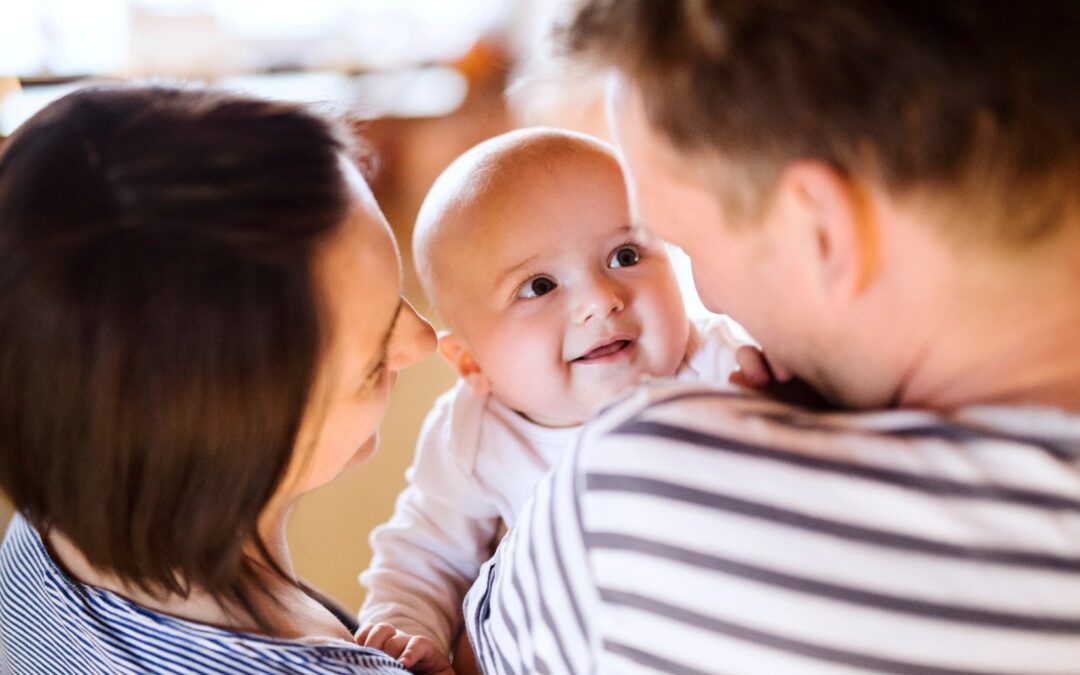
Independence looks very different during a baby’s first year than it does later in childhood. It may be as simple as reaching toward a toy, sitting upright long enough to explore it, moving toward something interesting, or lifting both arms to tell you they want to be picked up.
These small changes show how babies gradually become more active participants in their own day. The timing varies from child to child, so baby milestones are best viewed as guideposts rather than a schedule every baby should follow exactly.
In the First Months, Babies Begin Doing More
Newborns rely on adults for nearly everything, but even during the first few months, you can see early changes in how they interact with the world.
Around 1 month, babies may briefly focus on a nearby face, react to sounds, and lift or turn their head for short periods.
By about 2 months, many babies smile when someone talks or smiles at them, make sounds besides crying, watch people move, and briefly hold their head up during tummy time.
Around 3 months, head control often becomes steadier. Babies may bring their hands toward their face or mouth, coo more frequently, and begin swiping toward nearby objects.
These are still early skills, but they give babies more ways to participate instead of simply reacting to what happens around them.
Reaching Is an Early Way to Act on Curiosity
A toy may catch your baby’s attention long before they can do anything about it. Then one day, the arm movement becomes more deliberate.
When Do Babies Reach for Things?
Purposeful reaching often begins to emerge during the early to middle months of infancy.
Around 4 months, many babies swing an arm toward toys, bring their hands to their mouth, hold a toy placed in their hand, and show stronger head control.
By about 5 months, reaching and grasping may become more accurate. Your baby might stretch toward a toy, grab it, and spend time turning or examining it.
Around 6 months, many babies reach for objects they want and explore them with greater control.
Reaching may seem like a small change, but it gives babies an early way to act on a preference: they see something interesting and try to get it.
Sitting Gives Babies More Freedom to Explore
Sitting changes how babies experience play.
At first, your baby may need plenty of support. Later, they may lean forward on their hands to balance. As control improves, those hands become available for holding and exploring objects.
When Do Babies Sit Up?
Sitting generally becomes steadier over the middle and later months of the first year.
Around 6 months, many babies are beginning to sit while leaning on their hands for support. During 7 and 8 months, sitting may become increasingly stable.
By around 9 months, many babies sit without support.
Once sitting feels easier, a baby may reach in several directions, move a toy from one hand to the other, bang objects together, or sit and play for longer periods. They have more freedom to decide what catches their interest and what to do with it.
Around 6 to 9 Months, Babies Have More Ways to Participate
The middle of the first year often brings noticeable changes in movement, communication, and play.
At around 6 months, many babies roll, reach for things they want, laugh, recognize familiar people, and take turns making sounds.
Around 7 months, sitting often becomes steadier, and babies may spend more time handling toys and experimenting with movement.
By about 8 months, some babies are beginning to explore ways of getting around while others are still happiest sitting and playing.
At around 9 months, many babies sit without support, move objects between their hands, look when their name is called, make repeated babbling sounds, search for something that falls out of sight, and lift their arms to be picked up.
That last example is especially telling. A baby who raises their arms toward you has found a clear way to communicate what they want without using words.
Mobility Expands What Babies Can Explore
For much of early infancy, babies depend on someone else to bring interesting things within reach. Mobility changes that.
When Do Babies Crawl?
Many babies become mobile during the second half of the first year, but there is a wide range of timing and movement styles.
Some crawl on hands and knees. Others scoot, creep, roll, or find another way to move across the floor.
Crawling itself is not something every baby must do on the same schedule. What matters here is the growing ability to act on curiosity. A mobile baby may move toward a toy, follow a caregiver across the room, or investigate something that caught their eye.
That freedom can make the world suddenly feel much bigger.
Gestures Help Babies Express What They Want
As hand control and social awareness grow, babies begin using movement for communication as well as play.
Reaching toward you, lifting both arms, waving, or eventually pointing can all help a baby make their interests and preferences easier to understand.
When Do Babies Wave or Point?
These gestures generally emerge during later infancy, but timing varies.
A baby may first watch adults wave goodbye many times before trying the movement. Pointing may develop as hand control improves and babies begin using gestures to direct attention toward something they notice.
By around 12 months, waving goodbye is a common developmental milestone.
These small gestures matter because babies are no longer limited to crying or vocalizing to get a message across. They have more ways to participate in an interaction.
Near the First Birthday, Babies Take a Bigger Role in Daily Routines
Between about 10 and 12 months, babies often become increasingly active during play, movement, and familiar routines.
Around 10 months, some begin pulling up, shifting between positions more easily, and using gestures with clearer intent.
By about 11 months, cruising along furniture may appear, and hand movements may become more precise. Babies may also imitate familiar actions and take a more active role in games or routines they know well.
At around 12 months, many babies:
- Wave goodbye
- Play simple interactive games
- Pull to stand
- Move while holding onto furniture
- Pick up small objects using the thumb and finger
- Understand a familiar word such as “no”
- Use “mama,” “dada,” or another special name meaningfully
Some babies also take independent steps before their first birthday. Others are still cruising or crawling, and independent walking is not required at 12 months.
What About Feeding Themselves?
Later infancy may also bring small signs of greater participation at mealtimes.
Depending on a baby’s development, readiness, and the foods being offered, some begin reaching for appropriate pieces of food and trying to bring them toward their mouth. Others may be more interested in touching or exploring food before regularly feeding themselves.
This is another example of how independence develops gradually. The goal is not for a baby to manage an entire meal alone. It is simply another way they may begin taking a more active role in a familiar routine.
Independence Still Depends on Responsive Care
A baby becoming more independent does not mean they need less connection.
Feeling safe with familiar caregivers gives babies a secure base for exploring, trying something new, and returning for comfort when they need it. A baby may crawl away to investigate a toy and then turn back to check for a familiar face. They may try to pull up, wobble, sit back down, and try again.
At daycare in Lutherville, MD, responsive care, familiar routines, sensory experiences, and time to explore give babies opportunities to participate more actively as their skills develop.
For a younger infant, that might mean lifting their head during tummy time or reaching toward a toy. Later, it may mean sitting independently, moving toward something interesting, using a gesture, or participating more actively during play.
Independence Does Not Follow One Timeline
One baby may be eager to move through the room but use only a few gestures. Another may spend more time sitting and babbling before becoming mobile. Both can be making meaningful progress.
Rather than measuring how independent your baby appears, look at the broader pattern of development across movement, communication, play, and interaction.
Talk with your child’s pediatrician if your baby is not meeting expected milestones, loses a skill they previously used, or if something about their movement, hearing, communication, or interaction concerns you.
During the first year, independence grows through small moments. Reaching, sitting, moving, gesturing, and participating in familiar routines all give babies new ways to explore the world while still relying on the secure relationships around them.