
A baby’s day can include a lot of feeding, sleeping, diaper changes, and settling.
So, when parents hear that infants have a curriculum, it is fair to wonder when that learning actually happens.
At Celebree School of Leander at Crystal Falls, infant care begins at 6 weeks. Teachers use individualized care plans and work with each child’s feeding, sleep, comfort, and developmental needs.
For infants, early learning is woven into the ordinary parts of the day.
Feeding, Sleep, and Comfort Come First
Babies do not need to stay awake for an activity when they are tired or wait to eat because something else is planned.
At Celebree School of Leander at Crystal Falls, infants are held during feedings and rocked to sleep. Morning check-ins also tell teachers when the child last ate, slept, and was changed.
That gives the classroom team a useful starting point after arrival.
Some mornings may begin with rest. On another day, a baby may be ready to eat or spend some time awake. The timing follows the child’s immediate needs.
Everyday Care Includes Plenty of Interaction
A separate lesson period is not necessary for a young infant to have meaningful interactions throughout the day.
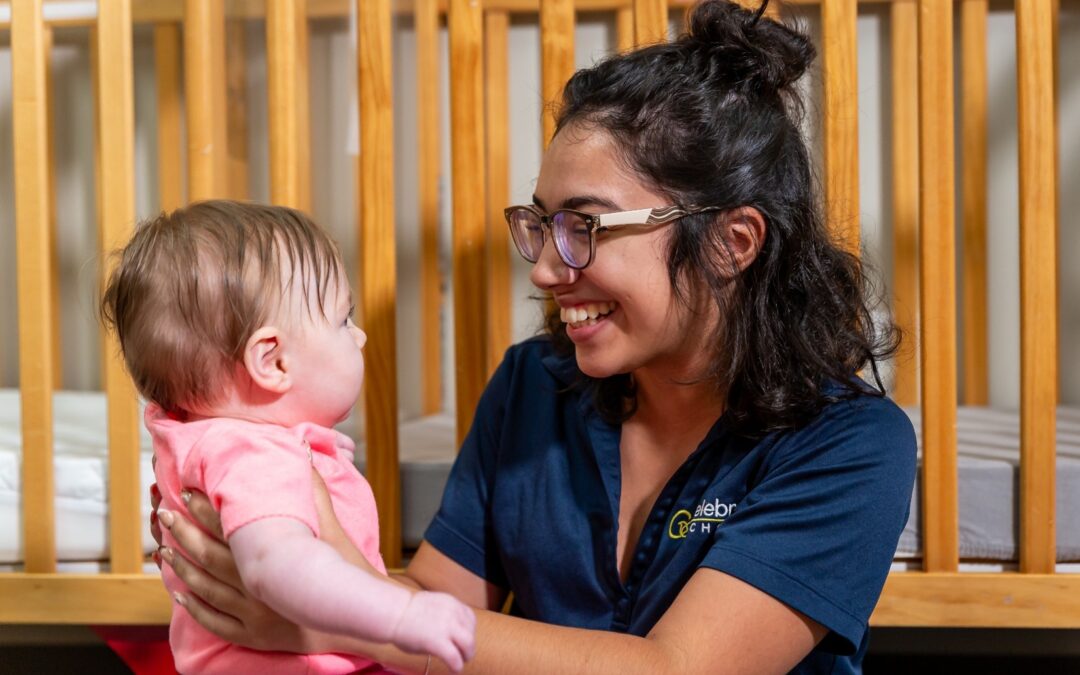
During a bottle, a caregiver might talk with the baby and respond to sounds or facial expressions. Familiar words and simple signs can also become part of diaper changes, settling, and other recurring routines.
These are ordinary moments, but they give babies repeated opportunities to hear language, respond to another person, and participate in back-and-forth interaction.
Awake Periods Leave Room to Explore
When a baby is rested, fed, and alert, there is more opportunity to move and take in the surroundings. Celebree School of Leander at Crystal Falls incorporates sensory exploration and connection into infant care.
A child might spend time moving on the floor, looking at a book, listening to a caregiver, handling a safe object, or watching activity nearby.
Not every alert period needs to be filled. Quiet observation has a place alongside more active engagement.
Teachers Pay Attention to What Draws Interest
Babies often make their preferences visible without words.
A sound, face, object, or movement may repeatedly capture a child’s attention. Teachers can notice those responses and decide when it makes sense to return to something the infant found engaging.
That could mean spending more time with a familiar book, continuing a face-to-face interaction, or giving the child another opportunity for floor movement.
The teacher’s observations help shape what comes next without turning the day into a fixed sequence of activities.
Infant Curriculum Does Not Require a Group Lesson
Several things may be happening in an infant classroom at once.
A child could be sleeping while another is finishing a feeding. Elsewhere in the room, an infant may be moving on the floor or spending time with a caregiver.
Curriculum still has a place in that setting.
For infants, it appears through movement, language, play, interaction, sensory experiences, and the everyday routines teachers share with children.
Everyone does not need to participate in the same activity together.
The Mix Shifts Across the Infant Program
Celebree School of Leander at Crystal Falls has infant classrooms for babies from 6 weeks to 9 months and from 9 to 18 months.
Earlier in infancy, feeding, sleep, comfort, and close interaction often occupy more time.
Later, babies typically have longer awake periods and additional ways to move, communicate, handle objects, and engage with their surroundings.
Those differences give teachers more options for the kinds of experiences they can offer while still working with the needs of the individual child.
Daily Updates Include Care and Play
Celebree School of Leander at Crystal Falls provides evening reports that include meals, diaper changes, naps, and play. Parents can see the practical details of feeding and rest along with some of what happened while their baby was awake.
That might include how the child spent playtime, what seemed to catch their attention, or another detail from their interactions during the day.
It gives families a more complete picture than bottles and naps alone.
What Should Parents Expect From Infant Curriculum?
Infant curriculum should look appropriate for infancy.
Parents can expect language, movement, sensory exploration, interaction, and play to show up throughout the day, often alongside the care routines babies already need.
Teachers also observe how children respond and use those observations to inform developmentally appropriate experiences.
There may not be a scheduled lesson block, but early learning is still part of the infant classroom.
Explore Infant Daycare at Celebree School of Leander at Crystal Falls
If you are exploring infant daycare at Celebree School of Leander at Crystal Falls, ask how teachers incorporate early learning around feeding, sleep, and other care needs.
You can also ask what play and exploration look like for younger and older infants and how families hear about those parts of the day.