
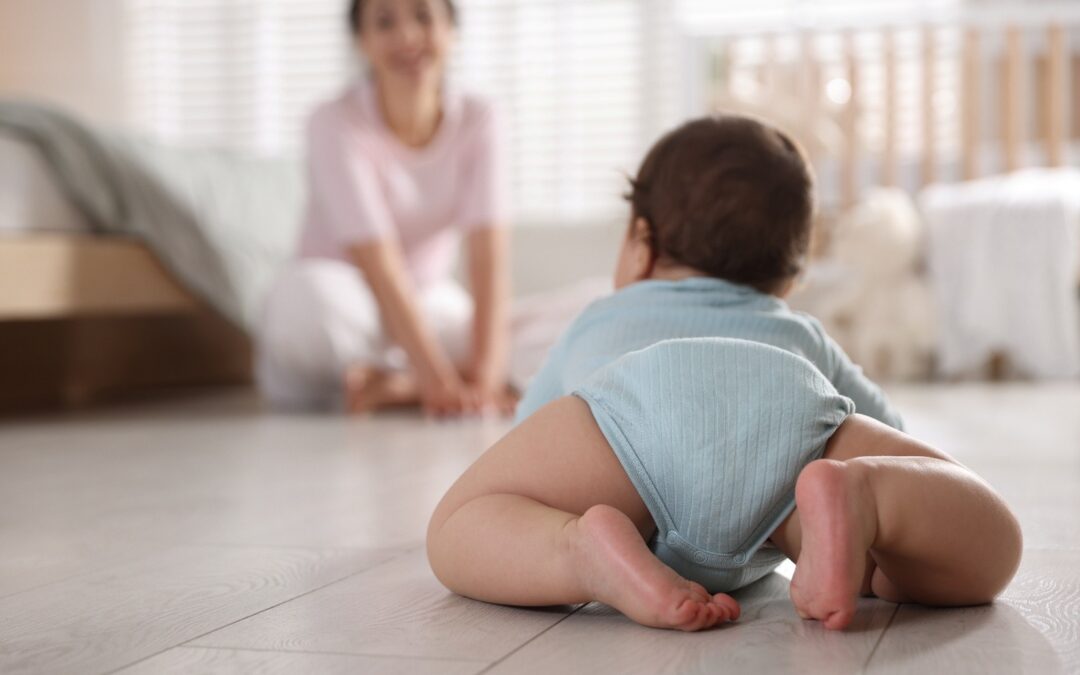
Your baby’s first birthday is getting close, and crawling still hasn’t happened.
Maybe they scoot across the floor. Maybe they roll to reach what they want. Or maybe they are happiest sitting until someone helps them move somewhere else.
If you are wondering when do babies start crawling, many babies master traditional crawling between about 7 and 10 months. But crawling itself is not on the CDC’s current 1-year milestone checklist. At 12 months, it becomes more useful to look at the bigger picture of how your baby moves, changes positions, and begins exploring upright movement.
Crawling Isn’t the Only Question at 12 Months
By the first birthday, parents may naturally start wondering whether a baby who has not crawled is falling behind. Crawling can be one part of mobility, but it is not the only part.
Some babies use a belly crawl or bottom scoot instead of the classic hands-and-knees pattern. A few may spend very little time crawling traditionally at all.
What matters more at this age is how movement is developing overall.
Is your baby finding ways to get from one place to another? Are they changing positions more independently? Are they beginning to bear weight through their legs or pull themselves upright?
Those details provide more useful context than crawling alone.
How Is Your Baby Changing Positions?
Think about what happens when your baby wants something just beyond reach.
Can they move from sitting toward the floor? Turn their body to get closer? Roll purposefully? Reposition themselves instead of waiting to be moved?
These transitions can be easy to overlook because they do not look as dramatic as crawling across a room. But they tell you something important about how your baby is learning to control their body and move more independently.
If your baby rarely changes positions on their own or seems to have very limited movement overall, that is worth mentioning to the pediatrician.
What If Your Baby Scoots Instead?
Some babies find bottom scooting extremely effective.
A baby may sit upright and use their legs, arms, or body weight to travel across the floor without ever dropping onto hands and knees.
AAP recognizes scooting and belly movement as alternative ways babies may get around, and some children never use a traditional crawl.
So, a 12-month-old who scoots should not automatically be treated the same as a child who has little independent mobility.
Look at what else your baby can do.
Are they moving themselves toward people and objects? Changing direction? Getting into different positions? Becoming more interested in standing?
The broader pattern matters.
Pulling Up Matters Around the First Birthday
At 12 months, upright movement becomes another useful piece of the picture. Current CDC 1-year movement milestones include pulling up to stand and walking while holding onto furniture.
That means a baby who does not traditionally crawl but is pulling up and beginning to cruise along furniture may be showing important mobility in another way.
On the other hand, if your baby is not crawling, scooting, pulling up, changing positions independently, or showing much interest in moving, that combination gives you more to discuss with the pediatrician than the missing crawl by itself.
Don’t Replace One Deadline With Another
Learning that crawling is not a required 1-year milestone can be reassuring. But it should not turn into, “Then I’ll just wait until walking.”
Milestone guidance is most useful when it helps parents notice patterns and start conversations.
There is no benefit to turning 12 months into a pass-or-fail date. There is also no need to wait several more months if something about your baby’s movement already concerns you.
If you have a question now, ask it now.
What Should You Bring Up With the Pediatrician?
By 12 months, it is reasonable to talk through the full mobility picture if crawling has not appeared. Bring up observations such as:
- Very limited independent movement
- Not pulling to stand
- Difficulty moving between positions
- Consistently favoring one side
- Unusual stiffness or floppiness
- Losing a skill your baby previously had
You can also bring up a concern that simply keeps bothering you, even if it does not fit neatly into a checklist.
Describe what your baby does during ordinary play. Your pediatrician can consider those observations alongside other developmental skills and decide whether anything needs closer attention.
You do not have to diagnose the problem before asking the question.
Movement Can Look Very Different at 12 Months
Two babies approaching their first birthday may have completely different ways of getting around.
One may crawl everywhere. Another may scoot, pull up, and cruise along furniture. Someone else may still be figuring out how to change positions and move toward what they want.
That variation is exactly why one crawling date cannot tell the whole story. Look for change over time.
Is your baby gaining new options? Becoming more confident moving through the room? Reaching new positions without as much help?
Those shifts can tell you far more than whether a traditional crawl ever appeared.
Following Movement at Celebree School of Laurel
At Celebree School of Laurel, infant teachers observe the everyday changes that happen as babies become more mobile.
One child may crawl across the classroom. Another may scoot toward a favorite toy, while someone else is beginning to pull up on sturdy furniture or move between sitting and the floor more independently.
Teachers can share those observations with families so parents have another view of what their baby is doing throughout the day.
The role of the school is not to diagnose a delay or decide when a child should crawl or walk. It is to provide age-appropriate opportunities for movement, document developmental changes, and keep families informed.
That communication can also give parents more specific examples to share with their pediatrician when questions come up.
Look Beyond the First Crawl
By 12 months, it makes sense to notice that crawling has not happened. But try not to make that one skill carry the entire weight of your concern.
Look at how your baby gets around, changes positions, uses both sides of the body, bears weight, and begins experimenting with standing.
If something about the bigger movement picture concerns you, bring it up rather than waiting for another milestone deadline.
Families exploring daycare in Laurel, MD, can visit Celebree School of Laurel to learn more about individualized infant care and the everyday opportunities babies have to move, explore, and build new skills. Contact our team to arrange a tour and see the infant program in person.