
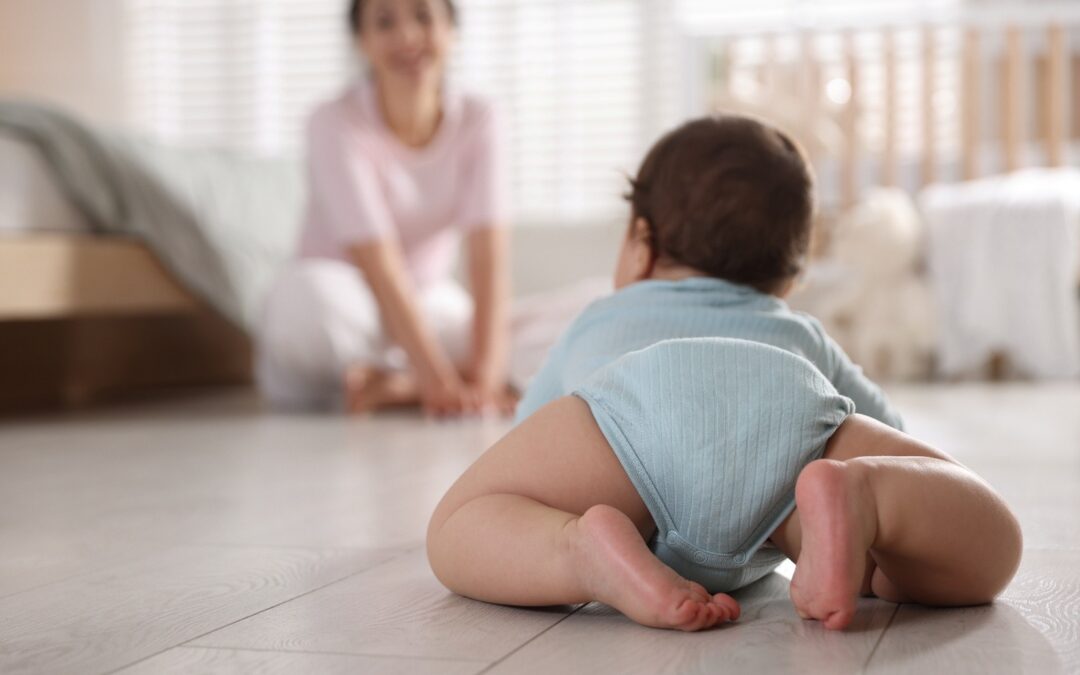
Two babies can be only a few days apart in age and still look very different developmentally. One may be crawling across the room while the other is perfectly content sitting, reaching, and figuring out how to get into a new position.
It is hard not to compare.
If you are wondering when do babies start crawling, many babies begin traditional hands-and-knees crawling around 7 to 10 months. That range is useful for understanding when crawling often develops, but it cannot tell you exactly when your baby will start moving.
The Same Age Doesn’t Mean the Same Timeline
Development does not happen on a synchronized schedule.
Even among healthy babies, hands-and-knees crawling can begin across a wide span of months. One baby may become mobile relatively early, while another spends much longer sitting, rolling, or experimenting with other movements first.
That difference can feel especially noticeable when you are around other families with babies close in age. Your friend’s 8-month-old may crawl. Yours may not. A month later, your baby may suddenly be moving everywhere.
Age gives parents a general reference point. It does not make two babies developmentally identical.
An Average Is Helpful Until It Starts Feeling Like a Deadline
Developmental ranges are useful because they give parents and pediatricians a sense of when many skills tend to emerge.
Problems can arise when the middle of that range starts to sound like a due date.
If you hear that babies often crawl around 8 or 9 months, it is easy to mentally circle that age on the calendar. Then the date arrives, and your baby is still sitting in the middle of the floor.
That alone does not tell you enough.
Crawling is one part of a much larger developmental picture, and there is meaningful variation in when and how babies become mobile.
Watch What Your Baby Is Doing Now
When another baby reaches a milestone first, shift your attention back to the child in front of you. You may notice your baby:
- Sitting with more control
- Moving into different positions
- Reaching farther without losing balance
- Pivoting or turning toward something interesting
- Shifting weight from one side to the other
- Finding another way to move across the floor
Those observations can tell you more about your baby’s current development than comparing crawling dates.
It is also worth knowing that the CDC’s 9-month milestone checklist includes skills such as sitting without support and getting into a sitting position. Crawling itself is not listed as a required 9-month milestone.
Crawling Can Look Different, Too
Comparisons become even less useful when babies are not using the same method of movement.
One baby may crawl on hands and knees. Another may move on their belly, scoot while sitting, roll intentionally toward something, or use a combination of movements.
Some babies spend relatively little time using a traditional crawl. So even the question “Is your baby crawling yet?” may not capture what is really happening.
A baby who is scooting across the room is clearly becoming mobile, even if their movement does not look like the crawling pattern you expected.
Milestone Checklists Aren’t Scorecards
Milestone information should help you notice development, not turn infancy into a competition.
A checklist can remind you of skills to watch for and give you something concrete to discuss with your child’s pediatrician. It cannot account for every way an individual baby will move through development.
That distinction matters when you find yourself comparing your baby with a sibling, cousin, child at daycare, or baby from your parenting group.
Another baby’s new skill does not automatically tell you something is missing from yours. Pay attention to changes over time. What is your baby doing now that they could not do a few weeks ago? What are they practicing repeatedly?
Where do you see growing control or curiosity? Those details create a much fuller picture.
Know When to Bring Up a Concern
Avoiding unnecessary comparisons does not mean ignoring something that worries you.
If you have concerns about your baby’s movement or development, bring them up with their pediatrician. You should also mention a loss of a skill your baby previously had or a persistent difference in how they use the two sides of their body.
You do not need to wait until a particular crawling deadline before asking a question.
Your pediatrician can consider your child’s development as a whole rather than judging one milestone in isolation.
Following Individual Development at Celebree School of Hershey
At Celebree School of Hershey, infant care reflects the understanding that babies of similar ages may be working on different skills.
Teachers observe each child’s physical, language, and social development and provide age-appropriate opportunities based on what that baby is currently ready to explore. Families also receive regular updates, giving parents and teachers opportunities to share the changes they are noticing.
One baby may be focused on getting into a sitting position. Another may be experimenting with crawling. Someone else may have found an entirely different way to travel across the floor.
The goal is not to compare one baby’s progress with another’s. It is to understand where each child is developmentally and respond to what they need next.
Let Your Baby’s Timeline Be Their Own
It is natural to notice when another baby reaches a milestone first. What matters more is the pattern of growth you are seeing in your own child.
Crawling may happen at 7 months, 9 months, later, or in a form you did not expect. Keep watching the new movements taking shape instead of measuring them against the baby sitting next to yours.
If you are looking for daycare in Hershey, PA, Celebree School of Hershey provides individualized infant care that respects each child’s developmental pace. Schedule a visit to meet our team and learn more about infant care at Celebree.